
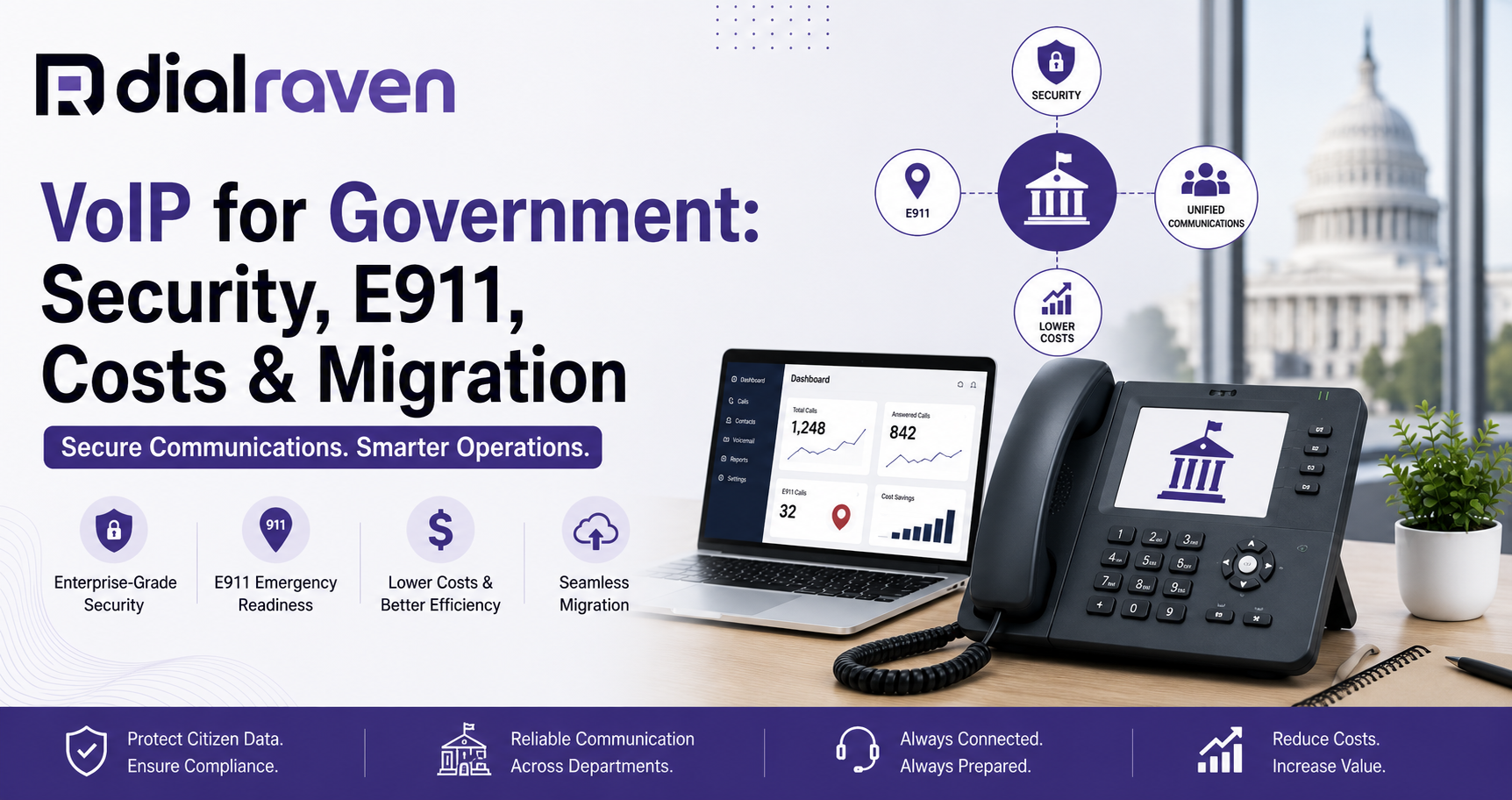
VoIP for Government: Security, E911, Costs & Migration
Plan a government VoIP system with clear guidance on security, E911, accessibility, costs, procurement, continuity, and phased migration.
Quick Answer
A government VoIP system should provide reliable public access, department routing, direct 911 dialing, accurate location data, accessible communication, role-based controls, and tested failover. Requirements must be matched to the agency, information handled, and procurement rules.
Dial Raven Team
VoIP Communication Expert
Government phone systems must keep public services reachable while supporting security, emergency calling, accessibility, records policies, and continuity across departments and locations. VoIP for government can simplify that environment, but only when the agency defines its requirements before comparing providers or pricing.
Dial Raven provides government VoIP solutions through a centrally managed cloud business phone system. This guide explains what federal, state, county, and municipal buyers should evaluate before replacing a legacy PBX, PRI circuit, or copper telephone service.
What Is VoIP for Government?
VoIP for government uses an IP network to manage calls, extensions, department queues, voicemail, mobile users, and multiple offices. Depending on the agency's requirements, the system may be fully cloud hosted, deployed on premises, connected to an existing PBX through SIP trunks, or built as a hybrid environment.
| Deployment Model | Best Fit | Main Planning Question |
|---|---|---|
| Hosted cloud VoIP | Agencies seeking central management and simpler scaling | What information will the service process or store? |
| On-premises IP PBX | Agencies requiring greater local control | Who will maintain, secure, and update the platform? |
| SIP trunking | Agencies keeping a compatible existing PBX | Can the current system meet routing, E911, and continuity needs? |
| Hybrid system | Phased migrations or mixed compliance environments | Which services stay local and which move to the cloud? |
The right architecture depends on the agency type, information handled, existing equipment, internal IT capacity, continuity requirements, and procurement rules. A product should not be described as universally government compliant without evaluating the actual use case.
Why Government Phone Systems Need a Different Plan
- Residents must reach the correct department without navigating an excessive phone menu
- Public-facing teams may experience sharp call spikes during deadlines, outages, emergencies, or service changes
- Several buildings and departments may need separate call flows under one administration model
- Emergency calls must provide direct access, appropriate notification, and accurate location information
- Recordings, voicemail, transcripts, and reports may be subject to agency retention and disclosure rules
- State and local services must consider effective communication for people with disabilities
- Continuity plans must cover internet, power, carrier, device, and facility failures
- Purchasing decisions may require formal specifications, security evidence, and competitive procurement
Government Department Call-Routing Examples
| Department | Primary Route | Overflow or After-Hours Route |
|---|---|---|
| General administration | Short auto-attendant or receptionist queue | Shared voicemail with assigned callback ownership |
| Permits and licensing | Specialist queue divided by request type | Callback queue or online-service guidance |
| Utilities and billing | Account and outage menu options | Overflow team plus emergency outage message |
| Public works | Department queue for service requests | On-call route for approved urgent issues |
| Courts | Separate routes for scheduling, payments, and clerk enquiries | Recorded instructions and department voicemail |
| Social services | Skills-based queue with language and accessibility support | Approved callback or escalation workflow |
A government auto-attendant should keep choices short and use plain department names. Call queues, schedules, and the fallback methods in Dial Raven's call-forwarding workflow guide can then manage overflow and after-hours calls.
Government VoIP Security: Start With the Use Case
Security requirements should be based on the agency, information, integrations, users, and administrative model. A public information line and a system that stores sensitive recordings or connects to protected information do not present the same risk.
- Document what call audio, voicemail, transcripts, contact details, and logs the system creates
- Define role-based access for administrators, supervisors, agents, auditors, and vendors
- Review encryption, identity controls, audit logs, incident response, backup, and data-export capabilities
- Identify integrations with identity, records, CRM, payment, public-safety, or case-management systems
- List required certifications, contractual controls, and agency-specific security evidence
- Confirm data ownership, subprocessors, retention, deletion, and exit procedures
Does Every Government VoIP System Need FedRAMP?
No. FedRAMP applies to federal cloud-service use cases that fall within its defined scope. Current FedRAMP scope guidance states that only a federal agency can determine whether its use of a cloud service is in scope, and that FedRAMP does not apply to every internet-based service used by a federal agency.
State, county, and municipal agencies may have separate state, local, contractual, or agency security requirements. Buyers should request exact evidence rather than accepting phrases such as 'government grade,' 'FedRAMP ready,' or 'FedRAMP aligned' as substitutes for a documented requirement and applicable authorisation status.
When Does CJIS Need to Be Evaluated?
An agency should evaluate the CJIS Security Policy when a phone platform, recording, transcript, integration, user, or vendor may send, store, process, or provide access to Criminal Justice Information. The FBI's CJIS Security Policy guidance explains that FedRAMP, StateRAMP, and SOC assessments may provide additional assurance but do not guarantee CJIS compliance.
This guide is general operational information, not legal or security advice. The agency's security officer, counsel, records officer, and applicable CJIS authority should determine the requirements for the specific deployment.
E911 Requirements for Government Buildings
Covered multi-line telephone systems must support direct 911 dialing without an outside-line prefix. They must also support required notification and convey dispatchable location information for covered fixed, non-fixed, and off-premises devices.
The 47 CFR § 9.16 requirements address direct dialing, notification, and dispatchable location. In a government environment, location records may need to distinguish the facility, building, floor, suite, room, or another detail that helps responders find the caller.
- Verify that every dial-capable station can reach 911 without a prefix
- Define where the on-site or off-site emergency notification will be sent
- Map fixed phones to accurate dispatchable locations
- Create a location-update process for softphones, mobile users, and moved devices
- Retest after office moves, device changes, renovations, or routing updates
Dial Raven's E911 compliance guide explains Kari's Law, RAY BAUM'S Act, direct dialing, notification, and dispatchable location in more detail. Agencies should confirm federal, state, local, and provider-specific requirements for their environment.
Accessibility and Effective Public Communication
ADA Title II applies to state and local government programmes, services, and activities. The U.S. Department of Justice explains that state and local governments must communicate as effectively with people with disabilities as they communicate with others.
Review the DOJ's Title II guidance for state and local governments when designing public telephone services. Procurement should consider accessible menu language, relay-service workflows, alternative contact channels, queue design, and processes for providing appropriate communication aids or services.
Government Phone System Cost
Government phone system cost should be evaluated as total cost of ownership rather than a licence price alone. The final budget may include recurring service, devices, network work, E911 configuration, storage, security integrations, installation, training, and support.
| Cost Area | What to Evaluate |
|---|---|
| Service licences | Named users, shared devices, common-area phones, queues, and required features |
| Telephone hardware | Desk phones, conference devices, headsets, analogue adapters, and replacements |
| Network and resilience | Switches, Power over Ethernet, cabling, internet failover, and backup power |
| Emergency calling | Location mapping, notification, configuration, maintenance, and testing |
| Security and records | Identity integration, recording storage, audit access, retention, and export |
| Migration and support | Inventory, configuration, porting, training, acceptance testing, and ongoing service |
Agencies retaining a compatible PBX can compare a full replacement with SIP trunking for an existing phone system. Dial Raven's SIP trunk pricing guide explains channels, usage, numbers, E911, and common additional charges.
Government RFP and Procurement Checklist
- Agency, department, location, user, device, and public-number scope
- Required deployment architecture and integration boundaries
- Security controls, certifications, reports, and agency-specific evidence
- E911 direct dialing, notification, location management, and testing
- Accessibility and effective-communication requirements
- Call recording, transcript, public-record, retention, and legal-hold requirements
- Service levels, uptime measurement, incident response, and support escalation
- Number porting, implementation milestones, training, and acceptance criteria
- Subprocessors, data ownership, export, deletion, termination, and transition assistance
- Itemised one-time, recurring, usage, support, and optional costs
Government VoIP phone services should be compared against the documented requirements and test plan, not a generic feature checklist. Require providers to identify assumptions, exclusions, dependencies, and customer responsibilities.
Continuity and Failover for Public Services
A continuity plan should explain how residents and staff communicate during an internet, power, carrier, device, platform, or building failure. Redundancy is valuable only when the alternate route is documented, monitored, and tested.
- Secondary internet or carrier route for critical locations
- Provider-side forwarding to approved backup numbers
- Mobile or remote answering for authorised personnel
- Uninterruptible power for network and telephone equipment
- Department-specific closure and emergency announcements
- Offline contact lists and manual recovery procedures
- Scheduled failover tests and documented restoration steps
How to Migrate a Government Phone System
1. Inventory Numbers, Circuits, Devices, and Contracts
List public numbers, direct numbers, extensions, PRI or SIP circuits, fax services, alarms, lifts, entry systems, modems, and other connected lines. Review contract dates and identify services that require specialist treatment.
2. Document Every Department Call Flow
Record business hours, menu options, queues, overflow routes, voicemail, after-hours handling, languages, accessibility processes, and emergency escalation for every public number.
3. Define Security, Records, and E911 Requirements
Map the information handled, required access controls, recording and retention policies, emergency locations, and evidence the selected provider must supply.
4. Audit Network and Power Resilience
Evaluate bandwidth, voice prioritisation, switches, Power over Ethernet, cabling, firewall configuration, internet diversity, backup power, and remote administration.
5. Configure, Test, and Port in Controlled Phases
Build the new system before cancelling the old one. Test inbound and outbound calls, transfers, queues, voicemail, caller ID, E911, failover, recording controls, and public announcements. Follow a documented process for porting government phone numbers.
6. Train Staff and Complete Acceptance Testing
Train administrators, department supervisors, reception staff, remote users, and support personnel. Complete written acceptance testing and retain the final call-flow, location, device, security, and recovery documentation.
Common Government VoIP Mistakes
- Treating every government agency as if the same compliance framework applies
- Accepting vague security language instead of exact evidence
- Using one emergency address for several buildings, floors, or rooms
- Ignoring accessibility and relay-service workflows
- Migrating public numbers before documenting every call route
- Forgetting fax, alarms, lifts, entry systems, and other analogue services
- Keeping recordings and transcripts without approved retention rules
- Assuming a backup route works without testing a real failure scenario
How to Choose VoIP for Government Agencies
- Can the provider support the required cloud, on-premises, SIP, or hybrid architecture?
- Can it provide the exact security evidence required by the agency?
- How are administrator roles, audit logs, recordings, transcripts, exports, and deletions controlled?
- How are E911 locations created, updated, and tested?
- Can the platform support accessible public communication workflows?
- How are departments, buildings, and public numbers managed separately?
- What happens during internet, carrier, platform, power, or site failure?
- Who owns inventory, configuration, porting, training, and acceptance testing?
- Are every one-time, recurring, usage, support, and exit cost itemised?
The strongest proposal should connect the agency's requirements to a clear architecture, security scope, E911 plan, call-flow design, continuity model, migration sequence, support process, and total cost.
Build a Government Phone System Around Documented Requirements
The right government VoIP system is not the platform with the longest feature list. It is the system that keeps public services reachable, meets the agency's verified requirements, gives administrators appropriate control, and has a tested plan for migration and failure.
Dial Raven can review your departments, locations, existing PBX, numbers, call flows, E911 locations, security needs, records requirements, and procurement timeline. Request a government phone-system assessment for a practical architecture and migration recommendation.
Frequently Asked Questions
What is VoIP for government?
VoIP for government is an IP-based phone system used to manage public numbers, department queues, extensions, voicemail, mobile users, and multiple offices. It may be cloud hosted, on premises, connected through SIP trunks, or deployed as a hybrid system.
Does every government VoIP system need FedRAMP?
No. FedRAMP applies to federal cloud-service use cases within its defined scope. Only the federal agency can determine whether its use of a cloud service is in scope. State and local agencies may have different contractual, state, local, or agency requirements.
Does a FedRAMP or SOC assessment guarantee CJIS compliance?
No. The FBI states that FedRAMP, StateRAMP, and SOC assessments may provide additional security assurance but do not guarantee compliance with the CJIS Security Policy. The agency must evaluate the specific system, information, access, and responsibilities.
What E911 features should a government phone system support?
A covered multi-line system should support direct 911 dialing, required notification, and accurate dispatchable location. Agencies also need a process for maintaining locations for fixed, moved, mobile, and off-premises devices.
How much does a government phone system cost?
The total depends on users, shared devices, telephone hardware, SIP or cloud service, network upgrades, E911 configuration, recording storage, security integrations, installation, migration, training, support, and contract terms.
Can a government agency keep its existing phone numbers?
Usually, yes, when the numbers are portable and the current account information is accurate. The agency should inventory every number, resolve ownership issues, keep the old service active, and test each route before cancelling the previous provider.
A government phone-system project becomes easier to evaluate when departments, public numbers, call flows, emergency locations, security requirements, records rules, and migration responsibilities are documented first. Book a government communications review with Dial Raven.
Related pages
Ready to modernize your phone system?
Talk to a Dial Raven specialist and get a plan built around how your team works.