
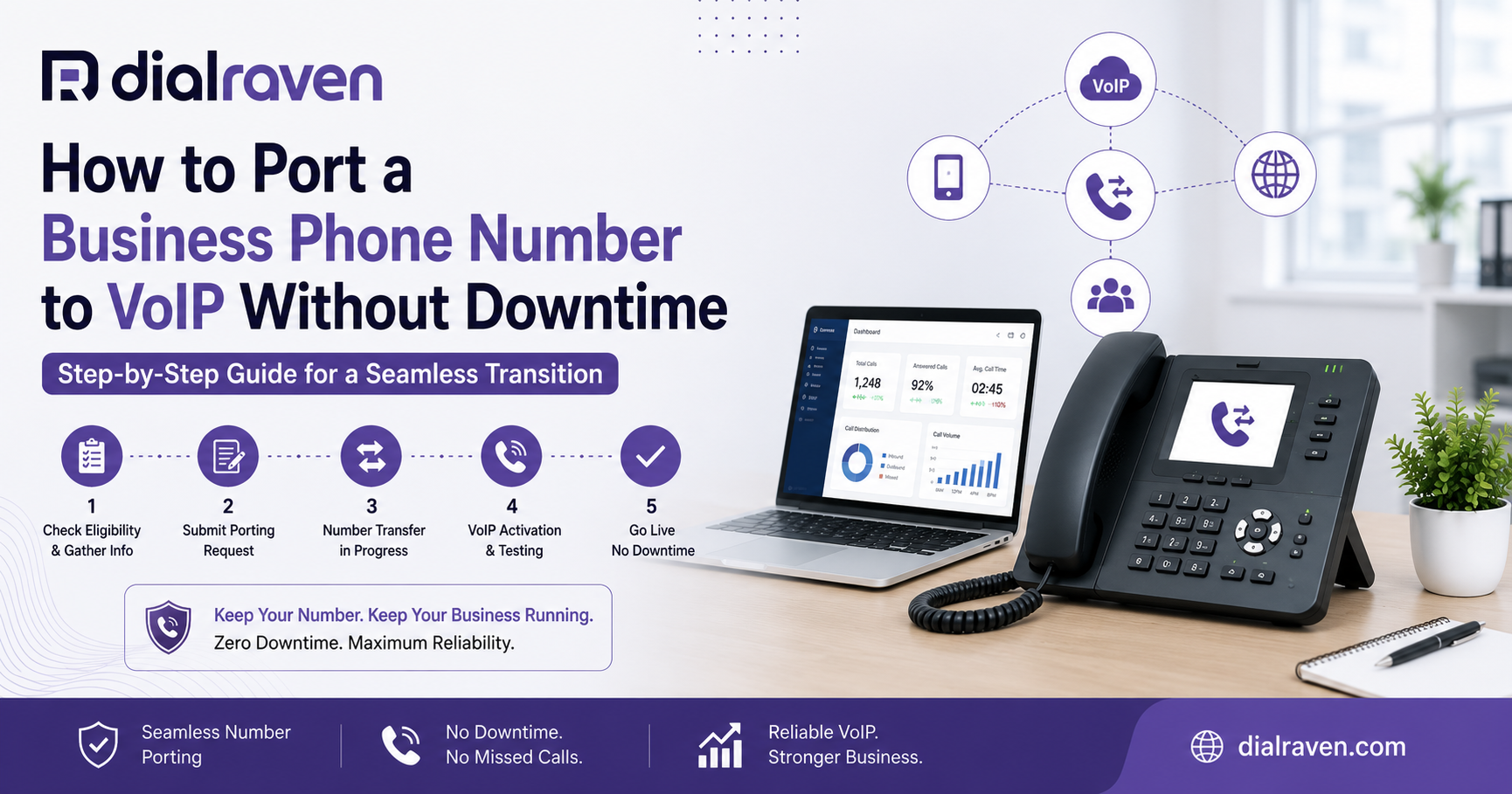
How to Port a Business Phone Number to VoIP Without Downtime
Porting a business phone number to VoIP? See real timelines by port type, the 5 reasons ports get rejected, and how to switch with zero missed calls.
Quick Answer
Yes — you can keep your business phone number when switching to VoIP. Porting is a legal right under FCC rules. Simple ports of one to three lines often complete in about one business day. Multi-line and toll-free ports take longer. Most rejections come from details that don't match your bill.
Dial Raven Team
VoIP Communication Expert
Yes, you can keep your number. Porting is a legal right, not a favour your old provider grants you. Simple ports of one to three lines are often done in about one business day, while multi-line and toll-free ports take longer — and almost every rejection traces back to information that doesn't match your current phone bill. Your business phone number is on your van, your invoices, your Google listing, and in the contacts of every customer who has ever called you, so when you decide to port a business phone number to VoIP, the technology is rarely what worries people. The number is.
The process is more predictable than the internet makes it look — but only if you handle the paperwork before you submit, not after it bounces. Here's what actually happens during a port, realistic timelines by port type, why requests get rejected, and how to run the cutover without missing a call.
The 5 Reasons Number Porting Gets Rejected
Most delays aren't technical. They happen because your new provider submitted details that didn't match what your old carrier has on file, and the request bounced. Here's what causes it and how to prevent each one before you submit.
| Reason | What It Looks Like | How to Fix It | Typical Delay |
|---|---|---|---|
| Account or address mismatch | Rejected with no clear explanation | Copy the account name and service address exactly as printed on your bill, punctuation included | 2–5 business days |
| Unauthorised contact | LOA signature doesn't match the account holder | Confirm the authorised contact with your carrier before signing anything | 3–7 business days |
| Pending order or account freeze | Carrier reports the number as in use or locked | Cancel any pending service change and clear the freeze | 3–10 business days |
| Missing account number or PIN | Request can't be validated | Pull both from the bill, or request a CSR from your carrier | 1–3 business days |
| Number isn't portable | Sits outside the receiving rate center, or was never truly yours | Confirm portability before committing to a switch date | Not resolvable |
Two field notes save more ports than any checklist. First: accuracy means matching the losing carrier's records, not what is technically correct. We have submitted an LOA with a business name spelled the wrong way on purpose, because that's how it sat in the old carrier's billing system — and it cleared on the first attempt. Second: verify who is authorised on the account before you start. A port rejected because the authorised contact left the company two years ago is the most common avoidable failure we see.
Not sure which of these apply to you? A free port eligibility check takes about ten minutes on our side. Send your latest bill and you'll get a straight answer on every number.
How Long Does Number Porting Take?
Simple ports must be processed in one business day under FCC rules. Multi-line business ports typically run 5–10 business days in practice, and toll-free numbers take longest because they move through a separate system. If you've seen wildly different timelines online, it's because most articles quote one figure without saying which port type it applies to.
The FCC's number portability rules define a simple port as one that generally doesn't involve more than one line or more complex adjustments to telephone switching equipment. That's narrower than most businesses assume — a 14-extension office with a hunt group and a fax line is not a simple port, and nothing obligates anyone to complete it in a day.
| Port Type | Realistic Timeline | What Drives It |
|---|---|---|
| Simple port (1 line, no complex routing) | 1 business day (FCC rule) | Clean paperwork |
| Small business, 2–10 numbers | 3–7 business days (estimated, typical) | Carrier validation queue |
| Multi-line or PBX replacement | 7–15 business days (estimated, typical) | Line-by-line verification |
| Toll-free numbers | 2–4 weeks (estimated, typical) | RespOrg change process |
| Any port with a rejection | Add 3–10 business days | Resubmission cycle |
Here's what almost nobody says out loud: your losing carrier controls the pace, not your new provider. We submit, they validate, and they issue a Firm Order Commitment (FOC) date. Anyone promising a guaranteed port date before that FOC comes back is promising something they don't control. What a good provider can guarantee is clean paperwork, fast resubmission if something bounces, and no service gap while you wait.
One clarification the industry blurs constantly: getting your new phone system live and getting your numbers ported are two separate timelines. We can have your system built, tested and running in under 24 hours. Your numbers arrive when the carrier releases them. Any provider conflating those two is setting you up for a bad week.
Can I Keep My Business Phone Number When Switching Providers?
Yes. Under FCC local number portability rules, you can switch providers and keep your number as long as you stay in the same geographic area. This works between landline, VoIP and wireless providers in any combination, and your old carrier cannot refuse to release the number — including if you owe them money.
That last point surprises people, so it's worth stating plainly: an outstanding balance or an early termination fee is not grounds for refusing a port. You still owe the money and your old provider can pursue it separately, but they cannot hold your number hostage over it. If a carrier tries, the FCC directs you to your state public utilities commission.
Two real limitations do exist. Numbers are tied to rate centers, so moving to a different region may mean the number can't follow you. And a number that was never genuinely assigned to your account — a shared line, or one held by a marketing agency or answering service on your behalf — is harder to claim than most owners expect. Check this before you sign with anyone.
What You Need Before You Submit a Port Request
Gather these five items first. Twenty minutes here prevents the majority of rejections, and everything comes off documents you already have.
- A recent full invoice — the complete bill, not the one-page summary. Account number, service address and legal account name must match it exactly
- Letter of Authorization (LOA) — the legal document authorising the transfer; your new provider prepares it and the authorised account holder signs it
- Customer Service Record (CSR) — your carrier's own record of what's on the account; request it if there's any doubt about which numbers you have
- Account number and PIN or passcode — often different from your online login credentials
- The authorised contact's name — verify this with your current carrier before signing, not after the port bounces
One warning above all others: do not cancel your existing service. This is the single mistake that isn't reversible. A disconnected number cannot be ported, and once the line closes that number can return to the carrier's pool and be reassigned to someone else. The FCC's guidance is explicit that you should not terminate service with your existing company before initiating service with the new one. Your old account closes automatically once the port completes.
How to Port a Business Phone Number to VoIP (Step by Step)
Here's the full sequence, and why it produces zero downtime: your old service stays live until the moment the new one takes over, both systems run in parallel through the transition, and nothing is disconnected until testing confirms the port landed cleanly.
- 1. Eligibility check — your provider reviews the bill, confirms each number is portable, identifies the port type, and separates toll-free and vanity numbers onto their longer track
- 2. Paperwork — LOA signed, CSR pulled if needed, and account details verified character-for-character against the bill. This step decides whether everything else goes smoothly
- 3. Submission — the port request goes to your losing carrier. The clock starts here, not when you first made the decision
- 4. Validation and FOC date — the losing carrier validates the request and issues a Firm Order Commitment date. Rejections happen at this stage and get resubmitted
- 5. Build while you wait — call flows, auto-attendant menus, ring groups and extensions are built and tested on temporary numbers, and desk phones arrive pre-configured
- 6. Cutover — numbers move on the FOC date, usually within minutes. Temporary forwarding bridges the brief window where calls could land on either system
- 7. Test, then disconnect — confirm everything works before you close the old account, and only in that order
Step five is where most of the value sits, so don't sit idle waiting for a date. If you're building your system from scratch, our step-by-step guide on how to set up a business phone system covers call flow configuration and go-live, and the business phone hardware guide covers what to have on hand before cutover day. By the time the FOC date arrives, the port becomes a routing change rather than a project.
Once the numbers land, run a 10-minute test: call in from an outside mobile, call out and check your caller ID displays correctly, run the auto-attendant menu end to end, leave a voicemail and confirm it delivers, send and receive a test SMS, then dial 911 from one extension, confirm your address with the operator and explain that you're testing.
Porting a Landline Number to VoIP
Landline numbers port to VoIP the same way any other number does, and FCC rules cover intermodal ports explicitly. Two differences are worth planning around: landline ports generally take longer than wireless ones, and analog accounts often contain numbers nobody remembers — a fax line, an old alarm line, a direct line for someone who left in 2019.
Pull the full bill and account for every number before you submit, not after. If a number is genuinely dead, let it go. If it's a fax line, a cloud fax service keeps the workflow while removing the copper line entirely. Porting is one step inside a larger migration, so for the full picture — cost comparison, hardware, timing and what changes operationally — see our guide on switching from a landline to VoIP.
Two Things to Handle Before You Port
Both of these get skipped, and both cause problems that surface after go-live when they're harder to fix. First, if your business sends text messages — appointment reminders, confirmations, missed-call replies — start A2P 10DLC registration before the port rather than after. Registration can take weeks, and skipping it means your texting fails silently on day one while your calls work fine. Second, verify your E911 address at cutover. Under the FCC's MLTS 911 rules, implementing Kari's Law and RAY BAUM'S Act, multi-line phone systems must allow direct 911 dialling without a prefix and must transmit a dispatchable location.
Frequently Asked Questions
How long does number porting take for a small business?
A simple single-line port is processed in one business day under FCC rules. Most small businesses porting two to ten numbers see 3–7 business days in practice. Toll-free numbers typically take two to four weeks.
Should I cancel my old phone service before porting?
No — never. A disconnected number cannot be ported and may be released back into the carrier's pool. Keep your existing service active until the port completes and you've tested it. The old account closes automatically afterward.
Why do porting requests get rejected?
Most rejections come from details that don't match the losing carrier's records: a mismatched business name or service address, an unauthorised signature on the LOA, a pending order or account freeze, or a missing account number or PIN.
Will my phones stop working during the port?
No, if the migration is sequenced properly. Your old service stays live until cutover, your new system runs in parallel on temporary numbers, and temporary forwarding covers the brief switchover window.
Can I port only some of my numbers?
Yes — partial ports are common. Businesses often move their main lines first and retire unused ones. Be aware that keeping some numbers on the old account may mean keeping that account, and its monthly minimum, open.
Does it cost money to port a business phone number?
Providers are permitted to charge porting fees, and many do. Those fees are often negotiable or waived, so always ask. Dial Raven ports local, toll-free and vanity numbers free of charge.
What if my number is already disconnected?
Once disconnected, a number usually cannot be ported, and after a holding period the carrier can reassign it. Contact your old carrier immediately — occasionally a recently disconnected number can be restored, but it is time-sensitive.
Most of the anxiety around porting comes from not knowing what's on your own account. Send us your latest phone bill and we'll tell you, within one business day, which numbers are portable, what port type each one is, roughly how long it will take, and anything likely to cause a rejection. No obligation — and if something looks like a problem, we'll tell you before you commit to anything. When you're ready to port a business phone number to VoIP, we handle the LOA, the submission, the resubmission if a carrier bounces it, and the cutover, and porting is free on every plan. See our business phone system plans, get your free port check, or call (434) 697-2836 and talk to a real person.
Related pages
Ready to modernize your phone system?
Talk to a Dial Raven specialist and get a plan built around how your team works.