
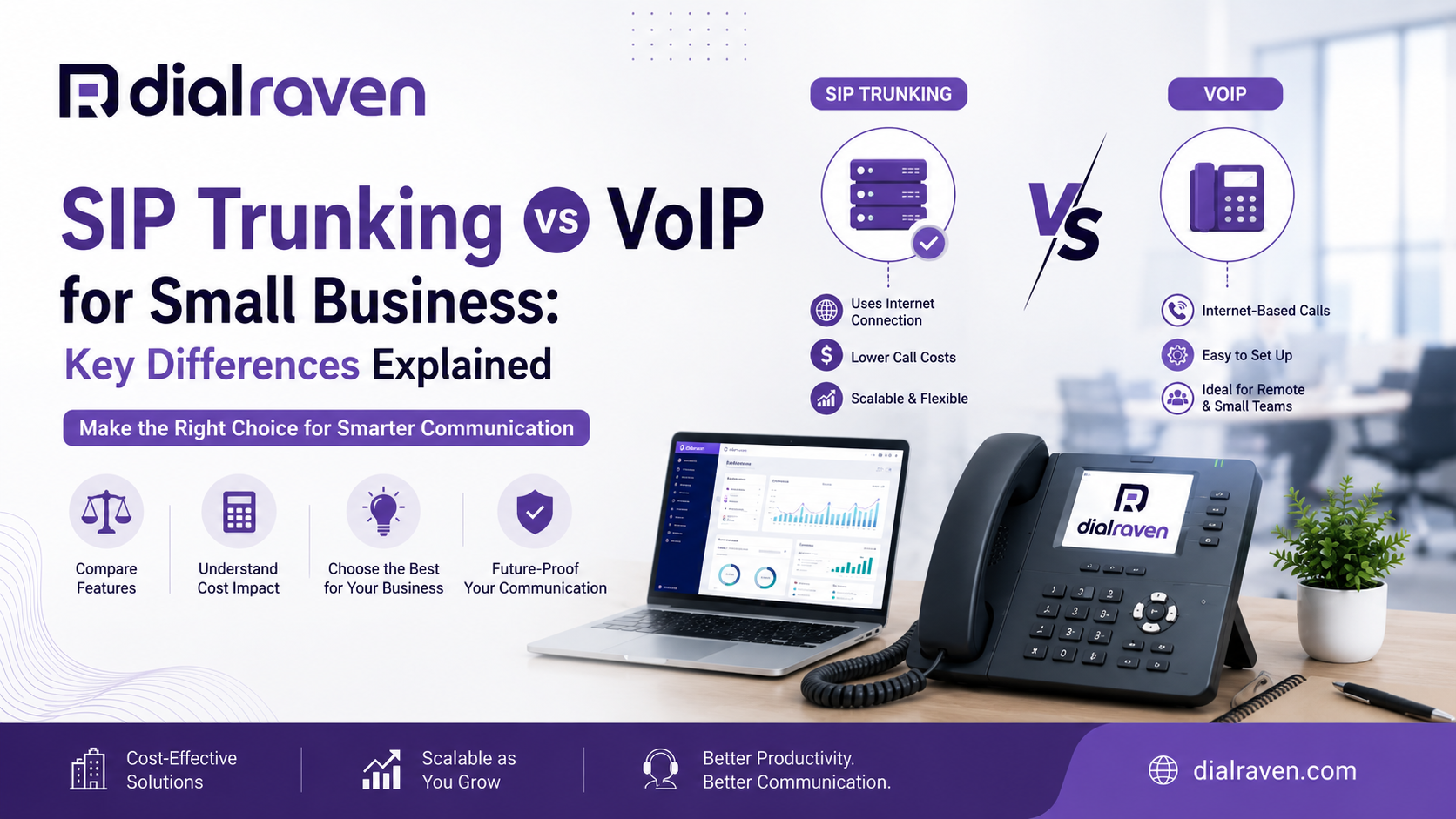
SIP Trunking vs VoIP for Small Business: Key Differences Explained
Not sure whether SIP trunking or VoIP is right for your business? This guide breaks down the real differences, costs, and which one SMBs should choose.
Quick Answer
VoIP is the broad technology that lets you make calls over the internet instead of traditional phone lines. SIP trunking is a specific method that connects your existing PBX phone system to the internet and public telephone network. For most small businesses without a PBX, hosted VoIP is the simpler, faster choice. Businesses that already own a PBX benefit more from SIP trunking.
Dial Raven Team
VoIP Communication Expert
If you've been researching phone systems for your business, you've almost certainly hit a wall of acronyms. SIP trunking. VoIP. Hosted PBX. SIP trunk vs hosted VoIP — what does any of it actually mean, and which one does your business need? Here's the short answer: VoIP is the technology that lets you make calls over the internet. SIP trunking is one specific way to implement that technology — particularly for businesses that already have a phone system in place. They're not competing options. In most cases, one builds on the other. But the real question isn't which technology is "better." It's which setup makes sense for your business right now. This guide breaks down the key differences between SIP trunking vs VoIP for small business, compares costs, and helps you make a clear, confident decision.
What Is the Difference Between SIP Trunking and VoIP?
The difference between SIP trunking and VoIP comes down to scope. VoIP (Voice over Internet Protocol) is the broad category — it's any technology that transmits voice calls over an internet connection instead of a traditional copper phone line. SIP trunking is a specific service within that category. Think of it this way: VoIP is the highway. SIP trunking is the on-ramp that connects your existing office phone system to that highway.
| VoIP (Hosted) | SIP Trunking | |
|---|---|---|
| Cloud-based phone service | Protocol that connects PBX to internet/PSTN | What it is |
| No — fully cloud-managed | Yes — requires an IP PBX | Hardware needed |
| Low — works out of the box | Medium — requires PBX configuration | Setup complexity |
| Small businesses starting fresh | Businesses with existing PBX systems | Best for |
| Add/remove users instantly | Add/remove channels as needed | Scalability |
| Yes (via provider features) | Yes (native SIP capability) | Supports voice + video + messaging |
| Per user/seat | Per channel | Monthly cost model |
How Does VoIP Work?
VoIP converts your voice into digital data packets, sends those packets across your internet connection, and converts them back to audio at the other end. The result: clear, reliable calls without a traditional phone line. For small businesses, the most common VoIP setup is a hosted VoIP or cloud PBX — where your provider manages everything in the cloud. You get a business phone number, call routing, voicemail, auto-attendant, and advanced features without buying or maintaining any hardware. It's the phone system as a service.
- No on-site hardware required
- Works on desk phones, mobile apps, and computers
- Scales instantly as your team grows
- Includes features like auto-attendant, call recording, and voicemail-to-email
- Setup typically takes less than 24 hours
What Is SIP Trunking and What Is It Used for in Business?
SIP (Session Initiation Protocol) trunking is a service that connects an on-premises IP PBX phone system to the public telephone network (PSTN) and the internet — using the SIP protocol to initiate, manage, and terminate calls. In plain terms: if your business already owns a PBX phone system and wants to replace expensive traditional phone lines with internet-based calling, SIP trunking is how you do it. Instead of paying for physical ISDN or PSTN lines, you purchase virtual "trunks" — each trunk handles one simultaneous call. What is SIP trunking used for in business? Common use cases include:
- Replacing traditional phone lines on an existing PBX system
- Enabling multi-location offices to share a single trunk pool
- Reducing per-minute call costs for high call volume businesses
- Adding video, messaging, and fax capability to a legacy phone system
- Providing disaster recovery and call failover routing
SIP Trunk vs Hosted VoIP: Which Costs Less?
Cost is usually the deciding factor for small businesses — so let's look at the SIP trunking vs VoIP cost comparison directly.
Hosted VoIP typically charges per user per month. A team of 10 at $25/user pays $250/month. You don't need hardware, there's no maintenance cost, and setup is included.
SIP trunking charges per channel (each channel handles one simultaneous call). A business that rarely has more than 5 active calls at once might pay roughly $15–$25 per channel — so 5 channels costs $75–$125/month. However, you need an existing IP PBX to connect to those channels, and that PBX has its own cost and maintenance requirements.
| Hosted VoIP | SIP Trunking | |
|---|---|---|
| Per user (~$20–$35/user) | Per channel (~$15–$25/channel) | Monthly fees |
| None required | IP PBX required | Hardware |
| Typically included | May require IT/configuration | Setup cost |
| Teams of 1–20 with no PBX | High call volume + existing PBX | Best value for |
| Predictable, scales with headcount | Compounds over time with PBX investment | Long-term savings |
(Pricing figures are estimates based on industry averages. Contact Dial Raven for exact pricing.) The takeaway: hosted VoIP is almost always cheaper and faster to deploy for businesses starting from scratch. SIP trunking offers better long-term economics for businesses that already own a PBX and handle high call volumes.
Key Differences: SIP Trunking vs VoIP for Small Business
Here's a practical summary of how these two solutions differ across the factors that matter most to small businesses:
| Hosted VoIP | SIP Trunking | |
|---|---|---|
| Hours (same day) | Days to weeks (requires PBX config) | Setup time |
| No | Yes — basic PBX knowledge needed | IT required |
| Excellent — works from any device | Good — depends on PBX capabilities | Remote work support |
| HD voice via cloud | HD voice via SIP protocol | Call quality |
| Provider-managed failover | Requires configuration | Disaster recovery |
| Monthly plans available | Typically more flexible per-channel | Contract flexibility |
| Depends on provider | Native — voice, video, fax, messaging | Multimedia support |
Should I Use SIP Trunking or VoIP? How to Decide
This is the question most small business owners are really asking. Here's a practical decision framework:
Choose Hosted VoIP If:
- You don't have an existing PBX system
- You want to be up and running today, not next week
- Your team is remote, hybrid, or spread across locations
- You want one monthly bill with no hardware to manage
- You need mobile app access for your team
- You have fewer than 20–30 employees
Choose SIP Trunking If:
- You already own an IP PBX and want to keep it
- You handle a high volume of simultaneous calls
- You want to reduce per-minute costs on existing infrastructure
- You need multimedia capabilities (video, fax, messaging) at the PBX level
- You have an IT team comfortable managing telephony configuration
The good news for Dial Raven customers: you don't have to choose blindly. We offer both hosted VoIP through our Business Phone System and dedicated SIP Trunking — so whatever your current setup, we have a solution that fits without forcing you to rebuild from scratch.
Can You Use Both SIP Trunking and VoIP Together?
Yes — and many businesses do. SIP trunking is technically a subset of VoIP; all SIP trunking uses VoIP technology. Businesses with multiple offices often use hosted VoIP for remote workers and smaller satellite offices while running SIP trunking for their main location's PBX. The two can work side by side without conflict.
Frequently Asked Questions
Is SIP trunking the same as VoIP?
No — though they're closely related. VoIP is the broad technology for making calls over the internet. SIP trunking is one specific method of implementing VoIP, designed to connect an existing IP PBX system to the public telephone network.
What is the difference between SIP trunking and VoIP for small businesses?
For small businesses, the main difference is infrastructure. Hosted VoIP requires no hardware — you sign up and start calling. SIP trunking requires an existing IP PBX system and is better suited to businesses that already have phone infrastructure in place.
Which is cheaper — SIP trunking or hosted VoIP?
For small businesses starting fresh with no PBX, hosted VoIP is almost always cheaper because there's no hardware to buy. For businesses with an existing PBX and high call volume, SIP trunking can cost significantly less per month since you pay per channel rather than per user.
What is SIP trunking used for in business?
SIP trunking is used to replace traditional phone lines on an existing PBX system, enable multi-location call sharing, reduce per-call costs, add video and messaging capability, and provide failover routing for business continuity.
Can a small business use SIP trunking without a PBX?
Generally, no. SIP trunking is designed to connect to an IP PBX. If you don't have a PBX, hosted VoIP is the more practical and cost-effective option for your business.
Does Dial Raven offer both SIP trunking and hosted VoIP?
Yes. Dial Raven provides both a fully hosted Business Phone System (cloud VoIP) and dedicated SIP Trunking services, so you can choose the right solution for your current infrastructure — or use both.
Get the Right Phone Solution for Your Business
Whether SIP trunking or hosted VoIP is the right fit, the goal is the same: reliable calls, lower costs, and a phone system that grows with your business. Dial Raven offers both options — with fast setup, US-based support, and no long-term lock-in. Not sure which one fits your setup? Talk to our team and we'll help you figure it out in under 15 minutes. Get a Free Quote — or call us at (434) 697-2836. We'll match you with the right solution for your business, whether that's SIP trunking, hosted VoIP, or a combination of both.
Related pages
Ready to modernize your phone system?
Talk to a Dial Raven specialist and get a plan built around how your team works.