
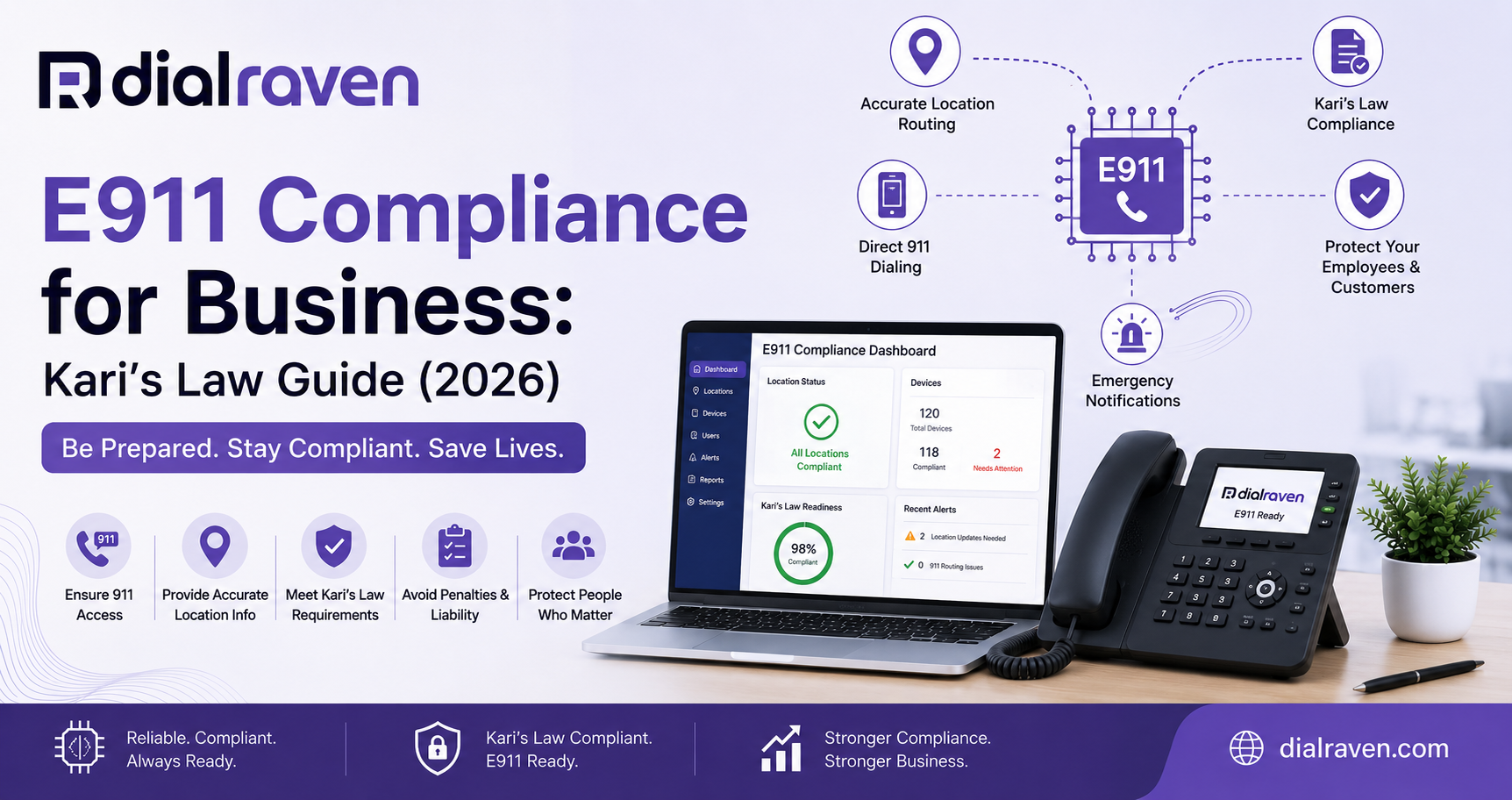
E911 Compliance for Business: Is Your Phone System Ready?
Is your phone system E911 compliant? Learn what Kari's Law and RAY BAUM'S Act require, who must comply, the penalties, and how to fix any gaps fast.
Quick Answer
E911 compliance means your business phone system lets anyone dial 911 directly (no "9" prefix), sends an internal alert when a 911 call is made, and passes a dispatchable location to responders. Under Kari's Law and RAY BAUM'S Act, most US multi-line phone systems must comply or risk FCC penalties.
Dial Raven Team
VoIP Communication Expert
If your office has more than one phone line, E911 compliance for business isn't optional — it's federal law. Two rules, Kari's Law and RAY BAUM'S Act, require most US business phone systems to let anyone dial 911 directly and send responders an exact location. Yet many small businesses have no idea whether their system actually meets the standard, and the ones running older equipment often don't. This guide breaks down what the law requires, who it applies to, what happens if you ignore it, and a five-minute way to check where you stand.
In short: Your business phone system is E911 compliant when three things are true: users can dial 911 without a prefix like "9," someone on-site or off-site gets notified the moment a 911 call is placed, and the system sends a dispatchable location (building, floor, room) to the 911 call center. If your system can't do all three, you likely have a compliance gap to fix.
What is E911 compliance for business?
E911 ("Enhanced 911") ties every 911 call to a precise, verified location so first responders know exactly where to go. For businesses, E911 compliance means your phone system meets the FCC's two governing rules for any multi-line setup. The goal is simple and serious: in an emergency, a call should connect instantly, alert your team, and lead responders straight to the person who needs help — not just to your front door.
This applies whether you run desk phones, a cloud platform, or softphones on laptops. Modern systems make compliance far easier than legacy hardware, which is one reason many businesses treat a compliance review as the moment to finally move to a cloud-based business phone system.
Kari's Law and RAY BAUM'S Act, explained
Both rules were adopted by the FCC in 2019 and together form the backbone of E911 compliance in the United States. Kari's Law and RAY BAUM'S Act cover two different problems: reaching 911, and being found once you do.
What Kari's Law requires
Kari's Law is named for Kari Hunt, who was killed in a motel room in 2013 while her 9-year-old daughter tried four times to call 911 — the calls failed because she didn't know to dial "9" first for an outside line. The law fixes exactly that. It requires that any multi-line telephone system allow direct 911 dialing with no prefix, and that a notification (to a front desk, security, admin, or a distribution list) is triggered whenever someone dials 911, so your team can guide responders in.
What RAY BAUM'S Act requires (dispatchable location)
RAY BAUM'S Act adds the location piece. Its dispatchable location requirements mean a 911 call must carry more than a street address — it needs the specifics that help responders find the caller fast: building, floor, and room or suite, plus a callback number. In a multi-floor office, warehouse, or campus, that detail is the difference between a two-minute response and a dangerous delay.
What is a dispatchable location? It's the most precise practical description of where a 911 caller is — street address plus floor, room, or area — automatically sent to the Public Safety Answering Point (PSAP) when the call is placed.
Does this apply to you? MLTS 911 requirements
The rules apply to any multi-line telephone system (MLTS) — and that's a much wider net than most owners assume. If your business has a phone system serving multiple lines, extensions, or users (typical of almost every office, clinic, hotel, school, and multi-site operation), the MLTS 911 requirements apply to you. You don't need to be an enterprise; a 10-person office on a shared system counts.
- You have a multi-line or extension-based phone system (VoIP or on-prem PBX).
- Your system was manufactured, sold, imported, or installed after February 16, 2020.
- Your staff use desk phones, softphones, or a mobile app tied to your business number.
- You operate across multiple floors, buildings, or locations.
- You have remote or hybrid workers using company softphones.
There's one nuance worth knowing: the strictest obligations attach to systems installed or acquired after February 16, 2020. Older, untouched systems may be technically grandfathered — but that's cold comfort. If a legacy system can't dial 911 directly or share a location, the safety and liability risk remains, which is why most businesses upgrading from copper lines fold compliance into the move when they switch from a legacy landline to VoIP.
E911 compliance dates at a glance
| Requirement | What it covers | |
|---|---|---|
| Kari's Law — direct 911 dialing + on-site notification | All MLTS | February 16, 2020 |
| RAY BAUM'S Act — dispatchable location (fixed devices) | On-premises desk phones | January 6, 2021 |
| RAY BAUM'S Act — dispatchable location (non-fixed/off-premises) | Softphones, remote/hybrid workers | January 6, 2022 |
All three requirements are now fully in effect nationwide. Some states also layer on their own 911 rules, so a quick check of your state's requirements is worth doing on top of the federal baseline.
What happens if your business isn't compliant?
Two kinds of risk. First, regulatory: the FCC can impose penalties on businesses that install or operate non-compliant multi-line systems, and it actively monitors 911 complaints. Second — and more important — human and legal: if someone can't reach 911 or responders can't find them during a workplace emergency, the consequences and liability exposure are severe. Compliance is ultimately a duty-of-care issue, not just a paperwork one.
Is my phone system E911 compliant? (5-minute self-check)
You can answer the core question — is my phone system E911 compliant? — in a few minutes. Walk through these checks:
- Direct dialing: Pick up any phone and confirm you can reach 911 by dialing just 911, with no "9" or prefix first. (Do this safely — coordinate before test-calling 911, or ask your provider how to verify.)
- On-site notification: Confirm your system alerts a designated person or group (email, SMS, or on-screen) the instant a 911 call is placed.
- Dispatchable location: Check that each phone, softphone, and remote user has an accurate location on file that's sent with 911 calls — including floor and room where relevant.
- Remote/hybrid users: Confirm off-site softphone users can update their location so 911 routes correctly.
- Documentation: Make sure you know who's responsible for keeping locations current as people move desks or sites.
If you answered "no" or "not sure" to any of these, you have a gap. The good news: on a modern platform, closing it is usually configuration, not construction.
Your E911 compliance checklist (and how to fix gaps)
Here's a practical E911 compliance checklist to get and stay compliant:
- Audit every device — desk phones, softphones, mobile app users, and any analog holdouts.
- Remove dialing prefixes so 911 always works directly.
- Turn on 911 notifications to a monitored person or distribution list.
- Register accurate addresses and dispatchable locations for every user and site.
- Add a location-update workflow for movers, new hires, and remote staff.
- Post clear signage with building/floor/room info as a responder backstop.
- Re-verify periodically — location data goes stale as your team changes.
- Confirm your provider's role — know what they handle vs. what you configure.
Legacy PBX and analog systems struggle with almost every item on that list — updating locations means truck rolls and reprogramming. Cloud systems handle it in software. Here's the practical difference:
| Compliance task | Legacy PBX / analog & Modern cloud VoIP | |
|---|---|---|
| Direct 911 dialing | Often needs manual reprogramming | Built in by default |
| 911 notifications | Frequently unsupported | Standard (email/SMS/on-screen) |
| Dispatchable location updates | Manual, on-site | Self-service in the portal |
| Remote/hybrid worker 911 | Very hard | Location prompts per device |
| Ongoing maintenance | Ongoing tech visits | Automatic in the cloud |
How cloud VoIP makes E911 compliance for business simple
A cloud phone system is the fastest route to compliance because the hard parts — direct dialing, notifications, and dispatchable location — are handled in the platform, not on a wiring panel. You register addresses in a portal, remote staff confirm their location, and updates take seconds. If you're planning a change anyway, the setup is straightforward — our guide on how to set up a business phone system walks through porting numbers and going live, typically in under 24 hours.
Compliance rarely travels alone, either. The same businesses managing 911 rules often need HIPAA-compliant VoIP in healthcare or 10DLC registration for business texting — and a single modern platform can cover all three, which is why treating communications compliance as one project pays off.
Get a fast E911 compliance check with Dial Raven
At Dial Raven, we configure compliant business phone systems every day for US small and midsize businesses — direct 911 dialing, automatic notifications, and dispatchable location, set up correctly from day one, with real human support and no IT team required. If you're not sure whether your current system passes, we'll check it for you and show you exactly where you stand.
Not sure if your phone system is compliant? Get a free E911 compliance check — we'll review your current setup and flag any gaps, no obligation. Get a Free Quote or Book a demo today.
This guide is general information, not legal advice. Federal rules set the baseline; confirm your state and local 911 requirements for your specific situation.
Frequently Asked Questions
Does Kari's Law apply to small businesses?
Yes. Kari's Law applies to any multi-line telephone system, regardless of company size. A small office with a shared, multi-line or extension-based system must allow direct 911 dialing and send an on-site notification — the same as a large enterprise.
What is a dispatchable location in simple terms?
It's precise location detail sent with a 911 call so responders can find the caller quickly — the street address plus building, floor, and room or suite, along with a callback number.
Do remote or work-from-home employees need E911 compliance?
Yes. Since January 6, 2022, RAY BAUM'S Act covers non-fixed and off-premises devices, so softphone and remote users must be able to provide an accurate dispatchable location when they dial 911.
What's the penalty for a non-compliant phone system?
The FCC can impose monetary penalties on businesses that install or operate non-compliant multi-line systems, and non-compliance also creates serious safety and legal-liability exposure during an emergency.
Is a cloud VoIP system automatically E911 compliant?
Modern cloud VoIP systems are built to support all three requirements, but you still must register accurate addresses and keep dispatchable locations current for each user and site. The technology enables compliance; correct configuration completes it.
How do I check if my phone system is E911 compliant?
Confirm three things: 911 dials directly with no prefix, a notification fires when a 911 call is placed, and an accurate dispatchable location is sent for every device — including remote users. If any is missing, you have a gap to close.
Related pages
Ready to modernize your phone system?
Talk to a Dial Raven specialist and get a plan built around how your team works.