
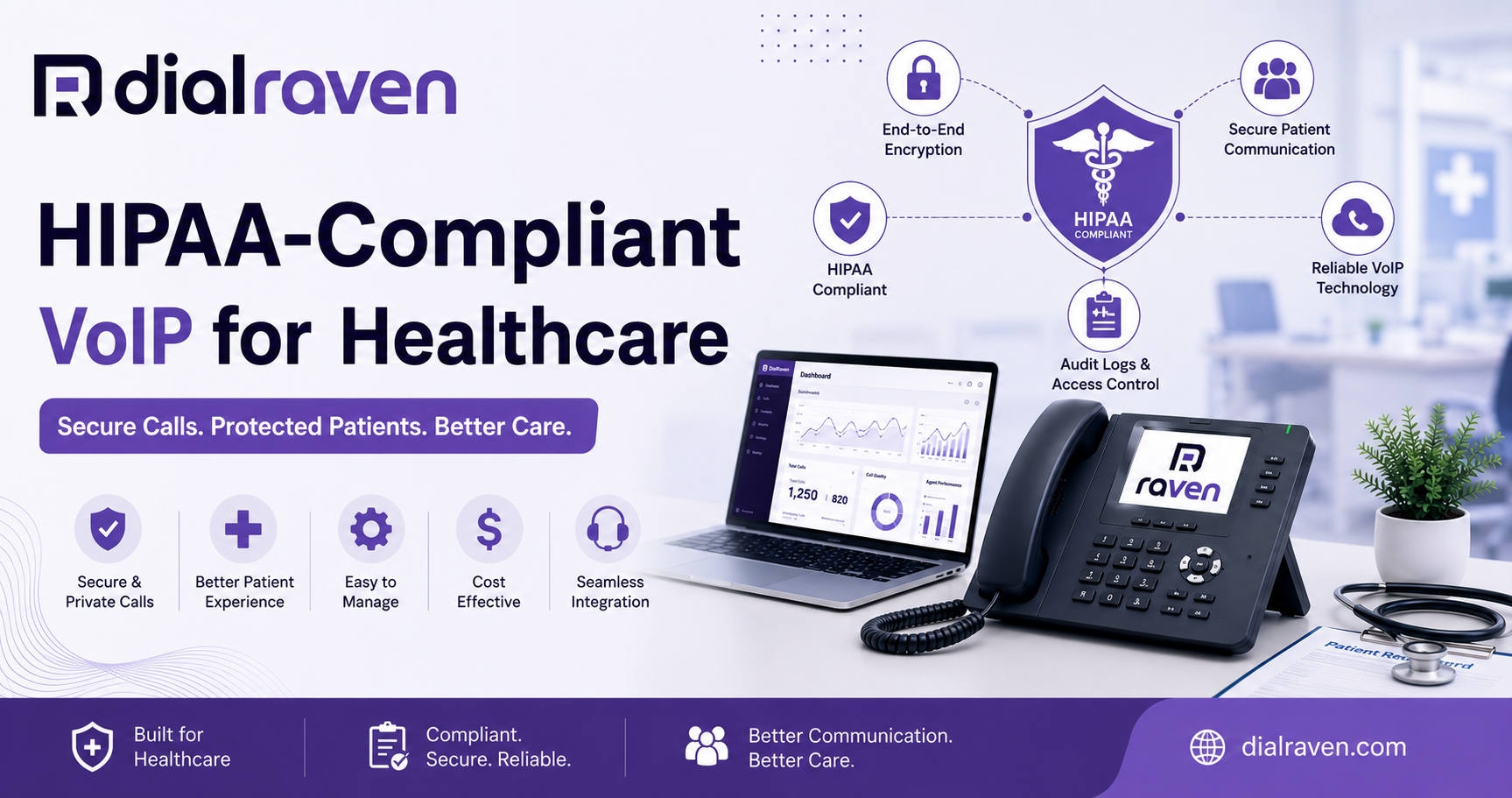
HIPAA Compliant VoIP for Healthcare: What Medical Practices Need to Know
Learn what HIPAA compliant VoIP means for medical practices, what features matter, and how to choose a secure phone system that protects patient data.
Quick Answer
HIPAA compliant VoIP is a cloud phone system that protects patient health information through encryption, access controls, and audit logs. Any healthcare provider that discusses or transmits PHI over the phone is required to use a HIPAA-compliant system.
Dial Raven Team
VoIP Communication Expert
If your medical practice still runs on a traditional phone system, there is a real compliance risk sitting at your front desk. Every appointment call, prescription inquiry, and billing question that crosses that phone line can carry protected health information — and under HIPAA, how you transmit and store that information matters as much as what you say. HIPAA compliant VoIP for healthcare is not a niche upgrade. It is a legal and operational requirement for any covered entity that communicates with patients over the phone. This guide explains what it means, what it requires, and what to look for when choosing a system built to meet those standards.
What Is HIPAA Compliant VoIP?
HIPAA compliant VoIP is a cloud-based phone system designed to handle voice calls, voicemail, fax, and messaging in a way that meets the security and privacy requirements set by the Health Insurance Portability and Accountability Act. Standard business VoIP systems are built for general use. They route calls over the internet, but they do not necessarily encrypt data at rest, enforce access controls, or provide the audit logging HIPAA demands. A HIPAA-ready system does all of those things — and it does them as a baseline, not an add-on. Dial Raven's secure call recording with role-based access is one example of a feature that must work this way from day one. The distinction matters because a data breach involving patient records can result in fines ranging from $100 to over $50,000 per violation. A phone system that handles protected health information without proper safeguards is not a gray area.
Does VoIP Need to Be HIPAA Compliant?
Yes — if your VoIP system transmits, stores, or records any patient health information, HIPAA applies to it directly. This includes phone calls where a patient discusses symptoms, voicemails left with appointment details, faxed lab results, and SMS reminders tied to a patient record. All of these are covered under the HIPAA Security Rule's definition of electronic protected health information, or ePHI. Healthcare providers are classified as covered entities under HIPAA. That means doctors, dentists, clinics, hospitals, therapists, and any practice that delivers or bills for healthcare services must ensure their communication infrastructure meets compliance standards. Their VoIP provider, in turn, becomes a business associate — and is legally required to sign a Business Associate Agreement before handling any patient data.
What Is a Business Associate Agreement for VoIP?
A Business Associate Agreement, or BAA, is a legally binding contract between a healthcare provider and any vendor that creates, stores, receives, or transmits protected health information on their behalf. For a VoIP phone system, this means the provider — the company hosting your cloud phone service — must sign a BAA before you can use their platform in a healthcare environment. The BAA defines what data the vendor can access, how they are required to protect it, what happens in the event of a breach, and how they must dispose of PHI when the contract ends. Without a signed BAA in place, a healthcare practice is not compliant — regardless of how technically secure the phone system is. When evaluating any VoIP phone system for healthcare providers, the first question to ask is straightforward: will this vendor sign a Business Associate Agreement? If the answer is no, the conversation ends there.
HIPAA Technical Requirements for a VoIP Phone System
HIPAA compliance for a VoIP system is not a single checkbox. The HIPAA Security Rule specifies physical, administrative, and technical safeguards that must be in place. For a cloud phone system, the technical requirements are the most relevant — and the most commonly overlooked.
- Encryption in transit — All voice calls and data must be encrypted using TLS (Transport Layer Security) for signaling and SRTP (Secure Real-Time Transport Protocol) for audio. This prevents interception during transmission.
- Encryption at rest — Voicemails, call recordings, fax documents, and transcripts must be stored in an encrypted format. Access to stored data must be controlled and logged.
- Role-based access controls — Only authorized staff should be able to access call logs, voicemails, or patient-related recordings. Permissions must be configurable by role, not just by individual.
- Unique user authentication — Every person accessing the system must have a unique login. Shared credentials are not HIPAA-compliant.
- Audit logs — The system must maintain a record of who accessed what data, and when. These logs must be available for review in the event of an audit or breach investigation.
- Secure voicemail — Voicemail left for patients or by patients may contain PHI. Storage and access must meet the same encryption and access control standards as call recordings.
- HIPAA-compliant virtual fax — Faxed documents frequently contain lab results, referrals, and patient records. Fax transmissions must be encrypted and stored securely.
VoIP Phone System for Healthcare Providers: Key Features to Look For
Not every cloud phone system marketed to healthcare organizations is built to the same standard. When evaluating a VoIP phone system for healthcare providers, these are the features that separate a compliant solution from one that only looks like one.
| Feature | Why It Matters for Healthcare |
|---|---|
| Signed BAA | Legal requirement before any PHI can be transmitted |
| TLS + SRTP Encryption | Protects calls in transit from interception |
| Encrypted voicemail storage | Voicemails often contain appointment details and patient info |
| Role-based access controls | Limits who can access recordings and call logs |
| Audit logging | Required for HIPAA breach investigations and compliance audits |
| HIPAA-compliant virtual fax | Lab results, referrals, and records are commonly faxed |
| Auto attendant + call routing | Reduces missed calls and directs patients to the right department |
| Mobile app with secure access | Lets staff communicate remotely without compromising PHI |
| 99.99% uptime SLA | Downtime in a medical office can directly impact patient care |
Who Needs a HIPAA Compliant Phone System for Medical Office Use?
HIPAA's definition of covered entities is broader than most people assume. If your organization delivers healthcare services, processes healthcare claims, or handles patient health information in any form, you are likely a covered entity — and your communication systems need to reflect that.
- Medical and family practices
- Dental offices and orthodontics clinics
- Mental health and therapy practices
- Urgent care centers and walk-in clinics
- Specialty practices (cardiology, dermatology, orthopedics, etc.)
- Home health agencies
- Physical therapy and rehabilitation centers
- Multi-location hospital groups and health systems
- Medical billing companies and healthcare clearinghouses
- Telehealth providers conducting virtual consultations
Risks of Using a Non-Compliant Phone System in Healthcare
A standard business phone system — even a well-known one — is not automatically HIPAA compliant. Using one without the proper safeguards exposes your practice to consequences that go beyond regulatory fines. HIPAA penalties are tiered based on the severity and intent of the violation. Fines at the lowest tier, where the practice did not know and could not have reasonably known about the risk, still start at $100 per incident and can reach $50,000. At the highest tier — willful neglect that was not corrected — penalties reach $50,000 per incident with no cap per year. Beyond the financial exposure, a publicly reported HIPAA breach damages patient trust in ways that are difficult to rebuild. In a sector where referrals and reputation drive patient volume, that consequence can be more costly than any fine.
Secure VoIP for Clinics and Medical Practices: What Dial Raven Provides
Dial Raven's healthcare communication solution is built for medical offices that need a HIPAA-ready phone system without the enterprise complexity or price tag. Every plan includes the security infrastructure required for compliance, and Dial Raven works with healthcare organizations to configure systems that fit how their team actually operates. Key capabilities included in Dial Raven's healthcare VoIP setup:
- HIPAA-compliant VoIP calling with encryption
- Auto attendant and intelligent call routing
- Voicemail-to-email with secure delivery
- HIPAA-compliant virtual fax — send and receive from email or browser
- Business SMS for appointment reminders and patient updates
- Cloud backup and secure storage
- Mobile app for remote access without compromising compliance
- 99.99% uptime SLA
- Setup in under 24 hours with no IT team required
- Transparent per-user pricing starting at $14.99/user/month
How to Choose the Right HIPAA Compliant VoIP Provider
Not every vendor that uses the phrase "HIPAA compliant" in their marketing has done the work to back it up. Here is a practical evaluation checklist for any medical office comparing providers.
- Will the vendor sign a Business Associate Agreement? Get this in writing before signing any contract.
- Is encryption applied end-to-end — both in transit and at rest? Ask specifically about TLS, SRTP, and how stored recordings are handled.
- What access controls are available? Look for role-based permissions, unique user authentication, and session management.
- Does the system maintain audit logs? These are required for HIPAA compliance and essential during a breach investigation.
- How is voicemail and fax handled? Both are frequently overlooked compliance gaps.
- What is the uptime guarantee? Downtime in a medical office is not just an inconvenience — it can affect patient safety.
- Is there documented support for compliance configuration? The vendor should help you set up the system correctly, not just hand you a login.
- What is the pricing structure? Transparent per-user pricing is easier to manage at scale than bundled feature tiers with hidden add-ons.
Frequently Asked Questions
What is HIPAA compliant VoIP?
HIPAA compliant VoIP is a cloud-based phone system that meets the security and privacy requirements of the Health Insurance Portability and Accountability Act. It protects electronic protected health information (ePHI) through encryption, access controls, audit logging, and secure storage — and requires the provider to sign a Business Associate Agreement (BAA) with any healthcare organization using the platform.
Does VoIP need to be HIPAA compliant?
Yes. If a VoIP system transmits, stores, or records any patient health information — including appointment calls, voicemails, fax documents, or SMS messages — it is subject to HIPAA regulations. Healthcare providers are classified as covered entities, and their VoIP providers become business associates, legally required to handle patient data in compliance with HIPAA's Security and Privacy Rules.
What is a Business Associate Agreement (BAA) for VoIP?
A BAA is a legally binding contract between a healthcare provider and a vendor that handles protected health information on their behalf. For VoIP, this means the phone system provider must sign a BAA before the system can be used in a healthcare setting. The BAA defines data access terms, breach notification requirements, and data disposal obligations. Without a signed BAA, a practice is not HIPAA compliant regardless of its other security measures.
What features make a VoIP system HIPAA compliant?
A HIPAA compliant VoIP system must include: end-to-end encryption for calls in transit (TLS and SRTP), encrypted storage for voicemails and recordings, role-based access controls, unique user authentication, comprehensive audit logs, and HIPAA-compliant fax handling. The vendor must also sign a Business Associate Agreement and provide documentation of their security practices.
How much does a HIPAA compliant VoIP system cost for a medical office?
Pricing varies by provider and team size. Dial Raven offers HIPAA-ready VoIP starting at $14.99 per user per month with no setup fees and no long-term contracts. Most medical practices save significantly compared to traditional phone systems or enterprise-tier healthcare communication platforms.
Can a small medical practice afford HIPAA compliant VoIP?
Yes. HIPAA compliant VoIP is not limited to large hospital systems. Small practices, solo providers, and multi-location clinics can all use cloud-based HIPAA-ready phone systems at per-user pricing that scales with team size. Dial Raven is specifically built for SMBs in regulated industries, including healthcare, and offers fast setup with no IT resources required.
Ready to Move Your Practice to a HIPAA-Ready Phone System?
Choosing the right phone system for a medical office is not just a technology decision — it is a compliance decision. Dial Raven's HIPAA-ready communication platform gives healthcare providers the security, reliability, and support they need to stay compliant and keep patients connected. Get a free quote today and have your new system live in under 24 hours — no IT team required, no long-term contract, and no hidden fees.
Related pages
Ready to modernize your phone system?
Talk to a Dial Raven specialist and get a plan built around how your team works.