
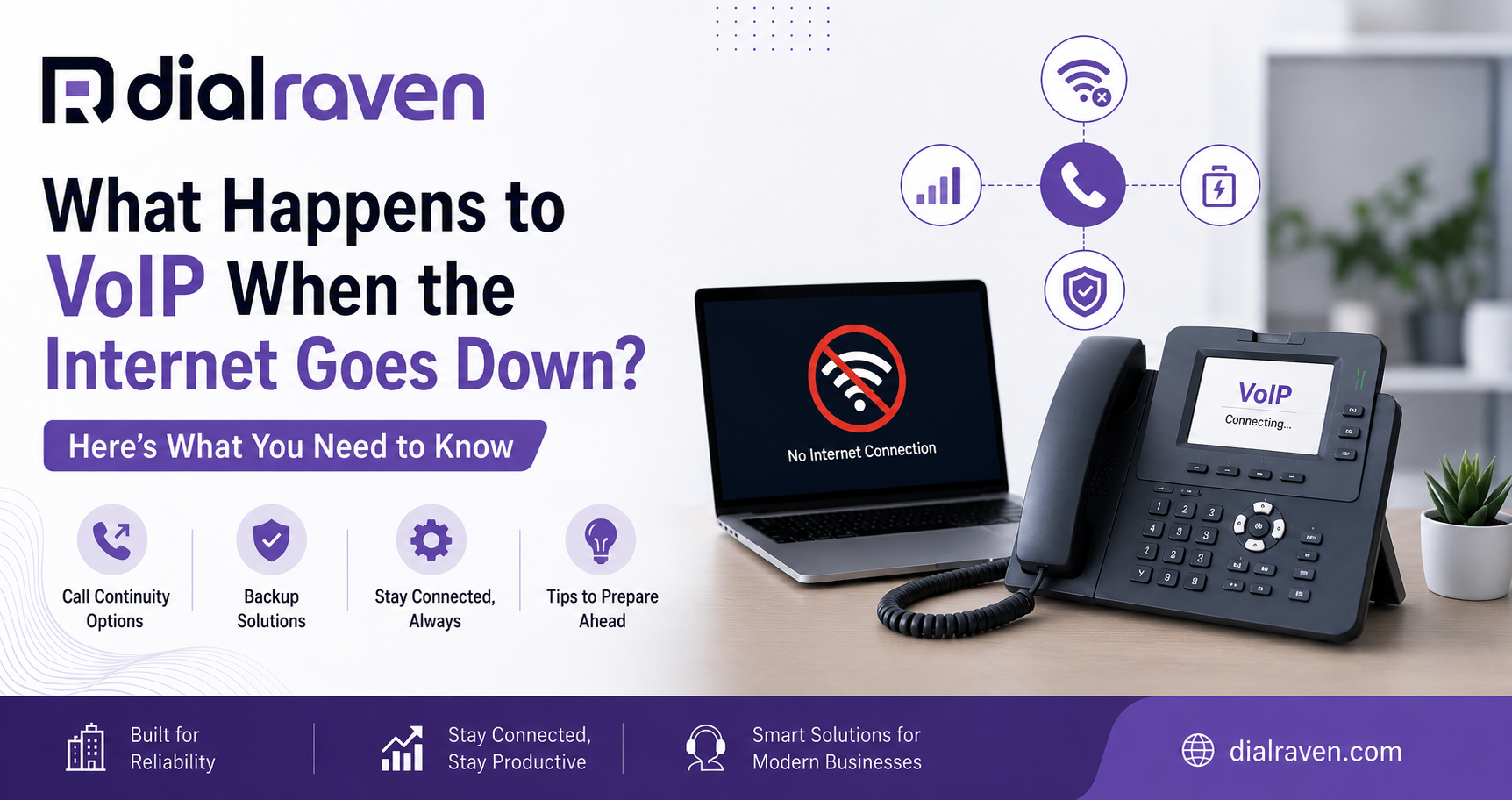
What Happens to VoIP When the Internet Goes Down?
What happens to VoIP when the internet goes down? Learn how failover, backup internet, mobile apps, and power protection keep business calls available.
Quick Answer
If office internet fails, VoIP desk phones using that connection usually stop working. A properly configured system can keep calls moving through failover forwarding, mobile apps, another location, or a backup internet connection so customers can still reach the business.
Dial Raven Team
VoIP Communication Expert
If your office internet goes down, VoIP phones using that connection will usually lose the network path they need to make and receive calls. But that does not automatically mean customers have to find your business unreachable. A properly configured cloud business phone system can route incoming calls away from the affected office, while employees may continue working through mobile devices, another location, or a backup connection. The real business question is not whether VoIP needs internet — it does — but what backup path takes over when your primary connection fails.
Will VoIP Work If the Internet Is Down?
VoIP carries live voice traffic over an IP network. If an office loses its only internet connection, desk phones connected to that network normally cannot make or receive calls through it. However, cloud-based phone systems can provide alternate paths. Incoming calls may be forwarded to a mobile phone, routed to another office, answered through a mobile VoIP app using cellular data, or sent to voicemail. With the right failover plan, losing one office connection does not have to mean losing every way customers can reach your business.
What Actually Happens During a VoIP Outage?
Not every VoIP outage has the same cause. An internet failure, local network problem, power outage, and voice-route failure affect different parts of the phone system, so the right backup depends on what actually goes down.
| Failure | What May Be Affected | Best Continuity Option |
|---|---|---|
| Primary internet outage | Desk phones and computers at the office | Call forwarding, backup ISP, or 4G/5G failover |
| Router or local network failure | Devices connected to the affected network | Mobile access, forwarding, or redundant equipment |
| Power outage | Modem, router, switches, and desk phones | UPS, mobile fallback, or another location |
| One office goes offline | Users at that location | Multi-site call routing |
| Voice route failure | Calls using the affected route | Redundant SIP routing |
What Is VoIP Failover?
VoIP failover is the automatic switch to a working backup route when the primary call or network path becomes unavailable. The broader NIST definition of failover describes an automatic switch from a failed system to a redundant or standby system. In business calling, the backup may be a mobile phone, a secondary internet connection, another office, or an alternate voice route. The key is to configure and test that backup before an outage happens.
7 Ways to Keep Business Calls Moving During an Internet Outage
- Configure failover call forwarding — failover call forwarding can redirect incoming calls to a predefined mobile number, employee, or alternate destination when the normal endpoint becomes unavailable.
- Use a mobile VoIP app — if office broadband fails but an employee still has cellular data or another Wi-Fi connection, the ConnectUC mobile app gives that user another way to access business calling.
- Keep cloud call routing in the plan — calls may still reach an auto-attendant, another employee, voicemail, or another location depending on how the cloud phone system is configured.
- Add a secondary internet connection — businesses that rely heavily on phone availability can use a properly configured second ISP connection to reduce dependence on one internet path.
- Consider 4G or 5G backup internet for VoIP — cellular connectivity can act as an alternate network path when wired broadband fails, but signal strength, capacity, and failover behavior should be tested first.
- Protect critical equipment from power loss — a UPS can help keep essential modems, routers, switches, and supported phone equipment powered during shorter interruptions.
- Add multi-site or voice-route redundancy — businesses with several locations can route calls around an unavailable office, while organizations retaining an existing PBX can use SIP trunking with redundant routing and automatic failover.
What Is the Best Backup Internet for VoIP?
There is no single best backup connection for every business. The right option depends on call volume, location, available providers, budget, and how damaging phone downtime would be. A call-heavy office may justify a second wired ISP, while a smaller business may be well served by cellular failover combined with automatic call forwarding.
| Backup Option | Best For | Main Advantage |
|---|---|---|
| Secondary wired ISP | Call-heavy offices | Keeps more normal office services online |
| 4G/5G connection | SMBs needing automatic backup | Uses a different connectivity method |
| Employee mobile data | Small teams and shorter outages | Provides a quick alternate connection |
| Another business location | Multi-site organizations | Uses an existing operational office |
| Call forwarding | Businesses focused on inbound-call continuity | Simple way to keep important calls reachable |
Whichever backup option you choose, test it under realistic conditions instead of assuming it will work when needed. Voice quality depends on more than download speed, so use a VoIP call quality test to check whether the connection can support business calling reliably.
Does VoIP Work During a Power Outage?
A power outage is different from an internet outage. Even if your VoIP provider's cloud platform remains available, equipment inside the office — including the modem, router, network switches, Wi-Fi equipment, and many desk phones — still needs electricity. Without backup power, those local devices may stop working even though the cloud phone service itself is still online.
- Use UPS protection for essential networking equipment
- Keep approved mobile devices charged and available
- Maintain cellular or alternate internet access where appropriate
- Configure call-forwarding rules before an outage
- Document which employees or locations should receive backup calls
A strong VoIP business continuity plan accounts for both connectivity failure and power failure rather than treating them as the same problem.
What About 911 During a VoIP Outage?
Emergency calling needs its own continuity plan. The FCC's guidance on VoIP and 911 service explains that VoIP service may not work when electrical power is unavailable or the required internet connection is down. Businesses should keep emergency-location information accurate, understand how their provider handles E911, and maintain an appropriate backup method for emergency communication. For a deeper review of business requirements, see Dial Raven's guide to E911 compliance for business.
Quick VoIP Business Continuity Checklist
- Identify the business numbers that must remain reachable
- Document the normal incoming call flow
- Assign backup destinations for important calls
- Enable failover forwarding where appropriate
- Provide mobile access to essential employees
- Evaluate secondary or cellular internet if downtime is costly
- Protect critical network equipment from power loss
- Review E911 location information
- Test failover using an external call
- Confirm normal routing returns after service is restored
How Dial Raven Helps Businesses Stay Reachable
Dial Raven combines cloud business calling with practical continuity options. Its business call forwarding can automatically reroute calls to a backup destination when a device or internet connection goes down. The ConnectUC mobile app gives employees another way to use their business line away from the office, while SIP trunking supports redundant routing and automatic failover for businesses retaining an existing PBX. The best setup depends on your locations, network design, call volume, and how much downtime your business can tolerate.
Frequently Asked Questions
What happens to VoIP phones when the internet goes down?
VoIP phones using the failed internet connection normally cannot make or receive calls through that connection. With failover configured, incoming calls may still route to mobile users, another location, voicemail, or another working connection.
Will VoIP work if the internet is down?
VoIP requires an IP connection for live voice traffic. Calls can continue when another working path is available, such as backup internet, cellular data, a mobile VoIP app, or provider-side call forwarding.
What is VoIP failover?
VoIP failover is the automatic switch to a working backup call or network route when the primary route becomes unavailable.
Does VoIP work during a power outage?
Office VoIP equipment generally requires electricity. UPS protection, mobile devices, cellular connectivity, and automatic call forwarding can help maintain communication when local power fails.
Do businesses need backup internet for VoIP?
Not every business needs a second connection. Businesses where phone downtime would create significant operational, sales, or customer-service problems should evaluate backup internet or another tested failover method.
Do not wait for an outage to discover that every customer call depends on one connection. Test your current network, document where important calls should go if that connection fails, and make sure the backup path works before you need it. If you need help designing a more resilient business phone setup, contact Dial Raven for a free consultation.
Related pages
Ready to modernize your phone system?
Talk to a Dial Raven specialist and get a plan built around how your team works.