
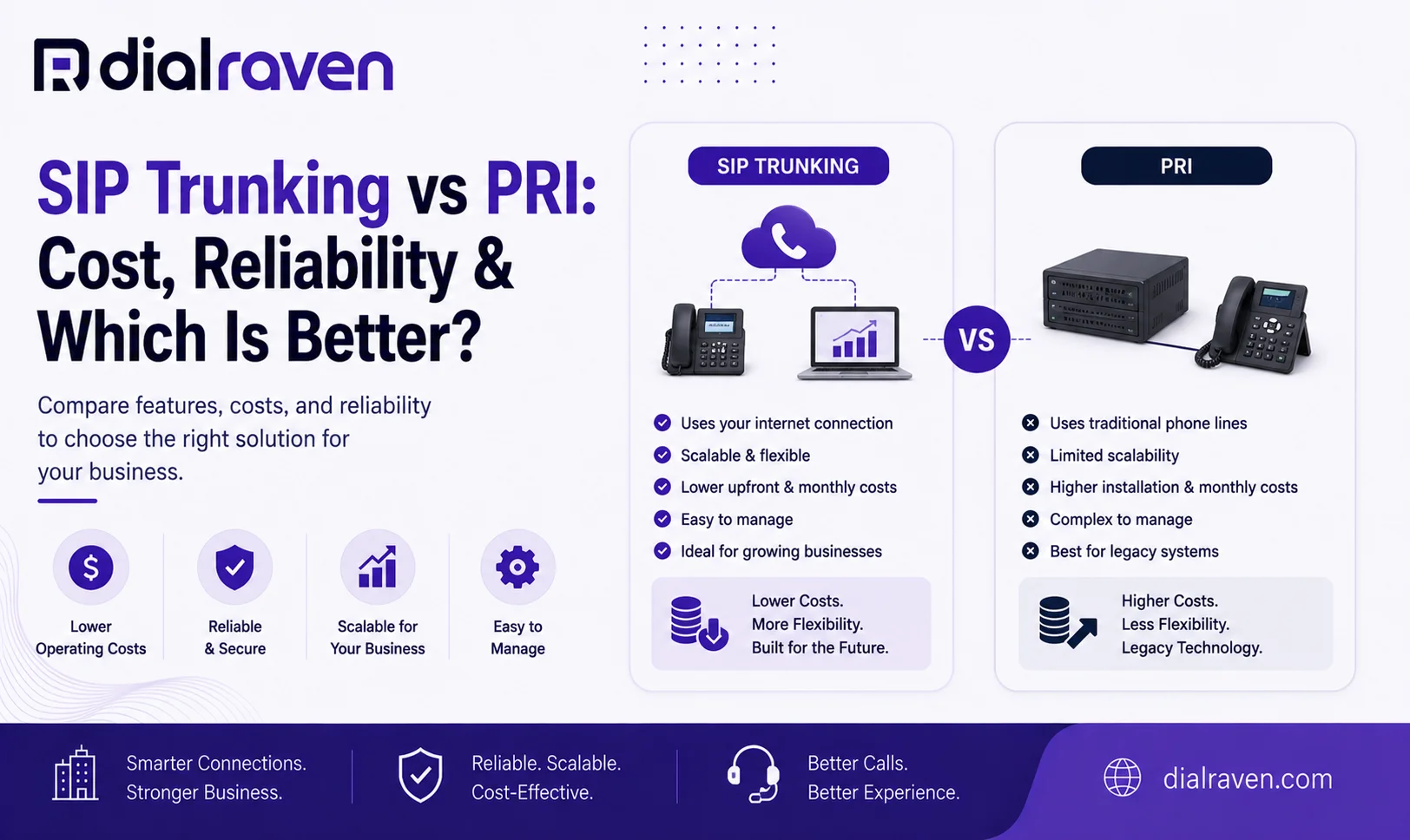
SIP Trunking vs PRI: Cost, Reliability & Which Is Better?
Compare SIP trunking vs PRI on cost, reliability, call capacity, scalability, and migration to see which option fits your business phone system.
Quick Answer
PRI uses dedicated physical circuits with fixed call capacity, while SIP trunking connects a PBX over IP with flexible channels. PRI can suit stable legacy environments; SIP is usually easier to scale and reroute. The right choice depends on your PBX, network, call volume, and continuity needs.
Dial Raven Team
VoIP Communication Expert
If your business still connects an on-premise PBX to the telephone network through PRI circuits, modernizing the phone system does not necessarily mean replacing everything you already own. The real SIP trunking vs PRI decision is often simpler: should you keep paying for fixed physical voice capacity, or connect the existing PBX through flexible IP-based SIP channels instead? For some businesses, PRI still works and an immediate replacement adds little value. For others, SIP trunking can make capacity easier to adjust, improve failover options, and modernize external connectivity without forcing a full PBX replacement.
SIP Trunking vs PRI: Quick Answer
PRI and SIP trunking both connect a business phone system to external telephone networks, but they do it differently. PRI uses dedicated digital circuits with fixed channel capacity, while SIP trunking delivers voice connectivity over an IP network and lets businesses provision simultaneous-call capacity more flexibly. If your existing PBX is reliable and SIP-compatible, moving from PRI to SIP may modernize connectivity without replacing the phone system. If the PBX itself is aging or limiting the business, a full cloud migration may make more sense.
SIP Trunking vs PRI at a Glance
| Factor | PRI | SIP Trunking |
|---|---|---|
| Connection type | Dedicated physical digital circuit | IP-based connection |
| Typical North American capacity | 23 voice channels per T1 PRI | Flexible concurrent-call channels |
| Existing PBX | Required | Usually retained if compatible |
| Scaling | Add capacity in fixed circuit increments | Add or remove channels more flexibly |
| Provisioning | May require physical carrier work | Primarily provider and network configuration |
| Network dependency | Dedicated voice circuit | Depends on IP connectivity |
| Failover | Requires additional circuit or routing design | Can support alternate IP routes and call forwarding |
| Remote flexibility | Limited by physical infrastructure | More flexible |
| Cost structure | Circuit-based | Channel or usage-based |
| Best fit | Stable legacy environments | Businesses modernizing an existing PBX |
The practical PRI vs SIP trunking difference is not simply old technology versus new technology. It is primarily a choice between fixed physical capacity and more flexible IP-based connectivity.
What Is PRI?
Primary Rate Interface, or PRI, is a digital telecommunications interface traditionally used to connect a business PBX to the public telephone network. In North America, a T1 PRI normally provides 23 B channels for voice or data and one D channel for signaling. Cisco's ISDN PRI documentation documents this 23 B plus one D channel configuration.
That gives one PRI circuit capacity for up to 23 simultaneous bearer-channel sessions. If a business needs substantially more call capacity, it generally has to provision additional PRI resources instead of simply adding a few virtual call paths.
Why Businesses Still Use PRI
- The existing on-premise PBX still works reliably
- PRI interface hardware is already installed
- Current telecom contracts remain acceptable
- Call volume is stable and predictable
- The business has established routing processes
- Staff already understand and support the environment
If the existing infrastructure is reliable and still meets the business need, replacing it purely because SIP is newer may not be financially justified. The decision should be based on operational value, cost, scalability, and future plans.
What Is SIP Trunking?
SIP trunking connects a compatible business PBX to a voice provider using IP rather than relying on a traditional PRI circuit. A SIP trunk is not one individual phone line. It is the connection between the PBX and provider, while SIP channels determine how many external calls can be active simultaneously. If you need the technology explained from the ground up, Dial Raven's guide to SIP trunking covers trunks, channels, PBX connectivity, and how calls reach the PSTN.
For example, a business that consistently peaks at eight simultaneous external calls may need capacity around that real usage level plus an appropriate margin instead of purchasing a fixed block of 23 channels.
SIP Trunking vs PRI: 7 Key Differences
1. Physical Circuit vs IP Connection
PRI uses dedicated telecom infrastructure between the business and carrier network. SIP trunking uses IP connectivity. That difference affects provisioning, scalability, redundancy, network planning, and the overall cost structure.
2. Call Capacity
PRI capacity is organized around the physical circuit. A North American T1 PRI commonly supports up to 23 simultaneous bearer channels. SIP capacity can generally be provisioned more granularly, allowing a business to align channels more closely with actual concurrent-call demand.
3. Scalability
PRI works well when demand is stable. The challenge appears when a business needs slightly more capacity, because growth may require another circuit even when only part of the additional capacity is needed. SIP allows capacity to be adjusted more flexibly for growth, seasonal call volume, new offices, or changing support teams.
4. Infrastructure
PRI depends more heavily on physical telecom interfaces and compatible on-premise hardware. SIP still requires a compatible PBX and reliable network environment, but it removes the need for the PRI circuit itself. Some older PBX platforms may require a gateway, adapter, or session border controller before they can use SIP.
5. Provisioning
PRI changes may involve physical carrier work, circuit availability, hardware, and scheduling. SIP capacity is software-defined to a greater degree, so adding or adjusting channels can often be handled through provider configuration rather than installing another physical voice circuit.
6. Multi-Location Flexibility
PRI infrastructure is tied more closely to specific physical locations. SIP can support a more flexible architecture across offices, although the exact design depends on the PBX, provider, network, security policies, and routing requirements.
7. Business Continuity
PRI benefits from a dedicated circuit, but a failed circuit still requires a backup plan. SIP can support alternate routing strategies such as secondary internet connections, provider-side failover, alternate office destinations, and forwarding to other endpoints. The quality of those capabilities depends on the provider and architecture rather than SIP alone.
SIP Trunking vs PRI Cost
There is no universal winner on price because the correct SIP trunking vs PRI cost comparison depends on current contracts, PBX hardware, call capacity, network requirements, usage, and redundancy. A useful comparison should look at total operating cost rather than one advertised monthly rate.
PRI Costs to Include
- Current PRI circuit charges
- Number of active circuits
- Installation or service fees
- PBX interface hardware
- Carrier maintenance
- Long-distance or usage charges
- Redundant circuit costs
- Contract obligations
SIP Costs to Include
- Concurrent SIP channels
- Calling usage or included minutes
- Phone numbers
- E911
- Number porting
- PBX configuration
- Gateway or SBC requirements where applicable
- Internet redundancy
- Support and monitoring
Dial Raven's SIP trunk pricing guide explains channel pricing, calling usage, numbers, E911, and other provider fees in greater depth. When comparing PRI with SIP, focus on equivalent business outcomes rather than choosing a provider based on the lowest advertised channel rate.
How Many SIP Channels Replace One PRI?
A North American T1 PRI normally provides up to 23 bearer channels, but that does not mean every company replacing one PRI automatically needs 23 SIP channels. The better method is to size the SIP trunk using your actual peak concurrent external calls.
- Peak simultaneous inbound calls
- Peak simultaneous outbound calls
- External transfers
- Conference-call requirements
- Seasonal spikes
- Planned growth
- An appropriate capacity margin
If a business has a 23-channel PRI but historically peaks at only 11 simultaneous external calls, purchasing 23 SIP channels may simply preserve unused capacity. Dial Raven's SIP trunk calculator can help estimate required channels and voice bandwidth from actual concurrent-call demand.
SIP Trunking vs PRI Reliability
The SIP trunking vs PRI reliability question needs a balanced answer. PRI uses a dedicated physical connection, which can provide predictable performance because voice traffic does not share the normal office internet connection. SIP depends on IP connectivity, network design, and provider infrastructure, so a poorly configured or unstable network can affect call quality and availability.
SIP can also support resilience options such as multiple internet connections, provider-side redundant routing, automatic call failover, alternate office destinations, mobile forwarding, and geographic redundancy. The better reliability question is not simply which technology is more reliable, but what happens when the primary connection fails. Dial Raven's guide on what happens to VoIP when the internet goes down explains backup connectivity, call failover, and continuity planning in more detail.
When Does PRI Still Make Sense?
- The current phone environment is stable and reliable
- The PBX is difficult or costly to adapt for SIP
- Internet connectivity at the location is limited
- Existing PRI capacity closely matches call demand
- Current contract economics remain acceptable
- The business plans to replace the entire PBX soon
Technology should solve a business problem. If PRI is performing reliably, costs are acceptable, and the entire PBX will soon be replaced anyway, forcing an intermediate migration may create unnecessary work.
When Should a Business Move From PRI to SIP?
- PRI capacity is consistently underused
- The business needs more simultaneous calls
- Adding PRI circuits is slow or expensive
- Multiple locations need more flexible connectivity
- Better failover options are required
- The existing PBX still has useful life
- The business wants to modernize connectivity without replacing all phone hardware
Dial Raven's business SIP trunking service is designed for businesses that want to preserve a compatible existing PBX while replacing legacy PRI connectivity with flexible SIP channels.
Keep the PBX With SIP or Replace the PBX Too?
This is often the more important decision. Replacing PRI does not automatically mean the existing PBX should remain indefinitely. If the PBX is modern, supported, reliable, and already integrated into important workflows, adding SIP can extend its useful life. If the PBX itself is expensive to maintain or limiting remote work, integrations, mobility, or administration, replacing only PRI may preserve the wrong part of the system.
| Your Situation | Keep PBX + Move to SIP | Consider Cloud VoIP |
|---|---|---|
| PBX is relatively modern | Strong fit | Optional |
| Hardware investment still has useful life | Strong fit | May be premature |
| PBX already supports SIP | Strong fit | Compare long-term needs |
| Business has capable internal IT | Often practical | Either option |
| PBX is expensive to maintain | Less attractive | Stronger case |
| Remote work is difficult | Depends on PBX | Stronger case |
| Integrations are limited | Depends on PBX | Stronger case |
| Hardware is near end of life | Temporary solution at best | Stronger case |
If your PBX still serves the business well, SIP trunking may be the most efficient modernization path. If the PBX itself is creating the operational problem, replacing PRI alone may simply preserve an aging system. Dial Raven's SIP trunking vs VoIP guide explains this next decision in greater detail.
PRI to SIP Migration: A Practical Process
Step 1: Inventory the Current Environment
Document PRI circuits, business phone numbers, DIDs, PBX make and model, gateways, extensions, fax or analog dependencies, E911 locations, call-routing rules, and peak call usage.
Step 2: Measure Concurrent Calls
Do not size SIP from employee count alone. Review busy-period call records and determine how many external calls occur simultaneously.
Step 3: Confirm PBX Compatibility
Verify whether the current PBX supports SIP directly or requires a compatible gateway, SBC, or other equipment. Compatibility should be tested before committing to the cutover.
Step 4: Review Network Readiness
- Internet capacity
- Latency
- Jitter
- Packet loss
- Firewall configuration
- Quality of Service
- Backup internet
- Power continuity
Step 5: Configure SIP Before Removing PRI
Whenever practical, build and test the SIP environment while the existing PRI service is still available. This creates a safer testing window and reduces pressure during cutover.
Step 6: Test Critical Call Functions
- Inbound calls
- Outbound calls
- Caller ID
- DIDs
- Call transfers
- Toll-free numbers
- E911
- Fax dependencies
- Failover
- After-hours routing
Step 7: Move Traffic and Monitor
Once acceptance testing is complete, move live traffic and closely monitor call quality, capacity, routing, and errors. Retire the old PRI service only after the replacement path is verified. If the project expands into a full phone-system replacement, Dial Raven's PBX to VoIP migration checklist covers the broader cutover process.
Final Verdict: SIP Trunking or PRI?
PRI remains functional technology and may still make sense for a stable legacy environment with no immediate reason to change. For businesses that want more flexible call capacity, easier scaling, stronger routing options, or a way to preserve a useful PBX while modernizing external connectivity, SIP trunking is often the more practical path.
The smartest question is not only whether you should replace PRI with SIP. It is whether your existing PBX is still worth keeping. If the answer is yes, SIP can modernize connectivity without forcing a complete replacement. If the answer is no, moving directly to a hosted business phone system may prevent you from investing more time and money into infrastructure that will soon be retired.
Frequently Asked Questions
What is the main difference between SIP trunking and PRI?
PRI uses dedicated physical digital circuits with fixed channel capacity, while SIP trunking connects a compatible PBX to telephone networks over IP and allows concurrent-call capacity to be provisioned more flexibly.
How many SIP channels replace one PRI?
A North American T1 PRI typically provides 23 bearer channels, but businesses should size SIP from actual peak concurrent calls rather than automatically purchasing 23 SIP channels.
Is SIP trunking cheaper than PRI?
It can be, especially when a business is paying for unused fixed PRI capacity. The full comparison should include channels, usage, PBX compatibility, network redundancy, support, migration, and existing contract costs.
Is PRI more reliable than SIP trunking?
PRI uses a dedicated physical circuit, while SIP reliability depends on network and provider design. A well-designed SIP environment can use redundant internet, alternate routing, and automatic failover to improve continuity.
Can SIP trunking work with my existing PBX?
Often yes. Many IP-capable PBX systems support SIP directly, while some older systems require a compatible gateway, session border controller, or other equipment. Compatibility should be checked before migration.
Can I keep my business phone numbers when moving from PRI to SIP?
In many cases, existing business numbers can be ported to the new provider. Number inventory and portability should be confirmed during migration planning before the old PRI service is disconnected.
Should I switch from PRI to SIP or replace my PBX completely?
If your PBX is reliable, supported, and still meets operational needs, SIP can modernize connectivity without replacing it. If the PBX is aging, expensive to maintain, or limiting remote work and integrations, a full cloud migration may make more sense.
Still using PRI and not sure whether to keep your PBX, move to SIP, or replace the phone system completely? Dial Raven can review your current PRI capacity, PBX, peak simultaneous calls, phone numbers, locations, network readiness, and failover needs. Get a free PRI-to-SIP assessment and we'll help identify the most practical migration path for your business.
Related pages
Ready to modernize your phone system?
Talk to a Dial Raven specialist and get a plan built around how your team works.