
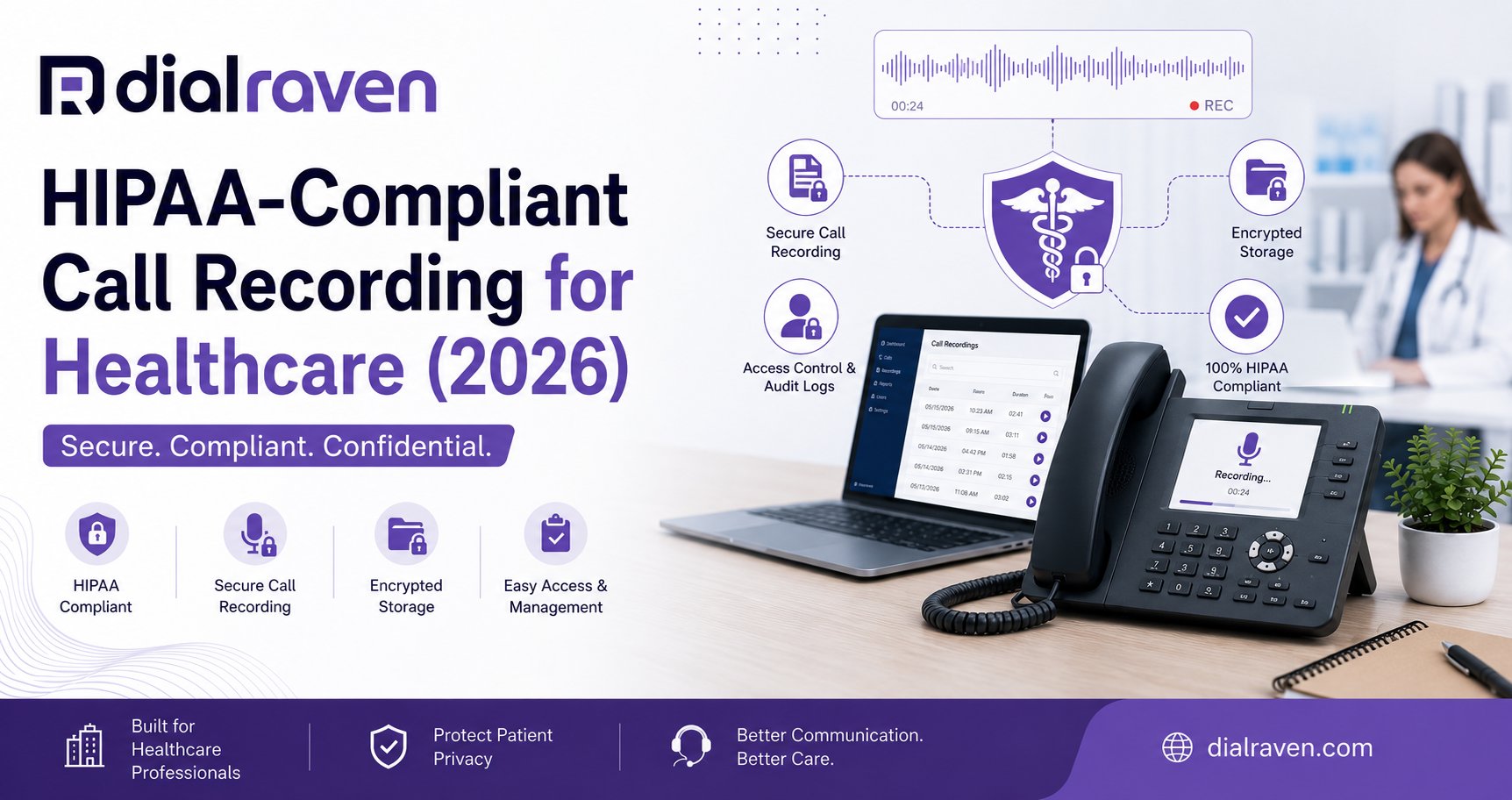
HIPAA-Compliant Call Recording for Healthcare (2026)
Learn how healthcare practices can record calls with safeguards for consent, secure storage, retention, AI transcripts, access, and BAAs.
Quick Answer
HIPAA does not automatically prohibit recording patient calls. Recordings containing identifiable health information must be protected as PHI or ePHI, while separate federal and state laws may require notice or consent.
Dial Raven Team
VoIP Communication Expert
Healthcare organizations record calls for quality review, staff training, documentation, and dispute resolution. But once a patient conversation is stored as audio or converted into a transcript, it creates privacy, security, access, and retention responsibilities.
HIPAA compliant call recording is not achieved by enabling one encrypted feature. A practice must decide which calls are recorded, what information they contain, who can access them, how long they remain stored, and whether every vendor handling the data is covered by an appropriate agreement. Call recording should be configured as part of a complete medical office phone system, not treated as a separate feature.
This guide provides general operational information and is not legal advice. Healthcare organizations should have qualified legal and compliance professionals review their recording policies and workflows.
Is Call Recording Allowed Under HIPAA?
HIPAA does not automatically prohibit recording patient calls. However, a recording that identifies a patient and includes information about treatment, appointments, prescriptions, billing, insurance, or healthcare services may contain Protected Health Information.
When a recording is created, transmitted, or stored electronically, it may be electronic PHI. The organization must evaluate how it is stored, accessed, shared, downloaded, transcribed, retained, and deleted.
The official HHS summary of the HIPAA Security Rule explains that regulated organizations must use reasonable and appropriate administrative, physical, and technical safeguards to protect electronic PHI.
A phone system can support a HIPAA-ready workflow, but configuration, policies, staff training, risk analysis, and daily use still matter.
When Is a Healthcare Call Recording Considered PHI?
A healthcare call recording may contain PHI when it identifies, or could reasonably identify, a patient and includes information related to healthcare, treatment, payment, or services.
| Call Example | Likely PHI Exposure | Recommended Approach |
|---|---|---|
| General office-hours question | Lower | Follow the approved recording policy |
| Appointment scheduling | Moderate | Restrict access and limit unnecessary details |
| Prescription refill request | High | Encrypt storage and define access and retention |
| Test-result discussion | High | Use tightly controlled clinical workflows |
| Billing or insurance call | High | Review health-data and payment-data exposure |
Appointment details, insurance information, prescription requests, and voicemail messages may reveal information about a patient's care even when no physician joins the call.
HIPAA Call Recording Requirements
HIPAA call recording requirements involve the complete recording workflow, not only the security of the audio file. Before enabling recording, review the following controls.
Define the Recording Purpose
Document why each type of call is recorded. Approved purposes may include quality assurance, staff coaching, documentation, dispute resolution, or patient-service review.
Avoid recording every call indefinitely simply because the technology allows it. Recording creates additional information that must be protected and managed.
Perform a Risk Analysis
Map where recordings and transcripts are created, stored, accessed, and transmitted.
- Cloud storage and backups
- Mobile and remote access
- Downloaded recording files
- Email notifications
- Third-party integrations
- AI transcription services
- Vendor and subcontractor access
Restrict Access by Role
Use unique user accounts and role-based permissions. Front-desk, billing, clinical, administrative, and compliance teams should see only the recordings required for their responsibilities.
Access should be removed promptly when an employee changes roles or leaves the organization.
Enable Audit Controls
The system should show who accessed, downloaded, shared, changed, or deleted a recording. The practice should also define who reviews activity logs and what happens when unusual behavior is discovered.
Protect Stored and Transmitted Data
Review encryption, authentication, permissions, backups, voicemail, transcripts, and download controls. Dial Raven's guide to HIPAA-compliant VoIP for healthcare explains how these safeguards fit into the broader phone environment.
HIPAA Call Recording Consent vs. State Laws
HIPAA is not the only rule that determines whether a call may be recorded. HIPAA governs how health information is used, disclosed, and protected. Separate federal and state recording laws determine whether one participant or all participants must consent.
For interstate calls, the laws of more than one state may be relevant. A legally reviewed HIPAA call recording consent workflow should consider the patient's location, the employee's location, whether the call is inbound or outbound, when recording begins, whether transcription is enabled, how consent is documented, and what happens when consent is declined.
Dial Raven's call recording laws by state guide explains one-party, all-party, mixed, and interstate recording scenarios.
Sample Call Recording Disclosure
"Thank you for calling [Practice Name]. This call may be recorded and transcribed for [approved purpose]. If you do not wish to be recorded, please press [number] or tell the representative so we can follow our approved non-recorded process."
This is a general template, not legal advice. The wording, timing, and consent process should be reviewed for the jurisdictions and call types involved. Additional examples are available in Dial Raven's call recording disclosure scripts.
If a patient declines recording, the approved process may involve pausing the recording, transferring the caller to a non-recorded queue, or scheduling a non-recorded callback. Staff should not improvise the response.
Does the Recording Vendor Need a BAA?
A Business Associate Agreement may be required when a vendor creates, receives, maintains, or transmits PHI on behalf of a covered entity or business associate.
The practice should confirm whether its BAA covers the complete healthcare call recording workflow.
- Audio recordings
- Voicemail messages
- Transcripts and AI summaries
- Cloud backups
- Analytics and integrations
- Technical support access
- Subcontractors
- Data return and destruction
The official HHS cloud computing and HIPAA guidance explains that a cloud provider handling ePHI for a regulated organization is a business associate, even when it stores encrypted information and does not hold the encryption key.
Do not rely only on a vendor's claim that a product is HIPAA compliant. Confirm the exact services, optional features, integrations, and subprocessors covered by the agreement.
HIPAA Call Recording Retention
HIPAA does not establish one universal retention period specifically for every healthcare call recording.
The correct period may depend on why the call was recorded, whether it supports treatment or operations, state medical-record requirements, contractual obligations, litigation holds, complaint procedures, and the organization's approved policy.
A HIPAA call recording retention policy should identify:
- Which call types are retained
- The approved retention period for each category
- Who can place a legal or investigation hold
- How recordings are securely deleted
- Whether backups follow the same deletion schedule
Do not confuse retention requirements for certain HIPAA policies and compliance documentation with a requirement to keep every recorded patient call for the same period.
Are AI Call Transcripts Covered by HIPAA?
An AI transcript may contain the same patient information as the original recording. Text may also be easier to search, copy, export, or email, which can create additional exposure.
Before enabling AI call transcription, review:
- Whether the transcription provider is included in the BAA
- Whether subprocessors handle the audio or text
- Whether patient information is used for model training
- How long audio, transcripts, and summaries are stored
- Who can search or export transcripts
- How inaccurate transcript text can be corrected
- How audio, transcripts, summaries, and derived data are deleted
Audio, transcripts, summaries, and extracted action items should be governed together because they come from the same patient conversation.
How to Choose HIPAA-Compliant Call Recording Software
Evaluate the complete workflow rather than choosing HIPAA compliant call recording software based on one security badge or marketing claim.
| Capability | What to Confirm |
|---|---|
| Business Associate Agreement | Recording, storage, transcription, analytics, and relevant subcontractors are covered |
| Recording controls | Recording can be managed by number, queue, department, user, or call type |
| Consent workflow | The system supports notices and approved consent actions |
| Non-recorded option | Recording can be paused or the caller can use another approved route |
| Access and audit controls | Role-based permissions and activity logs are available |
| Retention automation | Different retention rules can be applied to different call categories |
| Secure deletion | Expired recordings, transcripts, and related data can be removed |
| AI transcription | Audio, transcripts, summaries, and subprocessors are appropriately governed |
| Export controls | Downloads and external sharing can be restricted |
Dial Raven's healthcare communication solutions combine cloud calling, recording, transcription, routing, voicemail, and access controls within one communications environment.
The healthcare organization remains responsible for deciding how those capabilities should be configured and used.
Healthcare Call Recording Checklist
- The purpose of recording is documented
- Legal and compliance teams reviewed the workflow
- Notice and consent requirements were evaluated
- A non-recorded option was tested
- The BAA covers recordings and related services
- Permissions are role-based
- Audit logs are enabled
- Downloads and exports are restricted
- AI transcription settings were reviewed
- Retention and deletion rules are documented
- Staff members were trained
Common Healthcare Call Recording Mistakes
Treating HIPAA and Consent Laws as the Same Rule
A recording may be protected appropriately under HIPAA but still conflict with a state recording law. Both areas require review.
Giving Every Employee Access
Recording access should follow job responsibilities. Convenience is not a sufficient reason to expose patient conversations broadly.
Keeping Recordings Forever
Indefinite retention increases privacy, storage, discovery, and breach exposure. Keep recordings according to a documented purpose and policy.
Frequently Asked Questions
Is recording a patient phone call a HIPAA violation?
Not automatically. A recording containing identifiable patient information may be PHI or ePHI and must be protected according to applicable HIPAA requirements. Separate recording-consent laws may also apply.
Does HIPAA require patient consent before recording a call?
HIPAA is not the only rule that determines whether consent is required. Federal and state recording laws may require notice or consent from one or all participants.
Does a call-recording provider need to sign a BAA?
A BAA may be required when the provider creates, receives, maintains, or transmits PHI through recording, storage, transcription, analytics, or related services.
How long should healthcare call recordings be retained?
HIPAA does not set one universal retention period for every call recording. The period should reflect the recording's purpose, state laws, contracts, litigation holds, record obligations, and the organization's approved policy.
Are AI call transcripts protected health information?
They may be. If a transcript identifies a patient and contains healthcare information, it should be governed with appropriate access, storage, vendor, retention, and deletion controls.
HIPAA compliant call recording requires more than an encrypted audio file. The complete process must address purpose, consent, access, storage, transcription, retention, deletion, and vendor responsibilities. Dial Raven can review the technical configuration of your recording workflow, including prompts, permissions, AI transcription, storage settings, retention controls, and BAA coverage. Get a free healthcare call-recording configuration audit to identify technical and workflow gaps before patient calls are recorded.
Related pages
Ready to modernize your phone system?
Talk to a Dial Raven specialist and get a plan built around how your team works.