
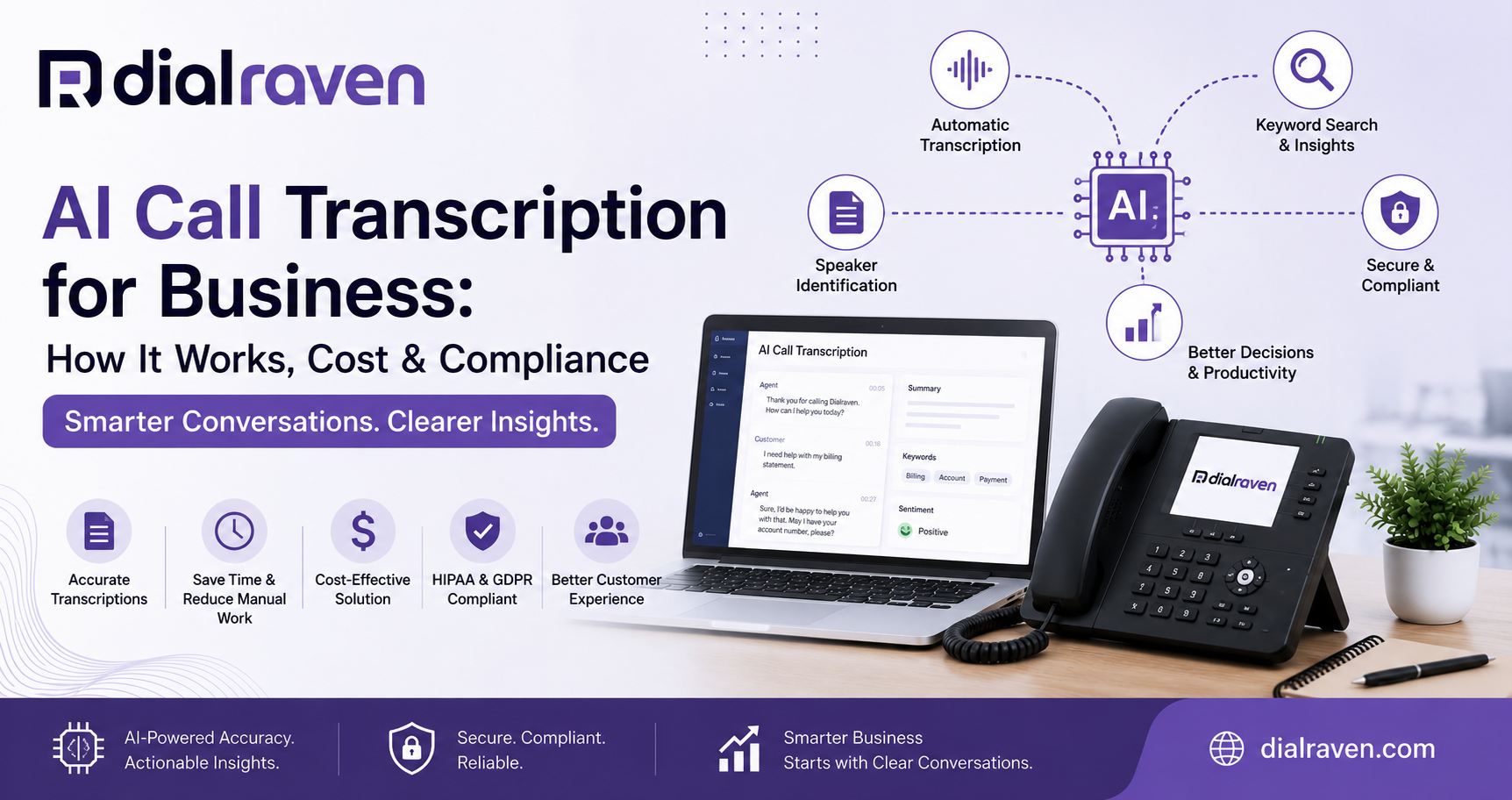
AI Call Transcription for Business: How It Works, Cost & Compliance
Thinking about AI call transcription for your business? Learn how it works, what it costs, and how to stay compliant with recording laws.
Quick Answer
AI call transcription automatically converts business phone calls into accurate, searchable text using speech-recognition AI. Modern business phone systems include it as a built-in feature, so every call is transcribed in real time without separate software, recording apps, or per-minute fees.
Dial Raven Team
VoIP Communication Expert
If you've ever hung up a call and immediately forgotten half of what was said, you already know why AI call transcription for business has become one of the fastest-adopted features in modern phone systems. Instead of scribbling notes mid-conversation or replaying a recording to catch one detail, AI transcription turns every call into searchable text the moment it ends. This guide breaks down how it works, what it costs, whether it's even legal to record your calls in the first place, and how to get it running without bolting on a separate app. If your team is comparing options, it's worth pairing this with our guide on the AI virtual receptionist for small business, since the two features are often used together.
What Is AI Call Transcription?
AI call transcription is technology that automatically converts spoken conversations into written text using speech-recognition models. Rather than recording a call and listening back later, the system processes the audio in real time (or shortly after the call ends) and produces a clean, searchable transcript — often with speakers labeled separately so it reads like a script rather than a wall of text. For businesses, this isn't just a convenience feature. It creates a written record of every customer conversation that can be searched by keyword, reviewed for training, or pulled up instantly during a dispute — without anyone needing to listen to the original recording.
Is It Legal to Record and Transcribe Business Calls?
This is the question most businesses ask before they ask anything else — and it should be. Recording or transcribing a call without proper consent can carry real legal and financial risk, so it's worth understanding before you turn the feature on. Under the federal Electronic Communications Privacy Act (ECPA), recording is legal with one-party consent — meaning if you're a participant on the call, your own consent is enough in most states. However, a number of states require all-party consent, meaning everyone on the call must be notified before recording begins.
- One-party consent states (most states): Only one person on the call needs to know it's being recorded — that can be you.
- All-party (two-party) consent states: Every participant must be informed before recording starts. This group includes California, Florida, Pennsylvania, and several others.
- Mixed-state calls: If you're calling someone in a different state, the stricter law generally applies — so a call between a one-party state and an all-party state should follow all-party rules.
- Best practice: Use an automatic disclosure message ("This call may be recorded for quality and training purposes") on every call, regardless of which state you're in. It's simpler than tracking consent rules state by state, and it protects you either way.
This is exactly why call recording laws by state matter even if you're a small, single-location business — a single missed disclosure on an out-of-state call can create unnecessary exposure. For a deeper look at how disclosure settings work inside a phone system, our call recording features page covers the automated notification options available on Dial Raven plans.
This article is for general informational purposes and isn't legal advice. If you operate across multiple states or in a regulated industry, confirm your specific obligations with legal counsel. (Source: U.S. Department of Justice — Electronic Communications Privacy Act overview)
How Does AI Call Transcription Work?
At a technical level, AI call transcription work happens in three stages, all running automatically in the background while your team simply takes the call as normal.
- Audio capture — The call audio is captured directly through your phone system as it happens, with no separate recorder or app needed.
- Speech-to-text processing — AI speech-recognition models convert the spoken audio into text in real time, identifying pauses, sentence breaks, and — on more advanced systems — individual speakers.
- Structured output — The finished transcript is stored, indexed, and made searchable, often alongside a summary, timestamps, and the option to jump to a specific moment in the original audio.
The result is a transcript your team can search the way you'd search an email inbox — by keyword, by date, or by caller — instead of replaying recordings minute by minute.
Built-In vs. Standalone Transcription Tools
There are two ways to get AI call transcription: build it on top of your existing phone system using a separate app, or use a business phone system with call transcription built directly into the platform.
| Standalone Transcription App | Built-In Transcription (Phone System) | |
|---|---|---|
| Separate signup, separate login | Already included in your phone system | Setup |
| Often per-minute or per-seat add-on | Included in your monthly plan | Cost structure |
| Requires uploading or syncing recordings | Transcribes automatically, no extra steps | Workflow |
| Usually needs a separate integration | Logs directly with your call history | CRM integration |
| Teams without a unified phone system | Teams that want one system, one bill, one login | Best for |
For most small businesses, the built-in route removes the most common friction point: remembering to use a second tool. If you're already running calls through a business phone system, adding transcription as a built-in feature is usually simpler — and cheaper — than layering on a standalone app.
How Accurate Is AI Call Transcription?
AI call transcription accuracy has improved significantly in recent years, but it still depends heavily on audio quality. Clear phone lines with minimal background noise typically produce highly accurate transcripts, while calls with heavy accents, crosstalk, or poor connections will have more errors.
- Clean audio, single speaker: Highest accuracy — transcripts are close to word-perfect.
- Multiple speakers, normal background noise: Strong accuracy, with occasional minor errors around overlapping speech.
- Poor connection or heavy accents: Accuracy drops noticeably — these calls benefit most from a "review the transcript against the recording" habit for anything compliance-critical.
For day-to-day use — sales follow-ups, customer service notes, internal training — modern AI transcription is reliable enough to replace manual note-taking entirely. For anything legally sensitive, it's still good practice to keep the original audio recording alongside the transcript.
What Does AI Call Transcription Cost?
Pricing varies depending on whether transcription is a standalone subscription or bundled into your phone system. Standalone tools are often priced per minute or per user, which can add up quickly for a team making dozens of calls a day. A built-in option, by contrast, is typically included in your existing per-user phone plan with no separate line item. Dial Raven includes AI Voice Transcription starting at $14.99/user/month, with no setup fees or per-minute charges. You can compare this against your current setup on our pricing page.
Getting Started With AI Call Transcription
If you're already using a cloud phone system, turning on transcription is usually a same-day change — there's no hardware to install and no separate account to manage. Businesses switching from a setup with no transcription at all are typically live within 24 hours, with number porting and call-flow configuration handled during onboarding. This is also a natural feature to pair with healthcare or other regulated environments, where a written, searchable record supports both HIPAA-ready compliance and day-to-day documentation needs.
Frequently Asked Questions
Is AI call transcription the same as call recording?
They're related but not identical. Call recording captures the audio of a conversation, while transcription converts that audio into searchable text. Most modern systems do both together — recording the call and generating a transcript automatically.
Is it legal to record business calls?
Yes, under federal law, as long as one participant consents — and in most U.S. states, that's all that's required. Some states require all-party consent, so it's safest to disclose recording on every call regardless of location.
How accurate is AI call transcription?
Accuracy is generally high on clear audio with normal background noise, though it can drop with heavy accents, poor connections, or multiple people talking at once.
Do I need a separate app for call transcription?
Not if your business phone system includes it natively. Built-in transcription transcribes every call automatically, without uploading recordings to a third-party tool.
How much does AI call transcription cost for a business phone system?
Standalone tools often charge per minute or per seat. Built-in transcription, like Dial Raven's AI Voice Transcription, starts at $14.99/user/month with no per-minute fees.
See AI Call Transcription in Action Stop replaying calls to catch the details you missed. Talk to a Dial Raven specialist and see how built-in AI transcription works on a live call. Book a Free Demo.
Related pages
Ready to modernize your phone system?
Talk to a Dial Raven specialist and get a plan built around how your team works.