
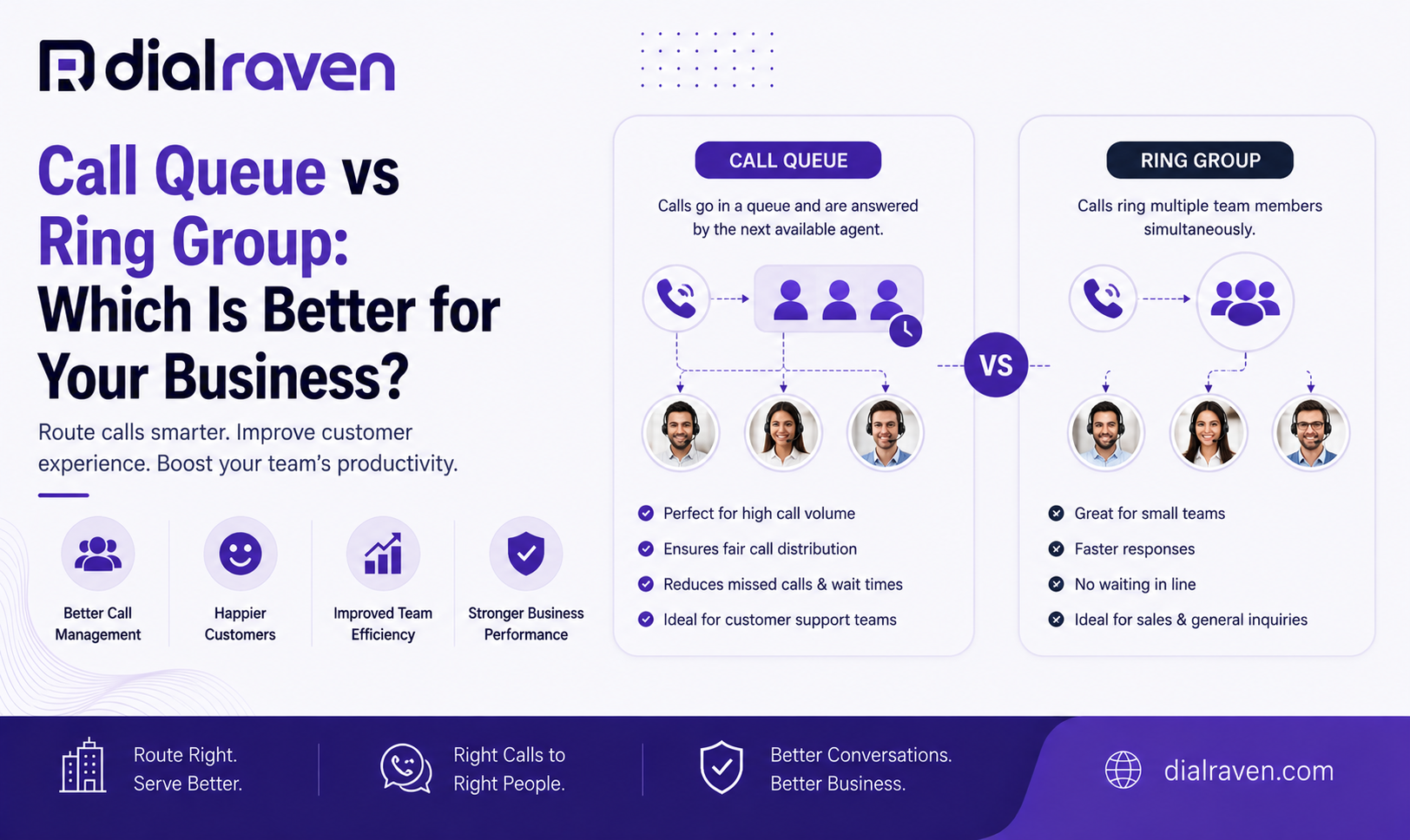
Call Queue vs Ring Group: Which Is Better for Your Business?
Compare call queues and ring groups by caller experience, routing, wait handling, reporting, and use cases to choose the right setup for your team.
Quick Answer
A ring group distributes incoming calls across several phones, while a call queue manages callers who must wait until someone is available. Ring groups suit simpler teams; queues add structured waiting, overflow rules, agent controls, and reporting for busier inbound operations.
Dial Raven Team
VoIP Communication Expert
When several employees share responsibility for the same business line, you need a clear rule for what happens when a customer calls. Should every available employee's phone ring? Should the system try people in a specific order? Or should the caller wait until the next team member becomes free? That is the practical call queue vs ring group decision. Both features distribute incoming calls across teams, but they solve different problems. A ring group is designed primarily to find someone who can answer now. A call queue is designed to manage callers when everyone who could answer is already busy. The simplest way to remember the difference is this: a ring group distributes ringing, while a call queue manages waiting.
Call Queue vs Ring Group: Quick Answer
A ring group sends one incoming call to several predefined users, either simultaneously or according to a configured ringing pattern. If nobody answers within the allowed time, the call normally follows a fallback route. A call queue adds another layer: when eligible team members are already busy, callers can wait in a virtual line until someone becomes available. Depending on the phone system, queues may also support hold messages, agent availability controls, overflow rules, callbacks, and performance reporting.
For a small team where someone is usually free, a ring group is often enough. For a busier sales, support, scheduling, or service operation where callers regularly arrive while staff are occupied, a queue provides more control.
Call Queue vs Ring Group at a Glance
| Factor | Ring Group | Call Queue |
|---|---|---|
| Primary purpose | Find an available team member | Manage callers waiting for an available team member |
| Typical caller waiting | Limited or no formal waiting queue | Yes |
| Hold music or messages | Usually limited | Common |
| Simultaneous ringing | Common | May be supported as a distribution method |
| Sequential routing | Common | Often supported |
| Agent availability or status | Usually simple | More structured |
| Queue position | No | May be available |
| Maximum wait rules | Basic fallback | More advanced |
| Overflow routing | Usually simple | More flexible |
| Reporting | Basic or limited | Typically more detailed |
| Best fit | Smaller, simpler teams | Busier inbound teams |
Exact capabilities vary by provider, so evaluate how a particular phone system behaves rather than choosing based only on the feature label.
What Is a Ring Group?
A ring group is a business phone system feature that sends an incoming call to a predefined group of employees. For example, a company might create a Sales ring group containing four sales representatives. When a prospect calls the sales number or is routed to Sales, the system tries members of that group according to the configured ringing pattern.
Simultaneous Ring
With simultaneous ringing, all eligible members ring at roughly the same time. The first person to answer gets the call. This works well when speed matters more than assigning calls evenly.
Sequential Ring
Sequential routing tries users in a defined order. A small office might route Receptionist → Office Manager → Backup Receptionist. This is useful when one employee should normally answer first but the business still needs backup coverage.
Rotating or Round-Robin Ringing
Some platforms rotate which member receives the first attempt so calls are spread more evenly. Provider terminology varies, so confirm how your specific system defines each routing strategy.
What Is a Call Queue?
A call queue is a virtual waiting line for incoming callers. When an eligible employee is free, the call can be delivered immediately. When everyone assigned to the queue is already busy, the caller remains in the queue until an agent becomes available or another configured rule takes effect.
- Hold music
- Recorded announcements
- Queue-position information
- Estimated wait information where supported
- Maximum wait limits
- Agent availability controls
- Different call-distribution strategies
- Overflow routing
- Callback options where supported
- Queue and agent reporting
Businesses handling consistent inbound volume can use Dial Raven's call center solutions to combine queues with skills-based routing, monitoring, recording, and analytics instead of relying only on basic group ringing.
What Is the Difference Between a Call Queue and a Ring Group?
The biggest difference between a call queue and a ring group is what happens when nobody can answer immediately. A ring group is primarily trying to locate an available person. A queue is prepared for the possibility that nobody is currently free. That difference changes the caller experience, management tools, reporting, and how the business handles peak call volume.
1. What Happens When Everyone Is Busy?
With a typical ring group, the system tries the configured members and then follows a no-answer destination when nobody accepts the call. That destination might be voicemail, another extension, another ring group, an external number, or another approved fallback. A queue instead allows the caller to remain waiting while the system monitors agent availability.
2. Caller Experience
Ring groups are designed around fast connection. If an employee answers promptly, the customer may never know a group exists. Queues are designed around managed waiting. A caller may hear a greeting, hold music, or status messages while waiting for the next available employee.
3. Call Volume
Ring groups work particularly well when the team can usually absorb incoming demand. A three-person front desk receiving occasional overlapping calls may need nothing more sophisticated. Queues become more valuable when several callers regularly arrive while staff are already speaking with customers.
- Customer support
- Sales
- Appointment scheduling
- Service departments
- Patient access
- Intake teams
- Reservations
- Call centers
The decision should be driven by call patterns rather than company size alone.
4. Agent Availability
A simple ring group often assumes that listed members should receive calls whenever the routing rule is active. Queues can provide more deliberate agent-state management. Depending on the platform, agents may be able to sign in, sign out, pause queue calls, or have availability determined by their current call status.
5. Routing Strategies
Both features may support several ringing patterns, but queues generally provide more structured distribution controls.
- Simultaneous
- Sequential
- Round robin
- Longest idle
- Fewest calls
- Skills-based routing
Not every provider supports every routing method. The goal should be matching the strategy to how the team actually works rather than selecting the setting with the most complicated name.
6. Reporting and Analytics
Reporting is one of the strongest reasons to move from simple group ringing to a formal queue. Managers may need to know how many calls entered the queue, how many were answered, how many callers abandoned, how long customers waited, when demand peaks, and whether staffing matches call volume.
7. Setup and Management Complexity
Ring groups are relatively simple: choose members, select ringing behavior, configure the fallback destination, and test. Queues require additional decisions about agent availability, call distribution, maximum wait times, queue limits, business hours, and overflow destinations. That additional complexity is worthwhile when the business actually needs the control.
Call Queue vs Hunt Group: Are They the Same?
Not necessarily. The term hunt group traditionally refers to a system that hunts through a defined group of destinations until someone answers. That makes a hunt group conceptually closer to a ring group than to a full queue. A call queue normally adds the ability to hold incoming callers while waiting for an available agent.
Phone providers do not always use these labels consistently. Some use hunt group and ring group almost interchangeably, while others use hunt group specifically for sequential routing. When evaluating call queue vs hunt group, focus on actual behavior: can callers wait, are queue announcements available, can agents control availability, is reporting included, and what happens when everyone is busy?
Ring Group vs Hunt Group: What's the Difference?
In many business phone systems, both terms describe ways of trying multiple employees without creating a formal waiting queue. One provider may define a ring group as several phones ringing together and a hunt group as phones being tried in sequence. Another may call both behaviors different ring-group strategies. For that reason, the ring group vs hunt group distinction should always be confirmed in the actual provider configuration before designing your call flow.
When Should a Small Business Use a Ring Group?
- The team is small
- Incoming volume is manageable
- Someone is usually available
- Several employees can handle the same caller
- Fast pickup matters more than structured waiting
- Detailed queue reporting is unnecessary
- The fallback route is simple
Example: Small Front Desk
Imagine a three-person professional office. The receptionist normally answers first, but the office manager and administrative assistant can also help. The business could ring all three simultaneously or try the receptionist first and the other two afterward. If nobody answers, the call can go to voicemail or another fallback. A formal queue may add unnecessary complexity.
When to Use a Call Queue
A queue becomes more appropriate when the problem changes from 'Who should answer?' to 'What should happen because everybody is already answering someone else?'
- Callers regularly reach busy staff
- Several calls arrive simultaneously
- Customers are willing to wait briefly
- Management needs wait-time or abandonment data
- Calls need to be distributed more evenly
- Agents need structured availability controls
- Overflow must change based on wait time or capacity
- The team handles an important sales, service, or support line
If queue demand becomes significant, staffing and routing should be reviewed together. Dial Raven's call center staffing calculator explains how call volume, handle time, occupancy, service level, and shrinkage affect the number of agents required.
Can You Use a Ring Group and Call Queue Together?
Yes. A well-designed business phone system does not necessarily force you to choose one feature for every situation. A call could follow a flow such as Main number → Auto attendant → Sales → Ring group → Queue overflow → Virtual receptionist. The ring group provides a fast first attempt when sales staff are likely to be free, while the queue or fallback protects the caller experience when nobody answers quickly.
The important principle is to design what happens to the caller, not simply which features are enabled.
Where Does an Auto Attendant Fit?
An auto attendant solves a different problem. It answers the call first and identifies where the caller should go. For example, a menu may offer Sales, Support, or Billing. Once the caller selects Support, that destination could be a ring group or call queue.
- Auto attendant — where should the caller go?
- Ring group — which available person should the system try?
- Call queue — what happens if those people are already busy?
- Overflow — what happens if waiting becomes too long?
Dial Raven's auto attendant can route callers to departments, extensions, and queues, while the dedicated IVR vs auto attendant guide explains the difference between basic menu routing and more advanced interactive call flows.
Ring Group vs Call Queue by Business Scenario
| Business Scenario | Best Starting Point | Why |
|---|---|---|
| Two-person front desk | Ring group | Simple and immediate pickup |
| Small sales team | Ring group | Any available representative can answer |
| Busy support department | Call queue | Callers regularly need managed waiting |
| Appointment scheduling team | Call queue | Multiple simultaneous callers and measurable demand |
| Sales team with occasional overflow | Ring group + queue | Fast first attempt with structured backup |
| Multi-location support | Shared queue or combined routing | Available teams across locations can help |
| After-hours on-call team | Ring or forwarding workflow | Formal waiting may not be appropriate |
For businesses operating several offices, a centralized phone environment can also route or overflow calls between locations. Dial Raven's guide to VoIP for multiple locations covers shared queues, location routing, failover, and centralized administration.
How Should Call Queue Overflow Work?
A queue should never mean keeping the customer waiting forever. Every important queue needs an overflow plan that determines what happens when normal handling is no longer appropriate.
- Maximum wait time is reached
- Too many callers are already waiting
- No agents are available
- The department closes
- A team becomes unavailable
- Another defined business rule is reached
Possible overflow destinations include another queue, a backup ring group, another business location, an external answering destination, a virtual receptionist, voicemail, or a callback workflow where supported. The correct destination depends on why the customer called and how quickly that call needs human attention.
What Call Queue Metrics Actually Matter?
Once a business needs formal queues, management should stop relying on impressions such as 'the phones seemed busy today.' Queue reporting should help answer whether staffing, routing, and overflow rules are actually working.
- Calls offered
- Calls answered
- Abandoned calls
- Average wait time
- Longest wait time
- Answer speed
- Queue volume by time of day
- Agent availability
- Service level
The purpose of reporting is to answer operational questions: do we have enough people, are calls entering the right queue, do overflow rules activate too late, and are customers waiting longer during specific periods? Dial Raven's call center solutions combine queue routing with supervisor visibility and real-time analytics so routing decisions can be evaluated against actual call behavior.
Call Queue vs Ring Group Decision Checklist
Use a Ring Group When
- Call volume is manageable
- Someone is normally free
- Several employees can answer the same type of call
- You mainly need fast distribution
- Basic fallback routing is sufficient
Use a Call Queue When
- Callers regularly arrive while everyone is busy
- Customers need a managed waiting experience
- Managers need queue analytics
- Agent availability matters
- More structured distribution is required
- Overflow rules need greater control
Use Both When
- You want an immediate ring attempt first
- Busy-period calls still need structured backup
- Different departments have different call-volume patterns
- You need multiple fallback stages
Final Verdict: Call Queue or Ring Group?
Neither feature is universally better. A ring group is usually simpler and works well when a small team needs multiple people to share incoming calls. A call queue becomes more valuable when callers routinely arrive while staff are already occupied and the business needs structured waiting, overflow control, agent availability, and performance reporting.
The decision comes down to one question: what should happen when every intended recipient is already busy? If the answer is 'try someone else and then use a simple fallback,' start with a ring group. If the answer is 'keep the caller in an organized waiting process until someone becomes available,' you probably need a call queue.
Frequently Asked Questions
What is the difference between a call queue and a ring group?
A ring group distributes an incoming call across several users so someone can answer quickly. A call queue can hold callers when all eligible agents are busy and may add wait messages, overflow rules, agent availability controls, and reporting.
Does a ring group put callers on hold?
A typical ring group is designed to try several phones rather than manage a formal waiting line. If nobody answers, the call normally follows a configured fallback. Exact behavior varies by phone-system provider.
What happens if everyone in a ring group is busy?
The result depends on the configured call flow. The call may go to voicemail, another extension, another group, an external destination, or a queue. Businesses should define a clear no-answer and busy fallback.
Can I use a call queue and ring group together?
Yes. A business can use a ring group for an immediate first attempt and send unanswered calls to a queue or another overflow destination. The order should match the desired caller experience.
Is a hunt group the same as a ring group?
Sometimes providers use the terms interchangeably, while others use hunt group for sequential routing and ring group for simultaneous ringing. Check the actual routing behavior rather than relying only on the feature name.
What is the difference between an auto attendant and a call queue?
An auto attendant answers and routes the caller based on a menu or selection. A call queue manages what happens after the caller reaches a department and all eligible agents are busy.
Which is better for a small business: a call queue or ring group?
A ring group is often sufficient for smaller teams with manageable call volume. A queue is better when callers regularly need to wait, managers need reporting, or the business requires more structured agent and overflow controls.
When should a business use a call queue?
Use a call queue when incoming calls frequently exceed immediate staff availability and the business needs structured waiting, distribution rules, overflow handling, agent controls, or queue performance reporting.
Not sure whether your business needs a ring group, call queue, auto attendant, or a combination? Dial Raven can review your call volume, departments, staff availability, business hours, overflow rules, and current missed-call problems and map a call flow around how your team actually works. Get a free call flow assessment and we'll help design the right routing setup.
Related pages
Ready to modernize your phone system?
Talk to a Dial Raven specialist and get a plan built around how your team works.