
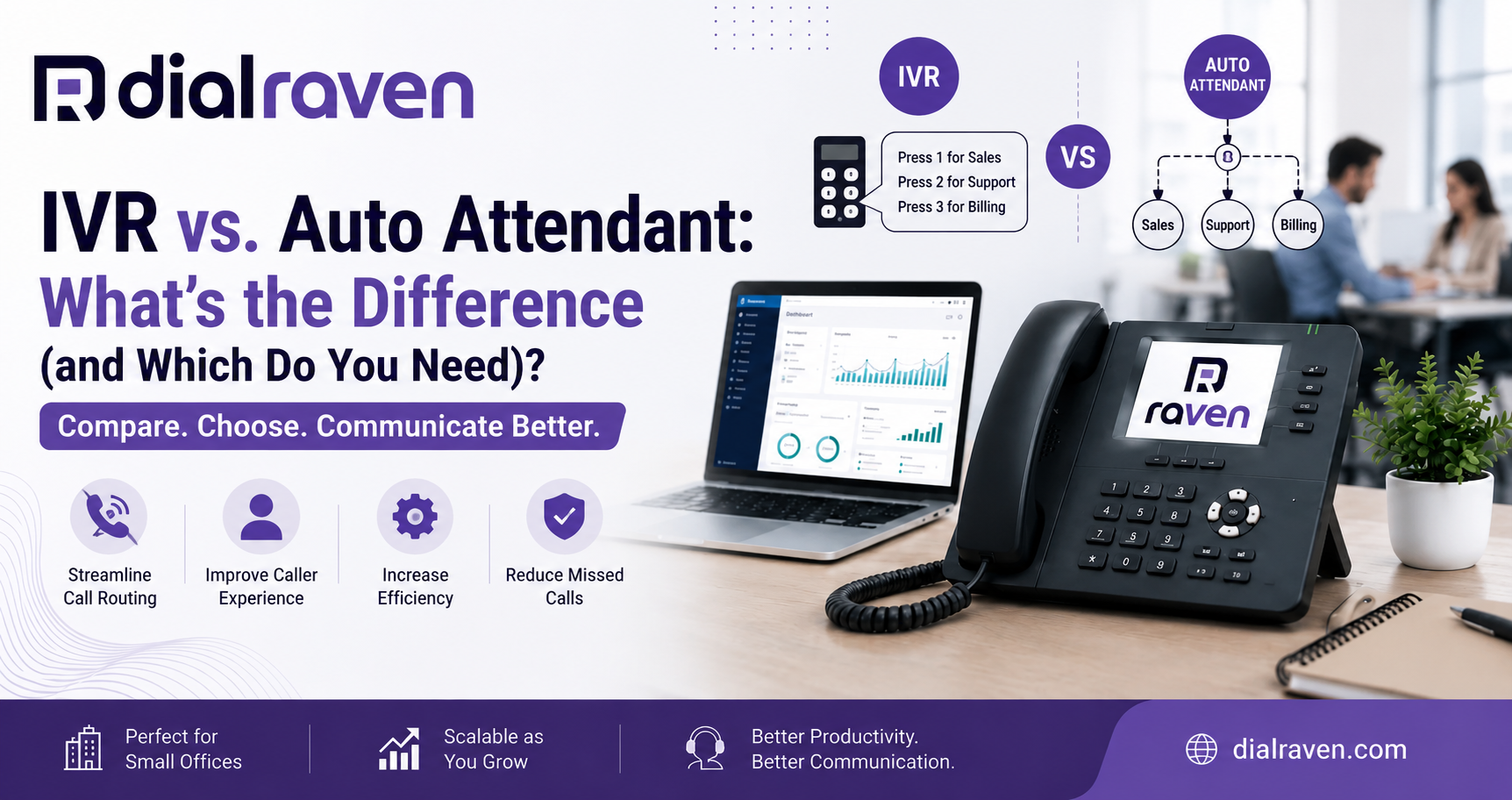
IVR vs. Auto Attendant: What's the Difference (and Which Do You Need)?
IVR and auto attendant aren't the same thing. Here's the real difference, when to use each, and which one your small business actually needs.
Quick Answer
An auto attendant is a simple digital receptionist that routes callers to the right person or department using a menu. IVR (Interactive Voice Response) goes further — it lets callers self-serve by voice or keypad, pulling live data to answer questions or complete tasks without an agent.
Dial Raven Team
VoIP Communication Expert
What's the Difference Between IVR and an Auto Attendant?
The short answer: an auto attendant routes calls, IVR resolves them. An auto attendant is a digital receptionist — it greets a caller and sends them to the right person or department based on a simple menu ("press 1 for sales, press 2 for support"). IVR, or Interactive Voice Response, does more — it lets callers speak or type information, pulls that data from a connected system, and can complete a task (checking an order status, verifying an account, booking an appointment) without a human ever picking up. Both are useful. Most confusion happens because businesses use the terms interchangeably when choosing a phone system, then end up with the wrong tool for how they actually operate.
What Is an Auto Attendant?
An auto attendant is the automated voice that answers your main business line before a caller reaches a person. It plays a greeting, offers a short menu of options, and directs the call — to an extension, a department, a voicemail box, or an after-hours message. It doesn't ask follow-up questions, doesn't look anything up, and doesn't complete transactions. Its only job is getting the caller to the right place quickly. If you've already read our complete auto attendant setup guide, you know it's typically the fastest, lowest-cost way to sound professional on your first ring. Businesses that write their own greetings often start from our auto attendant script examples rather than building menus from scratch.
Auto attendants work best when your call volume is manageable and your routing needs are simple: a handful of departments, clear business hours, and a small team. A single dentist's office, a two-person law practice, or a local contractor typically needs nothing more.
What Is IVR (Interactive Voice Response)?
IVR is the more advanced sibling. Instead of just routing, it interacts — collecting account numbers, verifying identity, checking order status, or processing a payment, all before (or instead of) reaching a live agent. IVR connects to a backend system (a CRM, a billing platform, an appointment calendar) to pull or update real information in real time. That's the core distinction: an auto attendant asks "where do you want to go?" — IVR asks "what do you need?" and can often answer it directly.
An IVR system for small business makes the most sense once call volume grows past what a simple menu can handle, or once customers are calling with repeatable, data-driven requests — appointment confirmations, balance checks, order tracking — that don't require a person every time.
IVR vs. Auto Attendant: Key Differences at a Glance
| Auto Attendant | IVR | |
|---|---|---|
| Routes calls to the right person/department | Resolves requests using live data | Primary job |
| Keypad menu only | Voice and/or keypad, two-way | Interaction type |
| No | Yes (CRM, billing, scheduling) | Connects to backend systems |
| Low — configure in minutes | Moderate to high — needs data integration | Typical setup complexity |
| Included in most VoIP plans | Often a higher-tier or add-on feature | Typical cost |
| Small teams, simple routing needs | Higher call volume, repeatable self-service tasks | Best fit |
Auto Attendant vs. Call Queue: Not the Same Thing Either
A third term gets mixed in here too: call queue. An auto attendant routes a caller before they reach a person. A call queue holds a caller after they've been routed, when every available agent is busy — playing hold music or a wait-time message until someone is free. You can (and often should) use both together: the auto attendant sends the caller to "Support," and the call queue manages what happens if every support line is busy. This combination is standard in call center solutions built for growing teams handling higher call volume.
IVR vs. Auto Attendant vs. Virtual Receptionist
There's a fourth option worth knowing before you decide: an AI virtual receptionist. Where a traditional auto attendant follows a fixed menu and traditional IVR follows scripted data lookups, an AI virtual receptionist understands natural spoken language, can hold a real conversation, and can hand off seamlessly to a live agent when a request gets complex. Think of it as the next step up: auto attendant handles simple routing, IVR handles structured self-service, and an AI virtual receptionist handles both — plus anything that doesn't fit neatly into a menu.
Does Your Business Need IVR or Auto Attendant?
- Choose auto attendant if: You have a small team, a handful of departments, and callers mostly just need to reach the right person.
- Choose IVR if: Callers frequently ask for the same type of information (order status, account balance, appointment times) that could be automated with a data lookup.
- Choose both together if: You're a growing business — auto attendant for routing, IVR for self-service, layered on top of each other.
- Consider an AI virtual receptionist if: Your call volume or complexity has outgrown fixed menus and you want natural conversation instead of "press 1 for..."
How to Get Started
Most small businesses don't need to choose once and live with it forever — the right business phone system lets you start with a simple auto attendant and add IVR or AI-driven call handling as your call volume grows, without switching providers or re-porting your number. If you're not sure which setup fits your call patterns today, get a free quote and we'll walk through it with you.
Frequently Asked Questions
What is the difference between IVR and an auto attendant?
An auto attendant routes callers to the right person or department using a simple menu. IVR lets callers interact directly — checking information or completing a task — by connecting to a live system, without needing a human to help.
What is IVR?
IVR (Interactive Voice Response) is phone technology that lets callers use voice or keypad input to get information or complete actions, like checking an order status, by pulling data from a connected system in real time.
Does my business need IVR or auto attendant?
If your call volume is low and callers mainly need routing to a person, an auto attendant is enough. If callers frequently request the same type of information that could be automated, IVR is worth adding.
Is an auto attendant the same as a call queue?
No. An auto attendant routes callers before they reach a person. A call queue holds callers after routing, when agents are busy, until someone becomes available.
Can I use IVR and auto attendant together?
Yes — most growing businesses use an auto attendant for initial routing and IVR for self-service tasks within specific departments, layered on the same phone system.
Is IVR expensive for a small business?
It depends on the provider. Basic IVR is often included or available as an add-on with modern cloud VoIP platforms, making it far more affordable than the custom on-premise IVR systems of the past.
Not sure whether your business needs auto attendant, IVR, or both? Book a demo today and we'll help you build a call-handling setup that actually fits how your team works.
Related pages
Ready to modernize your phone system?
Talk to a Dial Raven specialist and get a plan built around how your team works.