
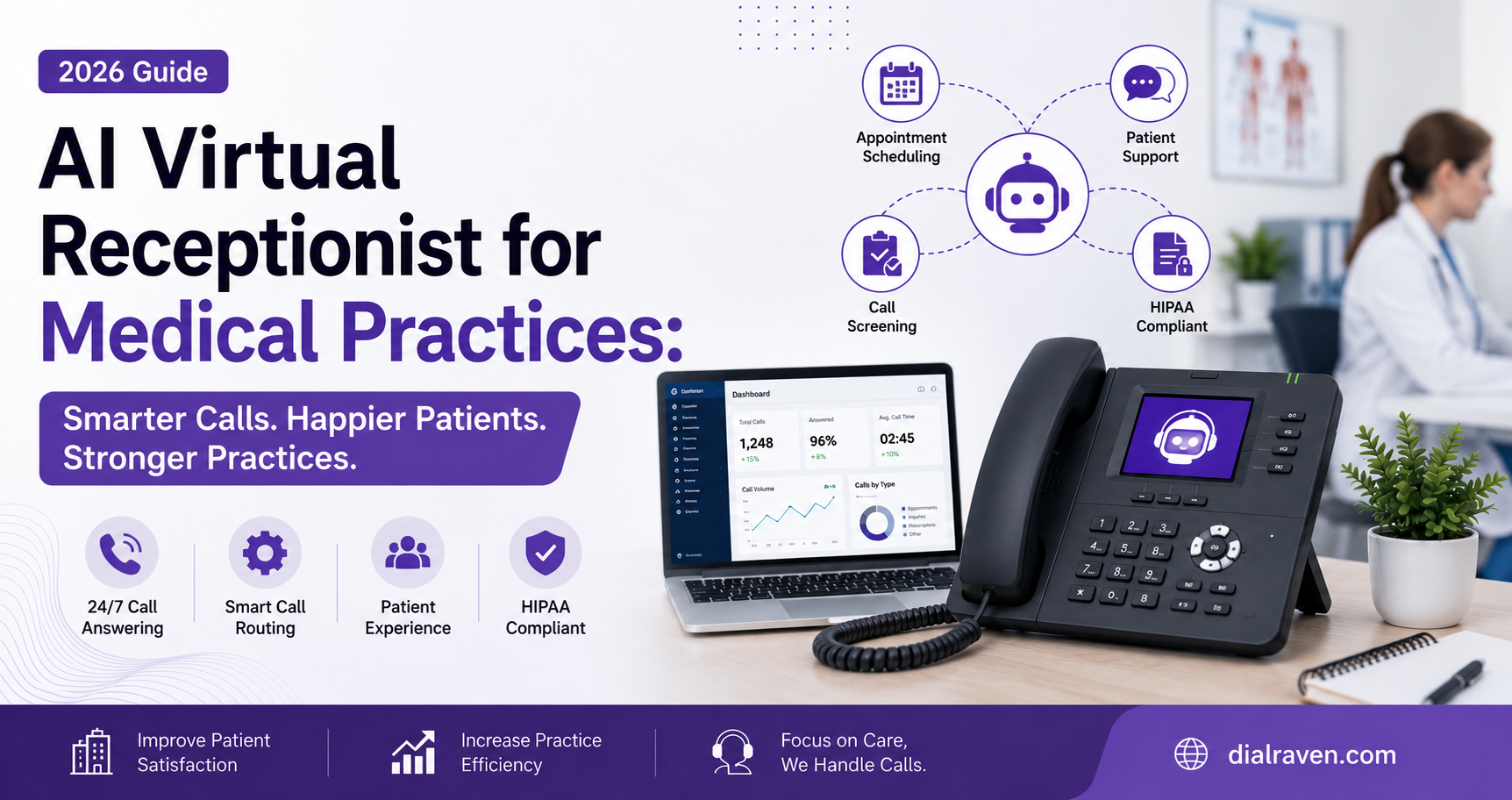
AI Virtual Receptionist for Medical Practices: 2026 Guide
Missed calls cost practices patients. See how an AI virtual receptionist for medical practices books visits and stays HIPAA compliant.
Quick Answer
An AI virtual receptionist for medical practices is a cloud-based system that automatically answers patient calls, schedules or reschedules appointments, collects basic intake details, and routes urgent calls to staff — 24/7, without adding front-desk headcount, while keeping patient communication HIPAA compliant.
Dial Raven Team
VoIP Communication Expert
Every unanswered phone call at a medical practice is a patient who might book with someone else instead. An AI virtual receptionist for medical practices answers calls instantly, day or night, schedules and reschedules appointments, collects basic intake information, and hands off anything urgent to your staff — all while keeping patient communication HIPAA compliant. This guide walks through how it works, what it costs in 2026, and how to decide if it's the right fit for your front desk.
Why Missed Calls Are a Bigger Problem Than Most Practices Realize
Front desks are busiest exactly when the phone is ringing the most — mid-morning check-ins, lunchtime rescheduling, end-of-day callbacks. Industry estimates suggest a significant share of inbound calls to medical practices — reported by some healthcare communication vendors at around 40% — go unanswered or land in voicemail during peak hours. Patients calling to book a first appointment rarely leave a message; they call the next practice on the list instead. That's the real cost: not just an annoying voicemail, but a lost patient relationship before it even starts.
What Is an AI Virtual Receptionist for Medical Practices?
An AI virtual receptionist for a medical practice is software that picks up every incoming patient call using natural-sounding conversational AI. Instead of a phone tree or voicemail, patients get answered immediately, can book, cancel, or reschedule an appointment, ask basic office questions (hours, location, insurance accepted), and get transferred to a live staff member the moment something needs a human — a clinical question, a billing dispute, or an urgent symptom.
Unlike a generic virtual receptionist for doctors office setups from years past — which were often just outsourced call centers reading a script — today's AI-driven versions understand context, follow your practice's specific intake rules, and log everything directly for your team to review.
How an AI Virtual Receptionist Works (Step by Step)
- Call comes in — answered instantly, no hold music, no voicemail
- AI identifies intent — new patient, existing patient, prescription refill, billing question, emergency
- Scheduling — books, moves, or cancels an appointment against your real-time calendar
- Basic intake — collects name, reason for visit, insurance provider (non-clinical details only)
- Smart routing — urgent or clinical questions are escalated immediately to a live staff member
- Logging — call summary and any patient-provided details are recorded for staff review
AI vs. Human vs. Hybrid Receptionist: What's Right for Your Practice
| Option | Best For | ||
|---|---|---|---|
| Option | Best For | Coverage | Typical Limitation |
| Human receptionist only | Small practices with low call volume | Business hours only | Misses after-hours and overflow calls |
| AI virtual receptionist only | Practices wanting 24/7 coverage on a budget | 24/7 | Can't handle complex clinical conversations |
| Hybrid (AI + human) | Most small-to-midsize practices | 24/7, with human escalation | Slightly higher cost than AI-only |
Most practices land on a hybrid setup — AI handles routine calls and after-hours coverage, while your existing staff stays focused on in-office patients and anything that needs a human judgment call. This is usually the most realistic starting point rather than replacing your front desk entirely.
Is an AI Virtual Receptionist for Medical Practices HIPAA Compliant?
This is the question every practice manager should ask before signing up with any vendor — and it's the one most competitor guides gloss over. A HIPAA compliant virtual receptionist should encrypt call and message data in transit and at rest, limit staff access to patient information on a role basis, and only share the minimum necessary information during a call. It should also support a signed Business Associate Agreement (BAA), which is required under HHS HIPAA guidance whenever a vendor handles protected health information on your behalf. If you're still working through your practice's broader phone infrastructure decisions, our guide to HIPAA compliant VoIP for healthcare covers what to check before switching providers.
Key Features to Look For
- 24/7 call answering with no hold queue
- Real-time appointment scheduling synced to your calendar
- Insurance and basic intake collection
- Smart routing for urgent vs. routine calls
- A unified inbox for calls, texts, and messages so staff aren't juggling separate tools
- Call recording and transcription for documentation and follow-up
How Much Does an AI Medical Receptionist Cost in 2026?
Pricing varies by vendor and call volume, so treat any number as a starting reference rather than a fixed quote. Some AI phone system vendors publish flat team pricing in the low-to-mid hundreds of dollars per month, while others charge per line or per minute. For an accurate AI medical receptionist cost for your specific patient volume and number of providers, it's worth getting a tailored quote rather than relying on a generic published rate — practice size, call volume, and the number of integrations you need (like EHR sync) all affect the final number.
How to Set Up an AI Virtual Receptionist Without Disrupting Your Front Desk
The transition is usually smoother than practices expect, especially if you're already moving to a modern communication setup. If you haven't yet gone through the broader process, our step-by-step guide on setting up a business phone system walks through number porting, call flow configuration, and go-live — the same groundwork applies before layering in an AI receptionist. Most practices start by routing only after-hours and overflow calls to the AI, then expand coverage once staff are comfortable with how it handles real patient calls.
Frequently Asked Questions
Is an AI virtual receptionist safe for patient information?
Yes, when the vendor supports encryption, role-based access, and a signed Business Associate Agreement as required under HIPAA.
Will patients know they're talking to AI?
Most modern systems introduce themselves clearly and are designed to sound natural, but practices can choose to disclose it upfront if preferred.
Can an AI receptionist handle a medical emergency call?
No — it should be configured to immediately escalate any urgent or clinical concern to a live staff member rather than attempt to handle it.
Does it work with my existing EHR or scheduling system?
Most AI virtual receptionist platforms integrate with common practice management and EHR tools, though the exact integrations available depend on the vendor.
How is this different from a virtual receptionist for doctors office that's a call center?
A traditional outsourced call center uses human agents following a script during set hours; an AI virtual receptionist works around the clock and can be configured to your practice's exact intake and routing rules.
Missed patient calls are lost patients. See how Dial Raven's AI-powered virtual receptionist keeps your front desk covered 24/7 while staying HIPAA compliant. Book a free demo and we'll walk through what it looks like for your practice.
Related pages
Ready to modernize your phone system?
Talk to a Dial Raven specialist and get a plan built around how your team works.