
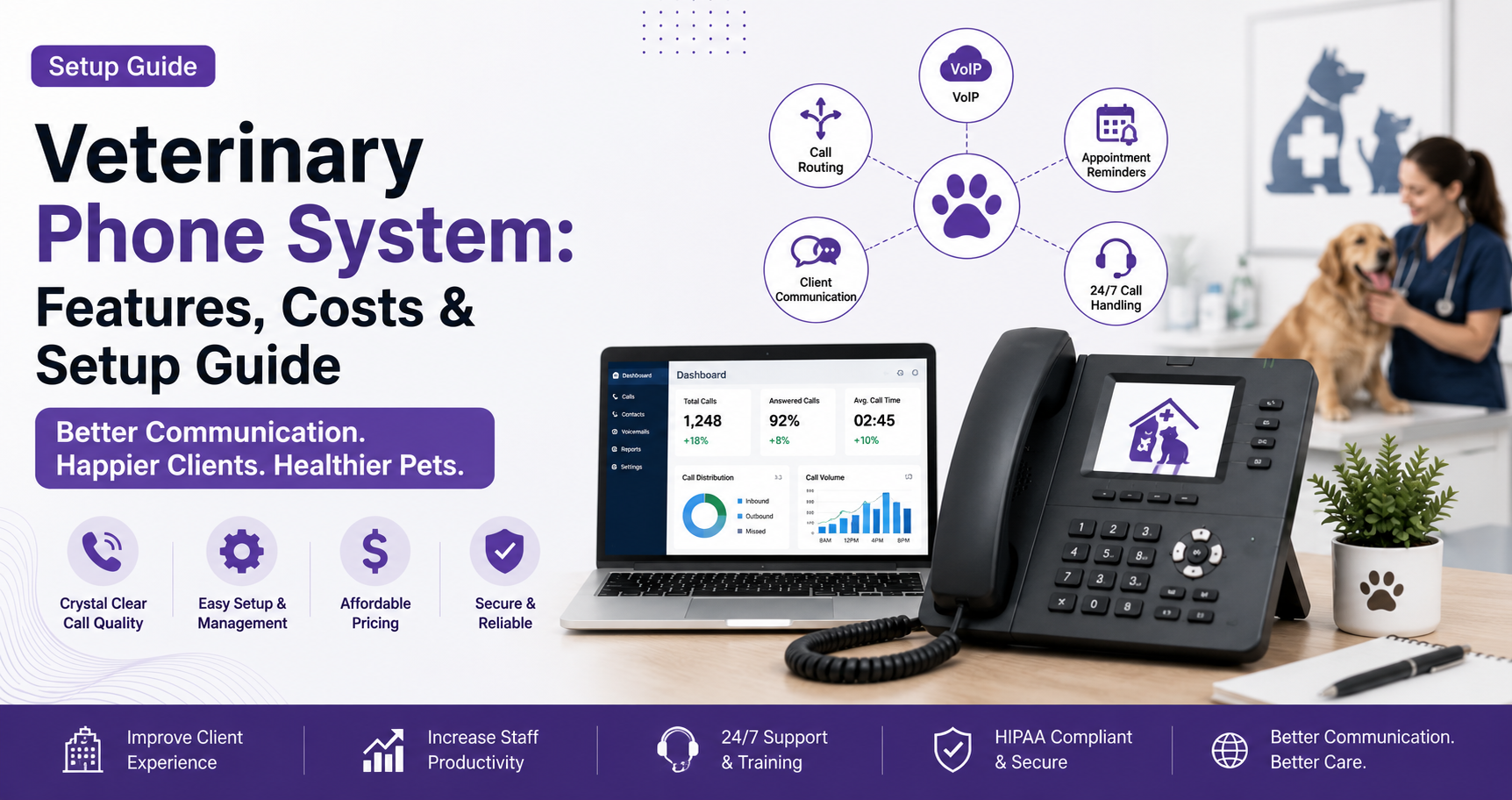
Veterinary Phone System: Features, Costs & Setup Guide
Learn which phone features, routing rules, costs, and setup steps help veterinary clinics manage appointments, emergencies, and after-hours calls.
Quick Answer
The best veterinary phone system is a cloud VoIP platform with call queues, emergency and after-hours routing, business texting, mobile access, reporting, and optional PIMS integration. It should match the clinic’s real call flow and make it easy for callers to reach the right team.
Dial Raven Team
VoIP Communication Expert
Veterinary clinics handle appointment requests, prescription refills, billing questions, lab-result calls, urgent cases, and after-hours inquiries every day. When all of those calls enter the same basic phone line, reception teams become overloaded and callers may wait too long or hang up. A modern veterinary phone system combines cloud calling, queues, smart routing, business texting, mobile access, and reporting. When configured around real clinic workflows, it helps staff manage calls more efficiently while making it easier for pet owners to reach the right person. This guide explains the features, costs, routing rules, and setup decisions veterinary clinics and animal hospitals should evaluate before choosing a system.
What Is a Veterinary Phone System?
A veterinary phone system is a business communications platform designed or configured for the call patterns of an animal clinic or hospital. It can route appointments, prescription requests, billing questions, emergency inquiries, and after-hours calls to the correct staff member or department. Most modern systems use Voice over Internet Protocol. A cloud-based VoIP phone system can work across desk phones, computers, mobile applications, and several clinic locations while being managed from one online dashboard. The most important factor is not whether the platform is labeled “veterinary.” It is whether the provider can configure it around the clinic’s staff, departments, operating hours, emergency procedures, and existing software.
Why Veterinary Clinics Need Smarter Call Handling
Veterinary calls do not all have the same urgency. A caller confirming a routine appointment should not follow the same path as someone reporting a possible emergency. A properly configured veterinary clinic phone system can help solve problems such as:
- Receptionists managing phone calls while helping clients in person
- New-client callers hanging up after long hold times
- Routine refill requests interrupting appointment scheduling
- Urgent calls failing to reach trained staff quickly
- After-hours callers receiving an unhelpful generic voicemail
- Multiple locations using disconnected numbers and workflows
- Managers lacking data on missed calls and waiting times
The goal is not to automate every conversation. The system should handle routine routing while making it easy to reach a person when judgment, empathy, or clinical knowledge is required.
Essential Veterinary Phone System Features
Call Queues and Smart Routing
Call queues keep callers connected when receptionists are busy instead of sending every unanswered call directly to voicemail. Routing rules can send calls to reception, pharmacy requests, billing, another location, or an overflow team. An effective veterinary call routing system should separate common caller needs rather than forcing everyone into one queue.
Emergency and After-Hours Routing
An animal hospital phone system should have separate routing rules for normal hours, lunch coverage, evenings, weekends, holidays, and unexpected closures. Urgent calls should reach trained staff, an on-call contact, or a clinic-approved emergency facility. Automated tools may route the call, but they should not diagnose an animal or replace clinical triage. Clinics should also review E911 compliance for business phone systems so emergency-location information is properly configured for each physical site.
Auto Attendant or AI Virtual Receptionist
An auto attendant uses fixed menu choices, while an AI virtual receptionist can understand spoken requests, answer approved administrative questions, collect caller details, and route calls by intent. AI can be useful for appointment requests, hours, directions, overflow calls, and after-hours message capture. Emergencies, complaints, emotional callers, and clinical questions should be escalated to trained staff.
Business SMS and Missed-Call Text Back
A clinic can use business SMS for appointment confirmations, callback coordination, and approved non-clinical updates. A missed-call text-back workflow can automatically acknowledge an unanswered call and invite the pet owner to reply. Clinics should follow applicable consent, privacy, carrier-registration, and record-retention requirements.
Mobile Access and Call Reporting
Cloud phone systems let authorized staff answer business calls from desk phones, computers, or mobile applications. This is useful for on-call staff, remote administrators, and multi-location veterinary groups. Managers should be able to review missed calls, peak call periods, average answer time, queue performance, after-hours volume, and calls by department or location.
Veterinary Call Routing Blueprint
A strong call flow begins with caller intent. Each common request should have a main destination, an overflow rule, and an after-hours action.
| Caller request | Main destination & Overflow or after-hours action | |
|---|---|---|
| New appointment | Scheduling or reception queue | Callback request or approved booking workflow |
| Existing appointment | Reception team | Voicemail-to-email or shared callback queue |
| Possible emergency | Trained clinical staff | On-call contact or approved emergency facility |
| Prescription refill | Refill workflow or pharmacy queue | Structured message for next-business-day review |
| Lab-result question | Assigned clinical team | Priority callback request |
| Billing question | Billing team | Dedicated voicemail or callback queue |
| Records request | Administration | Secure request instructions |
| Boarding or grooming | Relevant service team | Reception overflow |
| General information | Auto attendant or receptionist | Approved hours and location message |
Keep the main menu short. Too many options increase caller effort and can make urgent routing less obvious. Always give callers a clear way to reach a person.
How Much Does a Veterinary Phone System Cost?
Veterinary phone system cost depends on more than the monthly license. Clinics should evaluate the complete cost of service, hardware, messaging, AI tools, recording, integrations, and implementation. Common cost factors include:
- Number of users and locations
- Desk phones or other hardware
- Number porting
- SMS and MMS usage
- AI receptionist usage
- Call recording and storage
- PIMS or CRM integrations
- Setup, training, and support
- Contract length
- Additional queues or departments
Dial Raven publishes business phone plans starting at $14.99 per user per month, although final pricing depends on the required configuration. Review Dial Raven pricing and plan information and request a complete quote based on users, locations, messaging, queues, and AI requirements. The cheapest advertised license is not always the lowest-cost solution. Some providers charge separately for queues, mobile applications, recordings, integrations, or support.
How to Choose the Best Veterinary Phone System
Before comparing providers, document how the clinic currently handles calls. Ask:
- How many users, departments, and locations need service?
- How many calls arrive during peak hours?
- Which calls are appointments, refills, billing, records, or emergencies?
- Who answers when reception is busy?
- What happens after hours or during closures?
- Is PIMS integration required?
- Do staff need desk, desktop, and mobile access?
- Are business SMS and missed-call text back included?
- Can managers change routing themselves?
- What happens if the internet connection fails?
- Is setup, training, number porting, and support included?
Ask providers to demonstrate the clinic’s actual call flow rather than showing only a generic product dashboard.
How to Set Up a Veterinary VoIP Phone System
A veterinary VoIP phone system should be designed and tested before the clinic’s main number is transferred.
- List every phone number, extension, device, voicemail box, and clinic location.
- Identify missed calls, long holds, repeated transfers, and peak calling periods.
- Map separate routes for appointments, emergencies, refills, billing, and after-hours calls.
- Decide who receives urgent and overflow calls.
- Configure users, queues, greetings, mobile access, and permissions.
- Prepare number porting without canceling the old service too early.
- Test every call path from an external number.
- Train staff and monitor performance after launch.
For a broader implementation process, use Dial Raven’s business phone system setup guide.
How Dial Raven Supports Veterinary Clinics
Dial Raven combines cloud VoIP, smart routing, call queues, mobile access, business SMS, AI call handling, and AI voice transcription in one business communications platform. Veterinary practices can use these tools to build department routing, after-hours rules, overflow coverage, missed-call follow-up, and centralized communication across several locations. Exact PIMS compatibility should be confirmed during the consultation. The Dial Raven team can review the clinic’s current software, numbers, staff, locations, and call flow before recommending a configuration.
Frequently Asked Questions
What is a veterinary phone system?
A veterinary phone system is a business calling platform configured for animal-clinic workflows. It can manage appointments, prescription requests, emergencies, billing calls, after-hours routing, texting, and communication across several locations.
What is the best phone system for a veterinary clinic?
The best system is a reliable cloud VoIP platform that supports call queues, emergency routing, business SMS, mobile access, reporting, number porting, and any required PIMS integration.
How much does a veterinary phone system cost?
Cost depends on users, locations, hardware, messaging, recording, AI usage, integrations, and support. Dial Raven publishes plans starting at $14.99 per user per month, but clinics should request a complete configuration-based quote.
Can a veterinary phone system integrate with PIMS software?
Some systems offer native PIMS integrations, while others connect through APIs, middleware, or custom workflows. Confirm compatibility with the clinic’s exact software before choosing a provider.
Can an AI receptionist answer veterinary calls?
An AI receptionist can answer routine administrative questions, collect appointment requests, and route calls. Emergencies, clinical questions, complaints, and distressed callers should be escalated to trained staff.
Build a Better Veterinary Call Flow
Your clinic should not have to adapt its workflow to a generic phone tree. Dial Raven can review your numbers, departments, peak calling periods, missed calls, after-hours coverage, and emergency-routing requirements. Get a free veterinary call-flow and missed-call assessment. Dial Raven will identify routing gaps and recommend a phone-system configuration based on how your clinic actually handles calls.
Related pages
Ready to modernize your phone system?
Talk to a Dial Raven specialist and get a plan built around how your team works.