
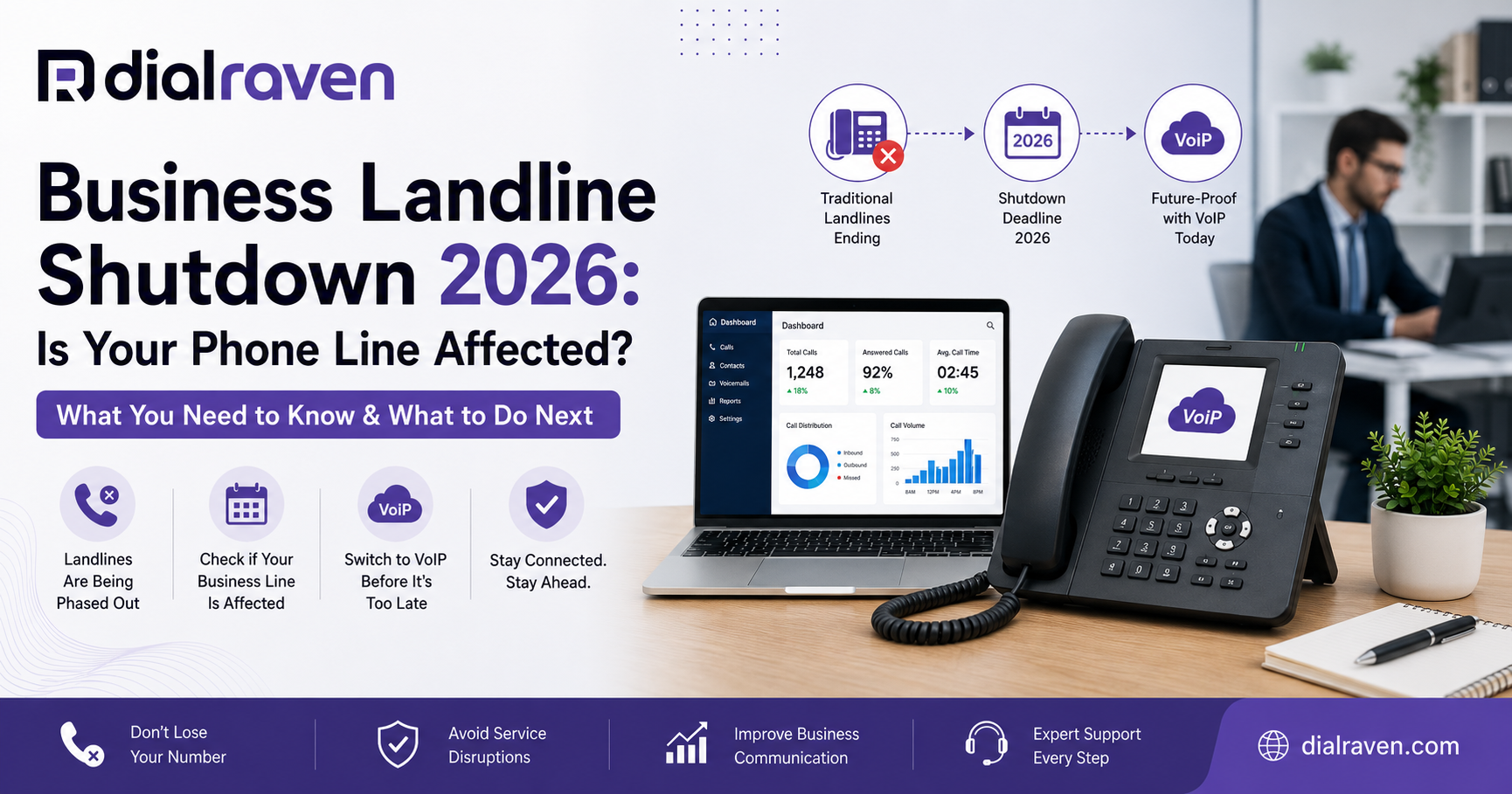
Business Landline Shutdown 2026: Is Your Phone Line Affected?
Carriers are retiring copper. Check in 10 minutes whether your lines are affected — and see which move to VoIP and which don't.
Quick Answer
Yes — US carriers are retiring copper landlines market by market, not on one national date, with notice periods as short as 90 days. Most business voice lines can port to VoIP and keep their number, but alarm, elevator and fire panel lines need a dedicated code-compliant replacement.
Dial Raven Team
VoIP Communication Expert
Yes — the business landline shutdown is real and already underway. US carriers are retiring copper phone lines market by market rather than on one national date, with customer notice periods now as short as 90 days. Most business voice lines can move to VoIP and keep their number. Alarm, elevator and fire panel lines need a different solution.
If your carrier has sent you a discontinuance notice, or your landline bill has climbed for no obvious reason, you are not imagining it. The business landline shutdown has moved from something the telecom industry talked about to something arriving in the post.
Here is what makes it different from a normal service change: you do not control the timing. Your carrier files with the FCC, you receive a letter, and a clock starts. So let's skip the background and start where you actually need to start — finding out whether this affects you.
How to Check If Your Business Lines Are Affected — in 10 Minutes
You do not need to wait for a letter. Work through these five steps.
- Read your bill line by line — look for analog, POTS, business line, measured business line, or TDM. Anything bundled as voice service over fiber or internet is already IP and is not affected
- Check for a rate increase — a sharp, unexplained climb in per-line cost is the earliest reliable signal, because carriers price remaining copper customers toward the exit before they file to discontinue
- Try to add or move a line — if your carrier declines, your service is grandfathered. Clearest test available, and it takes one phone call
- Ask your carrier directly — use this wording: 'Is my service at this address grandfathered? Has a Section 214 discontinuance been filed for my wire center? What is the projected retirement date?' Ask for confirmation in writing
- Walk the building — every jack, not just the phones. Fax machine, alarm panel, elevator phone, gate intercom, credit card terminal, back-office modem. Write down what each one connects to
Step five is the one businesses skip, and it causes the emergencies. The main line is never the problem — someone always notices when the phones stop. It's the alarm panel nobody has thought about since installation that fails a compliance inspection.
Business Landline Replacement Options: Which Lines Move to VoIP, and Which Don't
Your business landline replacement options depend entirely on what is plugged into each line — not on how many lines you have.
| What's on the line | Replacement path | Notes |
|---|---|---|
| Main business number | Port to VoIP | Keep the number; typically live in under 24 hours |
| Direct extensions / DIDs | Port to VoIP | Unlimited extensions on cloud systems |
| Toll-free number | Port to VoIP | Ports the same way as local |
| Existing on-prem PBX | SIP trunking | Keeps your PBX; replaces the copper feeding it |
| Fax machine | Cloud / virtual fax | Analog fax over VoIP is unreliable — move to email-based fax |
| Credit card terminal | IP or cellular terminal | Confirm with your payment processor first |
| Back-office modem | IP replacement | Check the vendor's IP path |
| Burglar alarm panel | Cellular or IP communicator | Alarm company's job, not your phone provider's |
| Fire alarm panel | Code-compliant communicator | NFPA 72 applies — licensed contractor only |
| Elevator emergency phone | Code-compliant replacement | Life-safety line — specialist installer, never DIY |
Two rows in that table have their own product path. If you want to keep an existing on-premise PBX and only replace the copper feeding it, SIP trunking does exactly that. And if you still run a fax line, the dependable route is cloud fax rather than trying to keep the machine alive on a digital connection.
The Lines That Move Cleanly
Voice lines are the easy part, and they're usually most of the bill. Your main number, extensions and toll-free numbers port to a cloud phone system, and the migration is administrative rather than physical. Number porting is a federally protected right — your existing carrier cannot refuse it while your account is active.
You also gain capability rather than merely preserving it: auto-attendant, call routing, voicemail-to-email, mobile and browser access, plus AI transcription and business texting on the same number. And the economics have stopped being close — copper pricing now moves in one direction, while cloud plans are priced per user with no line-by-line escalation and no hardware to maintain.
The Lines That Need Someone Else
We'll be direct, because it matters more than a sale: Dial Raven should not be your answer for fire alarm panels, elevator emergency phones or burglar alarm communicators.
Those are life-safety circuits governed by fire and building codes. They require certified equipment, a licensed installer, and documentation that survives an inspection. They are not a VoIP problem, and any provider who tells you otherwise is selling past their competence. Bring in your fire alarm contractor, elevator servicer and alarm company early — their calendars fill during a notice wave too.
Are Business Landlines Being Discontinued?
Yes. Every major US carrier is retiring copper infrastructure, and the pace increased sharply in 2026.
Two things happen before your line is switched off. First grandfathering: the carrier stops selling the service and refuses to add, move or modify existing lines. Existing lines still work, but they're frozen. Then discontinuance: the carrier files formally with the FCC to end the service, and a notice period begins.
AT&T stopped accepting new copper POTS orders across much of its footprint in October 2025. Lumen, Frontier and Verizon have issued comparable grandfathering notices. In March 2026 the FCC adopted rules removing several procedural hurdles carriers previously faced, which shortened the runway further.
- POTS — Plain Old Telephone Service, the analog line delivered over copper
- Wire center — the local exchange facility serving your address; retirement is scheduled per wire center, which is why timing varies street by street
- Section 214 discontinuance — the formal FCC filing a carrier makes to end a service
- TDM — the legacy switching technology underneath POTS, often used in filings instead of the word landline
There is no single nationwide switch-off date. Your neighbour two towns over may have three years. You may have three months.
Copper Line Retirement Timeline: The Dates That Matter
The copper line retirement timeline is a sequence of milestones, not one deadline. This is the current picture as of July 2026, drawn from carrier FCC filings and public statements.
| When | What happens | Who it affects |
|---|---|---|
| October 2025 | AT&T stopped accepting new copper POTS orders, moves and changes across much of its footprint | Anyone needing to add or relocate a line |
| Late 2025 | AT&T approved to discontinue service at wire centers serving roughly 90,000 customers across 18 states | Businesses in approved wire centers |
| March 2026 | FCC removed several procedural barriers to copper retirement | All copper customers nationwide |
| June 2026 | AT&T began decommissioning roughly 500 wire centers — about 10% of its footprint | Businesses in those wire centers |
| November 2026 | AT&T has filed to discontinue legacy TDM voice on or after this date | Customers in the filed areas |
| 2026–2030 | Lumen, Frontier and Verizon phase-outs proceed state by state | Everyone else |
| By 2029 | AT&T's stated target for retiring the bulk of its copper network | Remaining copper customers |
How Much Notice Will You Actually Get?
Less than you'd expect. Following the FCC's 2026 rule changes, notice windows have compressed to as little as 90 days.
Ninety days sounds workable until you consider what fits inside it: locating account numbers, gathering porting documents, choosing a provider, configuring call flows, provisioning hardware, testing. And you'll be doing it alongside every other business served by the same wire center. Porting queues congest exactly when notice waves land — that's consistently what we see on our own porting desk during a wave.
AT&T Discontinuing Landline Service for Business: What Your Notice Means
Because AT&T operates the largest copper network, most notices arriving at US businesses right now carry its name. If you have one in hand, read it for four things.
- The service being discontinued — filings say legacy TDM voice or analog business line, not landline. Match it against your bill
- The effective date — this is when the obligation to serve you ends, not when someone visits your premises
- The wire center or address list — confirm your specific location is included, because multi-site businesses often find only some locations are in the first wave
- The replacement offered — the carrier proposes its own product. That's a valid option, and not the only one, since you can port your numbers anywhere
What the notice won't do is triage your lines. It tells you the service is ending. It doesn't tell you your fire panel needs a code-compliant communicator while your main line needs nothing more than a port request.
What Happens If My Business Landline Is Disconnected?
The line stops carrying calls. No grace period, no automatic transfer.
- Inbound calls fail — the number on your website, Google Business Profile, vehicles and invoices reaches a dead line
- Your number becomes hard to recover — porting requires an active account, so once service terminates, transferring that number gets considerably harder and sometimes impossible. This is the most expensive mistake in the process
- Connected equipment goes dark — fax machines, alarm communicators, elevator phones and analog card terminals stop transmitting
- Compliance exposure opens — fire alarm and elevator lines are code-mandated, and a dead line is a failed inspection
- You migrate under pressure anyway — just with no time to compare providers, negotiate, or test
One rule separates the recoverable scenario from the unrecoverable one: never let your old service terminate before your numbers have ported.
Migrating Before the Clock Runs Out
The sequence is straightforward: inventory your lines, triage them against the table above, choose a provider, port your numbers and test for 24–48 hours — then cancel copper last, only once every port is confirmed. Cancelling early is how businesses lose numbers they've used for twenty years.
One obligation you inherit the moment you go IP: Kari's Law requires direct 911 dialling without an access code, and RAY BAUM'S Act requires a dispatchable location — building, floor, suite — to travel with the call. A properly configured system handles this by assigning a registered location per extension. Ask your provider to walk you through it before go-live rather than assuming it's covered.
Frequently Asked Questions
Are business landlines being discontinued?
Yes. AT&T, Verizon, Lumen and Frontier have all issued grandfathering notices, and AT&T has publicly targeted retiring the bulk of its copper network by 2029. It's happening market by market rather than on one national date.
How do I know if my business phone line is affected?
Check your bill for analog or POTS line items, watch for unexplained rate increases, and try to add or move a line — if the carrier refuses, your service is grandfathered. Then ask whether a Section 214 discontinuance has been filed for your wire center.
How much notice will my carrier give me?
Following the FCC's 2026 rule changes, as little as 90 days. That's enough time to migrate calmly only if your line inventory is already done.
What happens if my business landline is disconnected before I migrate?
The line stops carrying calls immediately, and recovering your number becomes far harder because porting requires an active account. Connected equipment such as fax machines and alarm communicators also stops working. Always port before cancelling.
Can I keep my business phone number?
Yes. Number porting is a federally protected right, and your carrier cannot refuse it while your account is active. Local, toll-free and vanity numbers all port.
Will my fax machine still work after the copper shutdown?
Not on an analog line, and analog fax over VoIP is unreliable. The dependable path is cloud fax, which sends and receives from email or a browser using the same fax number.
What happens to my elevator phone and fire alarm lines?
They need code-compliant replacements installed by licensed contractors, because NFPA 72 and local building codes apply. These are not a VoIP migration and should be handled through your fire alarm and elevator vendors.
Not Sure Which of Your Lines Are Affected? We'll Tell You — Free.
Send us your current phone bill and we'll map every line: which ones port to VoIP, which need a code-compliant replacement from a different vendor, and roughly how long your wire center has left. No cost, no obligation — and we'll tell you plainly where we're not the right answer.
Over 200 US businesses have already moved off legacy lines with Dial Raven. We port your numbers free, configure your call flows, provision hardware, and stay on the line through go-live. Most clients are live in under 24 hours, with a real person answering.
The business landline shutdown reaches you on your carrier's schedule. Getting ahead of it puts you back on your own. Get a free copper line audit and we'll review your lines this week.
Related pages
Ready to modernize your phone system?
Talk to a Dial Raven specialist and get a plan built around how your team works.