
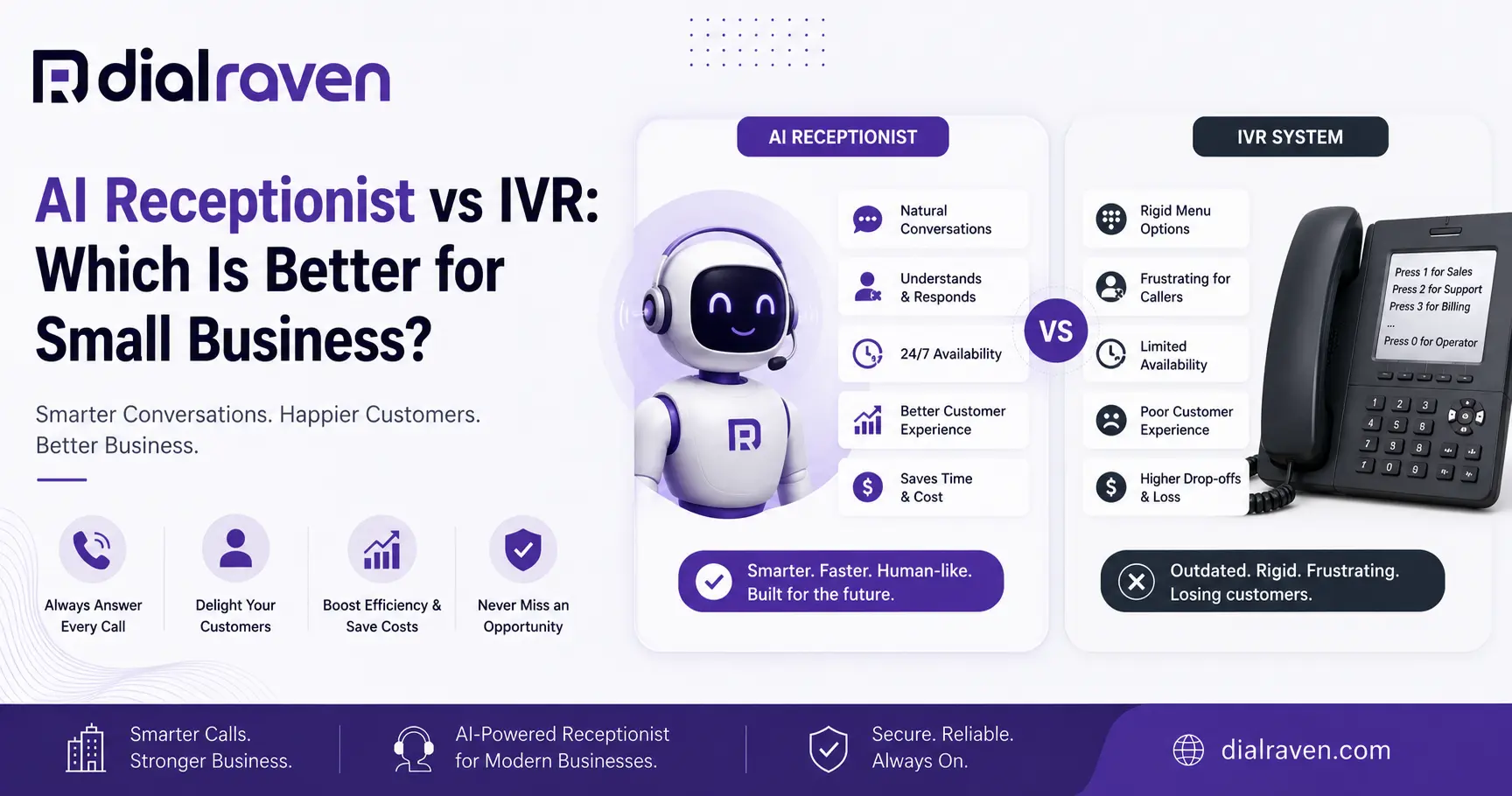
AI Receptionist vs IVR: Which Is Better for Small Business?
Compare AI receptionists and IVR on cost, caller experience, automation, routing, and use cases to choose the right setup for your small business.
Quick Answer
IVR uses predefined menus and routing rules, while an AI receptionist understands natural-language requests and can answer questions or complete workflows. IVR works well for predictable routing; AI is stronger for conversational calls. Many businesses benefit from using both.
Dial Raven Team
VoIP Communication Expert
When customers call your business, they usually want one of two things: to reach the right person or to get something done. Traditional Interactive Voice Response systems have handled the first job for decades by asking callers to press a number, choose a department, or follow a predefined phone tree. AI receptionists take a different approach by allowing callers to explain what they need in natural language. That makes the AI receptionist vs IVR decision less about old technology versus new technology and more about choosing the right call experience for your customers, staff, and workflows.
AI Receptionist vs IVR: Quick Answer
An IVR system uses predefined menus and rules to route callers or guide them through structured self-service. An AI receptionist uses conversational AI to understand what callers are asking and respond according to configured business information and workflows. Choose IVR when most calls follow predictable paths. Choose an AI receptionist when callers need to ask questions, explain their needs, provide information, or complete conversational tasks. For many small businesses, the best setup combines AI with traditional routing, queues, extensions, and human escalation.
AI Receptionist vs IVR at a Glance
| Feature | IVR | AI Receptionist |
|---|---|---|
| Caller interaction | Keypad or predefined voice choices | Natural-language conversation |
| Main purpose | Routing and structured self-service | Understanding, answering, routing, and automation |
| Call flow | Predetermined | Flexible within configured rules |
| Open-ended questions | Limited | Better suited |
| Department routing | Excellent | Can route based on caller intent |
| Lead capture | Basic or structured | Can collect conversational details |
| FAQ handling | Limited | Can answer approved business questions |
| Human transfer | Yes | Yes |
| After-hours use | Yes | Yes |
| Predictability | Very high | Depends on setup and guardrails |
| Best fit | Simple, repeatable call paths | Varied or conversational calls |
The practical difference is simple: IVR usually asks callers to follow the system's structure, while an AI receptionist tries to understand the caller's intent first.
What Is IVR?
Interactive Voice Response, or IVR, is automated phone technology that interacts with callers through recorded prompts and accepts input through keypad tones, speech, or both. A typical system might ask callers to press 1 for sales, press 2 for support, enter an account number, select a location, or join a call queue. IVR works especially well when a business already knows the small number of actions most callers need. It is also important not to treat IVR and an auto attendant as exactly the same thing. Dial Raven's IVR vs. auto attendant guide explains the distinction and where each technology fits.
When IVR Works Well
- Call paths are predictable and easy to define
- Departments or destinations are clearly separated
- Callers mainly need simple routing
- Exact and repeatable workflows are important
- The business wants tightly controlled prompts
- Existing phone-system features already solve the required self-service need
A short, well-designed IVR can provide an excellent caller experience. If a caller only needs to choose between sales, service, and billing, adding a conversational layer may create complexity without delivering much additional value.
What Is an AI Receptionist?
An AI receptionist is a conversational voice system that can answer business calls, interpret caller intent, provide approved information, collect details, and route or escalate calls according to configured rules. Dial Raven's AI receptionist for small business guide covers the broader technology, use cases, features, and cost considerations in more depth.
Instead of hearing 'Press 1 for appointments,' a caller may simply say, 'I need to reschedule my appointment.' The system can identify the intent and follow the appropriate workflow. Depending on the platform and integrations, an AI receptionist may answer routine questions, capture leads, collect appointment requests, take messages, perform basic qualification, route by intent, and provide after-hours coverage.
AI still needs clear boundaries. Businesses should define what the system may answer, which actions it can perform, what information it can access, and when a caller must be transferred to a person. Organizations evaluating AI governance can also use the NIST AI Risk Management Framework as a reference for thinking about testing, monitoring, reliability, and responsible AI deployment.
AI Receptionist vs Traditional IVR: 5 Key Differences
1. Caller Experience
Traditional IVR expects callers to choose from predefined options. AI allows people to explain what they need in their own words. That can reduce friction when customers do not know which department handles their problem. However, a simple IVR may still be faster when the available options are obvious.
2. Call Routing
IVR routes callers according to branches configured in advance. An AI receptionist can identify what a person is trying to accomplish first and then route the call based on that intent. Instead of deciding whether a billing problem belongs under accounts or customer service, the caller can simply explain the issue.
3. Questions and Information
Traditional IVR works best with structured choices and predetermined responses. AI receptionists are better suited to questions such as 'What time do you close?', 'Do you serve my area?', or 'Can someone call me about pricing?' The quality of the answer still depends on the accuracy and freshness of the information available to the AI.
4. Lead Capture and Workflows
A traditional phone tree may route a sales caller to an employee or voicemail. An AI receptionist can potentially collect useful context first, including the caller's name, contact information, requested service, location, preferred appointment time, and reason for calling. For lead-driven businesses, that context can make follow-up more useful than receiving an unstructured voicemail.
5. Unexpected Requests
IVR works within clearly defined paths. AI can interpret a wider variety of caller language, but every system still needs a fallback. Good automation should never trap a customer when it cannot confidently handle a request. The next step should be clear: transfer the call, enter a queue, capture a message, request a callback, or reach another appropriate destination.
AI Receptionist vs Phone Tree
A phone tree is the branching call path a caller follows through a business phone system. In a traditional setup, callers navigate that path themselves by pressing numbers or selecting spoken options. With an AI receptionist, the caller might instead hear, 'How can I help you?' The AI identifies the intent and sends the caller into the appropriate workflow. So the practical AI receptionist vs phone tree difference is not that routing rules disappear. The difference is how the system determines which route the caller needs.
AI Receptionist vs IVR Cost
There is no universal AI receptionist vs IVR cost because pricing varies by provider, call volume, included features, integrations, and implementation requirements. Traditional IVR functionality may already be included with a cloud business phone system, while more complex deployments can add custom menus, integrations, reporting, or professional setup.
- Monthly platform or subscription fees
- AI usage or call-minute charges
- Workflow configuration
- CRM, calendar, or other integrations
- Implementation and setup
- Additional phone numbers
- Reporting, storage, or premium support
Compare the cost of the complete workflow rather than the advertised software price alone. An IVR may route every appointment call to an employee, while an AI receptionist may cost more in software but reduce how many repetitive calls staff need to handle. Businesses researching this side of the decision can also review Dial Raven's virtual receptionist cost guide.
When Is IVR Better Than an AI Receptionist?
IVR is usually the better choice when callers mainly need predictable routing. It can work especially well when most callers choose from a few clear departments, complex conversation is unnecessary, exact routing rules matter, and existing phone-system features already solve the problem.
- Most calls have a small number of predictable destinations
- The business needs deterministic routing
- Self-service follows a structured process
- The workflow rarely changes
- Implementation simplicity is important
- Conversational automation would add little value
A small office with three departments may only need callers to reach sales, billing, or support. In that situation, a well-designed auto attendant or IVR can be simple, fast, and effective.
When Is an AI Receptionist Better Than IVR?
AI becomes more valuable when calls require understanding rather than simple routing. It is especially useful when callers frequently ask questions, missed calls may represent valuable leads, employees repeatedly answer the same questions, or after-hours callers need more than voicemail.
- Callers frequently ask routine questions
- Missed calls can mean lost sales opportunities
- Appointment or consultation requests are common
- Leads need basic qualification before follow-up
- Customers describe the same need in many different ways
- Context before transferring the call is valuable
- The business wants meaningful after-hours coverage
A home-service caller might say, 'My air conditioner stopped working and I need someone today.' That statement contains both the service need and the urgency. A conversational virtual receptionist can potentially recognize that context before routing the call or starting the next approved workflow.
Should You Use AI Receptionist and IVR Together?
For many small businesses, a hybrid setup is more practical than completely replacing one technology with the other. AI can handle the conversational part of the call while the underlying business phone system continues to manage structured routing, queues, extensions, schedules, overflow rules, and human escalation.
- Incoming call reaches the AI receptionist
- AI identifies what the caller needs
- Routine questions are answered from approved information
- Lead or appointment details are collected when appropriate
- Known department requests are routed
- Complex or sensitive calls are transferred to a person
- Unavailable staff trigger overflow, voicemail, or callback workflows
This approach lets a business modernize caller interactions without removing useful phone-system controls that already work well.
Can an AI Receptionist Replace IVR?
Yes, an AI receptionist can replace some IVR workflows, but replacing every IVR function is not always necessary. The better question is which parts of the current IVR create unnecessary caller effort. If callers repeatedly struggle to select the correct option, conversational AI may simplify the experience. If a branch already provides reliable department routing or tightly controlled self-service, keeping that structure may make more sense.
Businesses should improve the overall call flow rather than replacing technology simply because something newer exists. The best architecture may use AI for understanding intent while keeping traditional routing behind the scenes.
How to Choose Between IVR and an AI Receptionist
- Review why customers actually call instead of designing around assumptions
- Determine whether callers mainly need routing or task resolution
- Check what currently happens to valuable calls after business hours
- Identify which calls require human judgment or immediate escalation
- List the CRM, calendar, scheduling, or business systems the workflow must connect with
- Define a clear fallback for any request automation cannot handle confidently
If the answer is mostly predictable routing, IVR may be enough. If the caller needs conversation, context, information capture, or workflow automation, AI deserves a larger role. If both needs are common, a hybrid design is usually the most practical starting point.
Final Verdict: AI Receptionist or IVR?
Neither technology is automatically better for every small business. Choose IVR for predictable routing and structured workflows. Choose an AI receptionist when callers need natural conversation, answers, information capture, or more flexible automation. Use both when conversational handling and traditional phone-system controls solve different parts of the customer journey.
The best phone system is not the one with the most automation. It is the one that helps callers reach the right outcome with the least unnecessary effort.
Frequently Asked Questions
Is an AI receptionist the same as IVR?
No. IVR typically uses predefined menus and structured workflows, while an AI receptionist uses conversational technology to understand natural-language requests and respond according to configured business rules.
Can an AI receptionist replace IVR?
An AI receptionist can replace some IVR workflows, especially when callers need to ask questions or explain what they need. Structured routing may still be better handled by IVR in some businesses.
Is an AI receptionist better than a phone tree?
It can be better for varied or conversational requests. A short phone tree may still be faster when callers only need to choose from a few predictable destinations.
Is IVR artificial intelligence?
Traditional IVR is generally rules-based automation rather than AI. Some modern IVR platforms include speech recognition or conversational AI features.
Which costs more, an AI receptionist or IVR?
It depends on the provider, usage, integrations, and workflow complexity. IVR is often included with business phone systems, while AI receptionist pricing may include subscriptions, usage, implementation, and integration costs.
Can an AI receptionist and IVR work together?
Yes. AI can understand caller intent while IVR, queues, extensions, and routing rules continue to manage structured call paths and human escalation.
Not sure whether your business needs IVR, conversational AI, or a combination of both? Dial Raven can review how your calls are handled today and help design a practical setup for routing, automation, after-hours coverage, and human escalation. Get a free call-flow assessment and we'll help you identify the right approach for your business.
Related pages
Ready to modernize your phone system?
Talk to a Dial Raven specialist and get a plan built around how your team works.