
AI Receptionist vs Answering Service: 2026 Cost Guide
Compare AI receptionists and traditional answering services by cost, lead capture, customer experience, and hybrid use cases.
Quick Answer
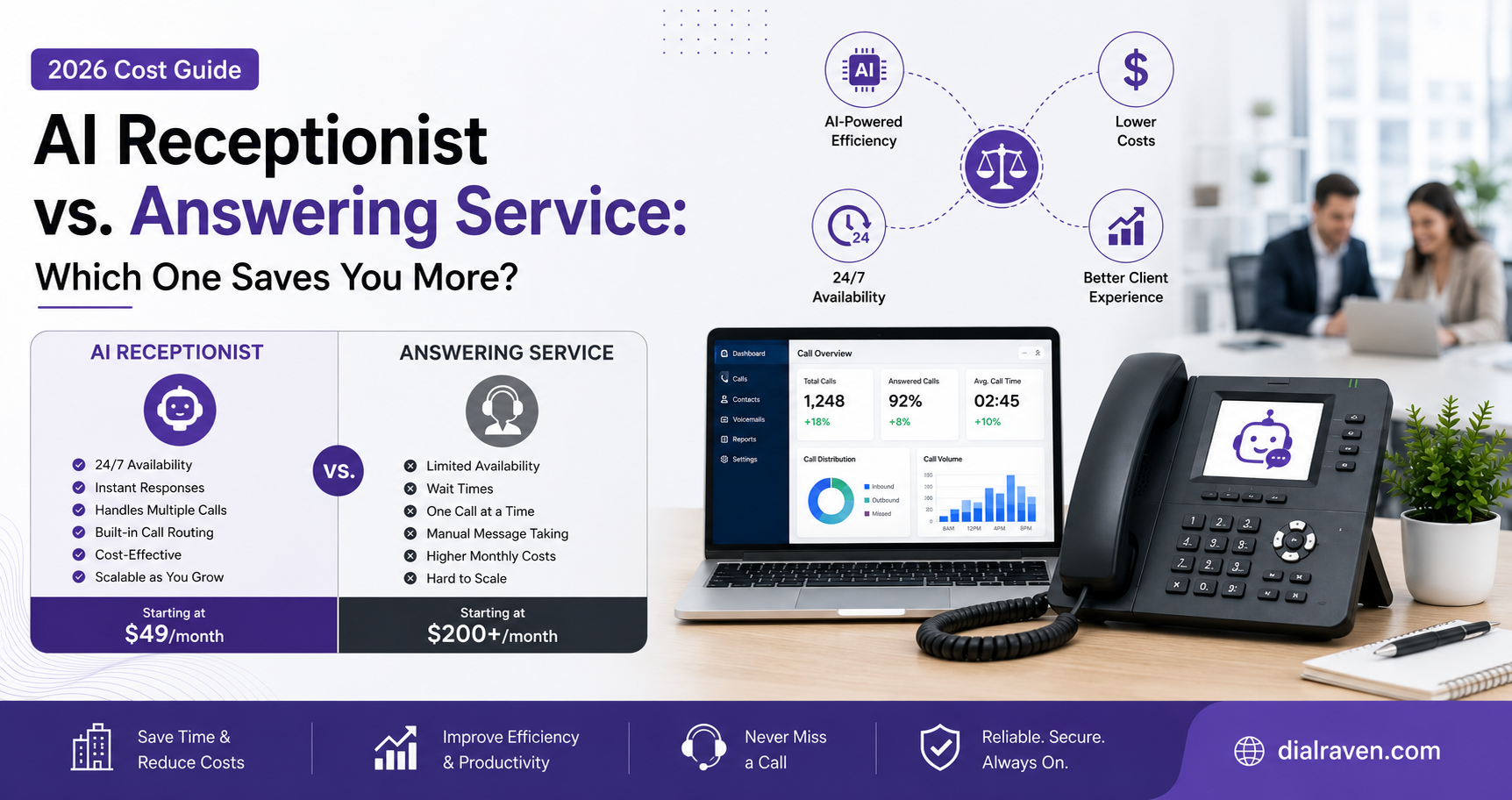
An AI receptionist uses software to answer, route, qualify, and book callers, while a traditional answering service uses human agents. AI is usually stronger for scale, consistency, and routine calls; people remain stronger for sensitive or complex conversations, so many small businesses use a hybrid model.
Dial Raven Team
VoIP Communication Expert
A missed call can mean a lost estimate, appointment, reservation, or new customer. Small businesses that cannot answer every call usually consider two solutions: an AI receptionist or a traditional answering service. Both provide call coverage, but they differ in cost, scalability, customer experience, and the tasks they can complete. This AI receptionist vs answering service comparison explains how each model works, where each performs best, and when a hybrid approach may deliver better results. For a broader introduction to the technology, read Dial Raven's AI virtual receptionist for small business guide.
What Is the Difference Between an AI Receptionist and an Answering Service?
An AI receptionist is conversational software that answers calls, identifies caller intent, provides approved information, collects details, routes calls, and can complete tasks such as scheduling appointments. A traditional answering service uses remote human agents who answer on behalf of your business. Depending on the plan, agents may take messages, transfer callers, follow intake scripts, or schedule appointments.
- AI automates repeatable conversations and workflows.
- Human agents provide judgment, flexibility, and empathy.
- A hybrid system uses AI for routine calls and people for exceptions.
The right option depends on call volume, conversation complexity, required integrations, and the value of each incoming lead.
AI Receptionist vs Traditional Answering Service at a Glance
| Factor | AI Receptionist | Traditional Answering Service |
|---|---|---|
| Call handling | Conversational software and automated workflows | Remote human agents following scripts |
| Availability | Can operate continuously | Based on contracted coverage hours |
| Simultaneous calls | Can usually handle several calls at once | Limited by available agents |
| Pricing | Subscription, usage, minutes, or calls | Minutes, calls, service tiers, or custom plans |
| Lead qualification | Structured and repeatable | Flexible but may vary between agents |
| Appointment booking | Available through supported integrations | Available with certain plans |
| Complex conversations | Requires escalation rules | Better suited to judgment-heavy calls |
| Best use | Routine, overflow, and after-hours calls | Sensitive or unpredictable conversations |
How Does an AI Receptionist Work?
- Answers using your business name and approved greeting
- Identifies what the caller needs through natural-language conversation
- Answers, qualifies, books, routes, or escalates the call
- Creates a summary or sends the outcome to your team
The system must be configured with accurate information about your services, business hours, locations, policies, qualification rules, and escalation procedures. AI should not be allowed to invent answers or make commitments outside its approved knowledge. Before launch, test unusual questions, background noise, interruptions, urgent situations, and failed transfers.
How Does a Traditional Answering Service Work?
A traditional answering service receives calls forwarded from your business number. A human agent answers using your company greeting and follows an agreed script. Basic plans often collect the caller's name, number, and reason for calling. More advanced plans may include appointment booking, order intake, bilingual support, dispatching, or emergency escalation.
The main advantage is adaptability. A trained person can recognize uncertainty, ask unscripted questions, and respond with empathy. However, performance may vary depending on agent training, queue volume, staffing levels, and familiarity with your business.
AI Receptionist Cost vs Answering Service Cost
Comparing advertised monthly prices is not enough. Businesses should compare the complete cost of the call-handling workflow. Traditional answering-service charges may include a base plan, usage overages, call transfers, appointment scheduling, after-hours coverage, custom scripts, bilingual support, and setup fees. AI receptionist costs may include the platform subscription, telephony usage, overages, calendar or CRM integrations, setup, and ongoing workflow management.
Use this calculation: total monthly cost = base fee + usage + integrations + overages + follow-up labor. A cheaper service may still cost more if it only creates messages that employees must return later. A more complete system may reduce follow-up work by qualifying the caller, booking the appointment, and sending confirmation during the original interaction.
Is an AI Receptionist Cheaper Than an Answering Service?
An AI receptionist is often more cost-effective for businesses with high or unpredictable call volume, frequent routine questions, after-hours demand, appointment-booking requirements, or several calls arriving at once. A traditional answering service may be more practical when call volume is low and most conversations require human judgment.
- Cost per answered call
- Cost per resolved call
- Cost per qualified lead
- Cost per booked appointment
- Employee time spent following up
The most valuable option is not necessarily the one with the lowest monthly fee. It is the one that successfully moves more callers to the next step at a sustainable cost.
Which Option Captures More Leads?
Lead capture depends on what happens after the call is answered. A basic answering service may take a message and forward it to your team. More advanced providers may qualify callers or schedule appointments, but those services are not included in every plan. An AI receptionist can consistently ask required questions, check service areas, collect contact details, offer appointment times, and send follow-up notifications.
| Metric | What It Shows |
|---|---|
| Answer rate | How many calls receive a response |
| Resolution rate | How many requests are completed |
| Qualification rate | How many callers match your criteria |
| Booking rate | How many appointments are scheduled |
| Escalation rate | How often a person is needed |
| Follow-up time | How quickly the caller receives the next response |
| Cost per lead | How much the completed workflow costs |
Calls that still go unanswered can also be recovered through automated follow-up. Dial Raven's missed-call text-back guide explains how SMS can restart the conversation before the caller contacts a competitor.
AI Receptionist vs Human Answering Service for Customer Experience
Where AI Performs Well
- Immediate call answering
- Consistent approved information
- Simultaneous call handling
- Structured lead collection
- Appointment scheduling
- After-hours coverage
- Automated summaries and follow-up
Where People Perform Well
- Emotional or sensitive conversations
- Unusual requests
- Complex sales discussions
- Vague or incomplete explanations
- Situations requiring judgment
- High-value customer relationships
AI should not be forced to handle situations that require empathy or discretion. Similarly, human agents should not spend expensive time repeatedly answering simple questions that can be automated.
When Is a Hybrid Reception Model Best?
A hybrid model uses AI as the first point of contact and transfers specific calls to a person. The AI can answer immediately, identify the caller's intent, resolve routine questions, collect lead details, and book appointments. Urgent, complex, or sensitive calls are then transferred to a team member. If nobody is available, the system can create a structured summary and send confirmation through business SMS.
- Most calls are routine, but some require empathy
- Call volume changes throughout the day
- Employees cannot answer while serving customers
- After-hours callers need immediate assistance
- Several locations share one phone number
- High-value leads must reach a person quickly
Which Model Fits Your Business?
| Business Type | Recommended Starting Model | Why |
|---|---|---|
| Home services | AI-first with human escalation | Fast qualification and estimate booking |
| Medical or dental office | Hybrid | Routine scheduling plus sensitive calls |
| Law firm | Hybrid or human-first | Structured intake with human judgment |
| Property management | Hybrid | Routine questions and urgent maintenance calls |
| Hospitality | AI-first with staff transfer | Repeatable reservation and location questions |
| Professional services | Hybrid | Automated scheduling with human consultations |
| Low-volume specialist | Human or limited hybrid | Complexity may matter more than volume |
Regulated businesses should also evaluate privacy, call recording, data retention, access controls, and vendor agreements before deployment.
Questions to Ask Before Choosing
- Can the service complete the caller's task or only take a message?
- How are urgent or complex calls escalated?
- What happens when usage exceeds the plan allowance?
- Can it connect with our calendar, CRM, and phone system?
- How are inaccurate answers or poor call outcomes corrected?
- What is the complete monthly cost?
- Can we test realistic call scenarios before launch?
A demonstration should include an easy question, a complicated request, an interruption, and a failed-transfer scenario. This reveals more than a polished scripted demo.
Can You Add AI to Your Existing Phone System?
In many cases, an AI receptionist can connect through call forwarding, a virtual number, SIP, or a cloud phone platform. However, using separate phone, AI, SMS, and reporting tools may create duplicated costs and fragmented records. An integrated platform can keep call routing, reception, summaries, and messaging within one communications environment.
Businesses evaluating this approach can explore Dial Raven's virtual receptionist service and review its VoIP pricing.
Final Verdict
Choose an AI receptionist when calls are mostly repeatable, fast answering matters, and the business needs scalable appointment booking, qualification, or after-hours coverage. Choose a traditional answering service when conversations are infrequent but sensitive, unpredictable, or dependent on human judgment. Choose a hybrid model when routine calls can be automated but customers still need easy access to a person for complex or high-value situations.
The best decision should be based on actual call volume, common caller requests, resolution rates, and cost per qualified lead—not the lowest advertised monthly fee.
Frequently Asked Questions
What is the main difference between an AI receptionist and an answering service?
An AI receptionist uses conversational software to answer questions, qualify callers, schedule appointments, and route calls. An answering service uses human agents who follow instructions and may take messages, transfer calls, or complete additional tasks.
Is an AI receptionist cheaper than an answering service?
It can be cheaper for businesses with high call volumes, repetitive questions, or continuous coverage requirements. Compare base charges, usage limits, overages, integrations, and follow-up labor before deciding.
Can an AI receptionist book appointments?
Yes. When connected to a compatible scheduling system, it can check availability, offer appointment times, collect caller details, and send confirmations.
Can an AI receptionist transfer calls to a person?
Yes. Calls can be transferred based on the caller's request, urgency, department, business hours, or other predefined rules.
Are human answering services better for sensitive calls?
Human agents are generally better when conversations require empathy, nuanced judgment, or responses outside a predefined workflow.
Can a business use both AI and human receptionists?
Yes. A hybrid model allows AI to handle routine, overflow, or after-hours calls while transferring sensitive and complex conversations to a person.
Dial Raven can evaluate your call volume, current phone setup, answering costs, after-hours gaps, and lead-handling workflow. Request your free front-desk cost and missed-call analysis to receive a practical recommendation for AI, human, or hybrid coverage.
Related pages
Ready to modernize your phone system?
Talk to a Dial Raven specialist and get a plan built around how your team works.