
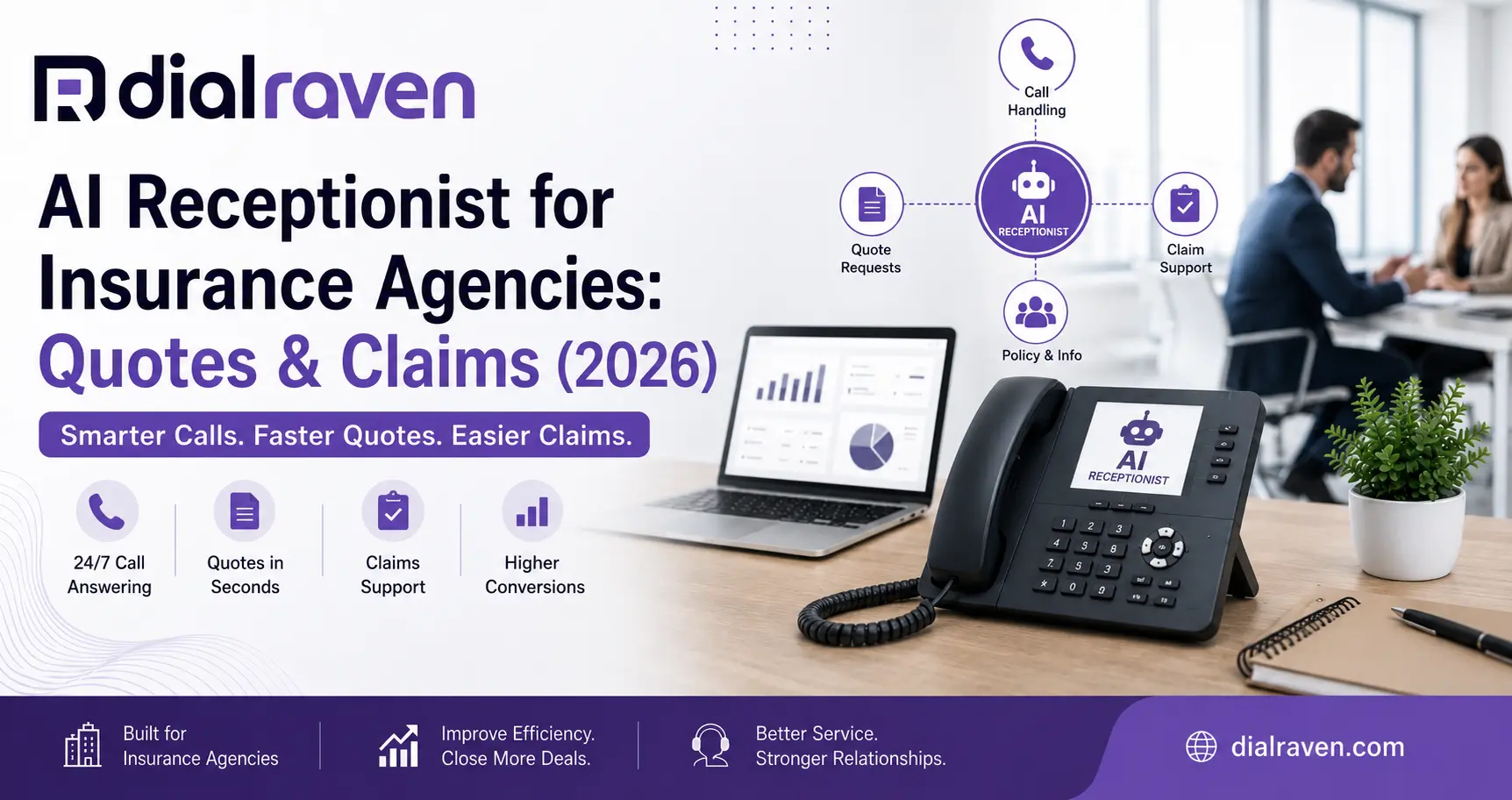
AI Receptionist for Insurance Agencies: Quotes & Claims (2026)
See how AI receptionists help insurance agencies capture quote leads, route claims, handle policyholder calls, and provide 24/7 coverage.
Quick Answer
An AI receptionist for insurance agencies can answer calls 24/7, capture quote requests, collect initial claim details, route policy-service calls, and transfer conversations requiring licensed insurance advice to the right producer or staff member.
Dial Raven Team
VoIP Communication Expert
A prospect calls for an auto quote while every producer is already on the phone. A policyholder needs help after an accident at 7:30 p.m. Another customer wants a certificate or policy-service update while your CSR is handling three other requests. These calls should not all end up in the same voicemail box. An AI receptionist for insurance agencies can answer first, identify why someone is calling, capture approved information, and route the conversation into the right workflow. Quote prospects can reach sales, claim-related calls can follow the agency's first-notice process, and service requests can reach the right CSR without pulling licensed producers into every routine call.
The goal is not to make AI an insurance adviser. It is to make the front end of the agency more responsive while keeping licensed advice, judgment, negotiation, and sensitive decisions with qualified people.
What Is an AI Receptionist for Insurance Agencies?
An AI receptionist for insurance agencies is conversational call-handling software configured around an agency's intake and routing rules. Instead of making every caller listen to a long phone menu, it can understand requests such as needing a quote, reporting an accident, requesting an insurance card, asking about a renewal, or trying to reach a specific agent. A properly configured virtual receptionist service can provide 24/7 first-response coverage, collect information, route calls, take messages, and create clearer handoffs when agency staff are unavailable.
The most important capability is knowing when the conversation should leave automation and reach a licensed producer or experienced staff member. The best insurance AI receptionist is not the one that tries to answer everything; it is the one that reliably identifies intent, captures useful context, and gets each caller to the right next step.
What Can an Insurance AI Receptionist Handle?
| Call Type | AI Can Help With | Human or Producer Should Handle |
|---|---|---|
| New quote | Contact details, line of business, basic intake, routing | Advice, recommendations, final quoting, binding |
| Claim or FNOL | Initial incident details and routing | Coverage interpretation and claim decisions |
| Policy service | Capture request and identify policyholder need | Complex changes or licensed advice |
| Renewal | Capture questions and request review | Coverage recommendations and changes |
| Billing | Basic routing and approved information | Disputes or complex account issues |
| Certificate or document | Capture request and required details | Exceptions or approval-dependent requests |
| After-hours call | Identify intent and create the next action | Urgent or sensitive situations requiring staff |
An insurance AI receptionist is most valuable when it handles structured reception work rather than pretending every insurance conversation can be automated. Each agency should define what information the AI may collect, which answers are approved, and exactly when a producer, CSR, or other staff member must take over.
How Should AI Handle New Quote Calls?
A new quote call may be one of the most commercially important calls an agency receives. If every producer is unavailable, sending the caller directly to voicemail creates unnecessary delay. Instead, an AI receptionist for insurance agents can collect approved intake information such as the caller's name, phone number, email, type of insurance requested, personal or commercial line, state or service area, preferred callback time, and existing-client status.
The AI can then transfer the call, notify the appropriate producer, or create a callback request. If your agency is also evaluating the underlying calling infrastructure, Dial Raven's phone system for insurance agencies guide covers VoIP, call routing, business texting, and the broader communications setup. The key distinction is that AI can capture and organize the opportunity, while licensed professionals should handle recommendations, final quotes, sales conversations, and binding where required.
Can an AI Receptionist Handle Claims or FNOL Calls?
An AI receptionist can support First Notice of Loss, or FNOL, intake when the agency clearly defines what information should be collected and where the call should go next. An approved workflow might collect the policyholder's name, contact information, date and approximate time of loss, general location, type of incident, parties or property involved, and preferred callback information.
The receptionist can then route the report according to the agency's process. It should not independently determine whether a loss is covered, estimate a settlement, interpret policy language, or make promises about how a claim will be handled. A claims-related caller may already be stressed, so the objective should be a clear and efficient handoff rather than an automated claims decision.
How Can AI Handle Policyholder Service Calls?
Not every existing-client call requires a producer immediately. An insurance virtual receptionist may help identify and route requests involving insurance cards, certificates of insurance, billing questions, renewal reviews, policy documents, address or contact changes, policy-change requests, or requests for a producer callback.
What the AI can actually complete should depend on the agency's systems, permissions, security controls, and business rules. For higher-risk requests, the safer workflow is often to identify exactly what the policyholder needs and route the request to the appropriate CSR or producer with useful context. After a call, AI voice transcription can help turn permitted conversations into searchable text, summaries, and action items so staff have a clearer record of what the caller requested.
When Must a Licensed Insurance Professional Take Over?
Insurance differs from many industries because licensing requirements apply to specific activities. The National Association of Insurance Commissioners explains that people who sell, solicit, or negotiate insurance in the United States generally must be licensed as insurance producers. State insurance departments oversee producer activities and licensing requirements.
- Recommending coverage or specific policy options
- Explaining which policy is best for the customer
- Advising whether coverage limits are sufficient
- Negotiating insurance terms
- Finalizing or binding coverage where licensing is required
- Interpreting complex policy language
- Making coverage determinations
- Handling sensitive disputes
- Answering questions outside the approved knowledge base
AI reception should therefore be designed around a clear boundary between administrative intake and licensed insurance activity. For official background, review the NAIC producer licensing guidance. Exact licensing requirements vary by activity and state, so agencies should review their workflows with appropriate compliance professionals.
How Should After-Hours Insurance Calls Work?
After-hours coverage is one of the clearest uses for an AI answering service for insurance agencies. The workflow should begin by identifying why the person is calling rather than simply announcing that the office is closed.
- Quote prospect — capture approved intake details and create the correct sales follow-up
- Existing policyholder — identify the service request and route or document it
- Claim or FNOL — follow the agency's approved incident-intake and escalation process
- Billing question — provide approved general information or create a service task
- Uncertain or sensitive request — escalate according to the agency's human fallback rules
During storm events or other high-call-volume periods, this structure can help separate quote, service, and claim callers before they reach staff. The result should be an organized queue of actionable conversations rather than dozens of generic voicemails.
AI Receptionist vs. Traditional Insurance Answering Service
| Capability | AI Receptionist | Traditional Answering Service |
|---|---|---|
| 24/7 availability | Often available | Depends on provider and plan |
| Simultaneous call handling | Highly scalable | Staffing dependent |
| Insurance-specific intake | Configurable | Depends on agent training |
| Quote lead capture | Strong with defined workflow | Usually possible |
| FNOL intake | Possible with defined rules | Usually possible |
| Complex judgment | Should escalate | Better human capability |
| Licensed insurance advice | Requires licensed human involvement | Depends on staff licensing |
| Automatic call summaries | Often available | Varies |
For many agencies, the strongest approach is hybrid. AI handles predictable first-response and intake work, while CSRs and producers take over where judgment, empathy, licensing, negotiation, or relationship management matters.
What About AI and Insurance Compliance?
AI can make an insurance agency more responsive, but automation does not remove existing regulatory obligations. The NAIC continues to examine artificial intelligence in insurance, including its effects on consumer protection, privacy, governance, accuracy, and state-based regulation.
- Define what the AI is allowed to answer
- Define what it must never answer
- Keep approved information current
- Require human escalation for uncertain responses
- Review interactions where appropriate
- Control access to customer information
- Verify applicable call-recording and disclosure requirements
- Test the workflow with difficult scenarios
- Maintain appropriate human oversight
For current regulatory background, review the NAIC artificial intelligence resources. An AI system should support the agency's compliance processes rather than inventing its own interpretation of insurance requirements.
How Much Does an AI Receptionist Cost for Insurance Agencies?
AI receptionist cost for insurance agencies varies because vendors use different pricing structures. Common models include monthly subscriptions, per-minute usage, per-call pricing, usage bundles, per-location pricing, setup or implementation charges, integration fees, and additional messaging or automation charges.
- After-hours answering
- Quote-intake workflows
- FNOL routing
- Call transfers
- Support for multiple producers or departments
- Business SMS follow-up
- Call summaries or transcription
- CRM or AMS connectivity
- Usage limits and overage charges
- Support and workflow changes
Do not compare providers only by the advertised monthly price. A lower starting price can become expensive if the workflows your agency needs require multiple paid add-ons. Compare total cost against call volume, producer count, service workflows, integration requirements, and the level of support your agency needs.
How to Set Up an AI Receptionist Without Disrupting Your Agency
- Review recent calls and separate quote, claim, service, billing, renewal, and document requests
- Define what information AI may collect for each call type
- Document questions or actions that require a licensed producer
- Build routing rules for producers, CSRs, queues, and fallback destinations
- Test difficult calls such as uncertain policy questions and upset claimants
- Start with overflow or after-hours coverage before expanding automation
- Review real call outcomes and adjust workflows over time
Follow-up should also be part of the workflow. Where appropriate, business SMS can help continue conversations from the agency's business number instead of requiring staff to use personal phones.
Is an AI Receptionist Right for Your Insurance Agency?
An AI receptionist for insurance agencies makes the most sense when producers and CSRs spend too much time sorting routine calls, valuable quote prospects reach voicemail, or after-hours callers do not have a clear next step. The strongest system is not the one that tries to replace licensed professionals. It is the one that gets each caller into the right lane faster — quote, claim, service, or human assistance — with enough context for your team to act.
Frequently Asked Questions
What is an AI receptionist for insurance agencies?
An AI receptionist for insurance agencies is conversational software that answers incoming calls, identifies whether someone needs a quote, claim assistance, policy service, or another type of help, captures approved information, and routes the conversation to the appropriate person.
Can an AI receptionist handle insurance quote requests?
Yes. It can collect approved intake details and route or schedule follow-up with the appropriate producer. Licensed professionals should remain responsible for insurance advice, recommendations, final quoting, and binding where required.
Can an AI receptionist take a First Notice of Loss?
It can support an approved FNOL intake workflow by collecting initial incident details and routing the information appropriately. Coverage interpretation, claim decisions, and professional judgment should remain with qualified humans.
Can an AI receptionist sell insurance?
AI can assist with administrative intake and routing, but people who sell, solicit, or negotiate insurance generally must meet applicable state producer-licensing requirements. Agencies should establish clear boundaries for licensed activity.
Can an AI receptionist answer insurance calls after hours?
Yes. After-hours coverage can capture quote prospects, identify service requests, support approved FNOL intake, and route urgent or sensitive calls according to the agency's rules.
How much does an AI receptionist for an insurance agency cost?
Pricing varies by vendor and may include subscription fees, usage charges, implementation, integrations, messaging, or overages. Agencies should compare total cost based on their actual call volume and required workflows.
Quote prospects, claim calls, and policyholder requests should not disappear into voicemail when your team is busy. See how Dial Raven can help build a smarter insurance call flow with AI-powered reception, routing, messaging, and producer handoffs. Book a free demo to discuss how it could fit your agency.
Related pages
Ready to modernize your phone system?
Talk to a Dial Raven specialist and get a plan built around how your team works.