
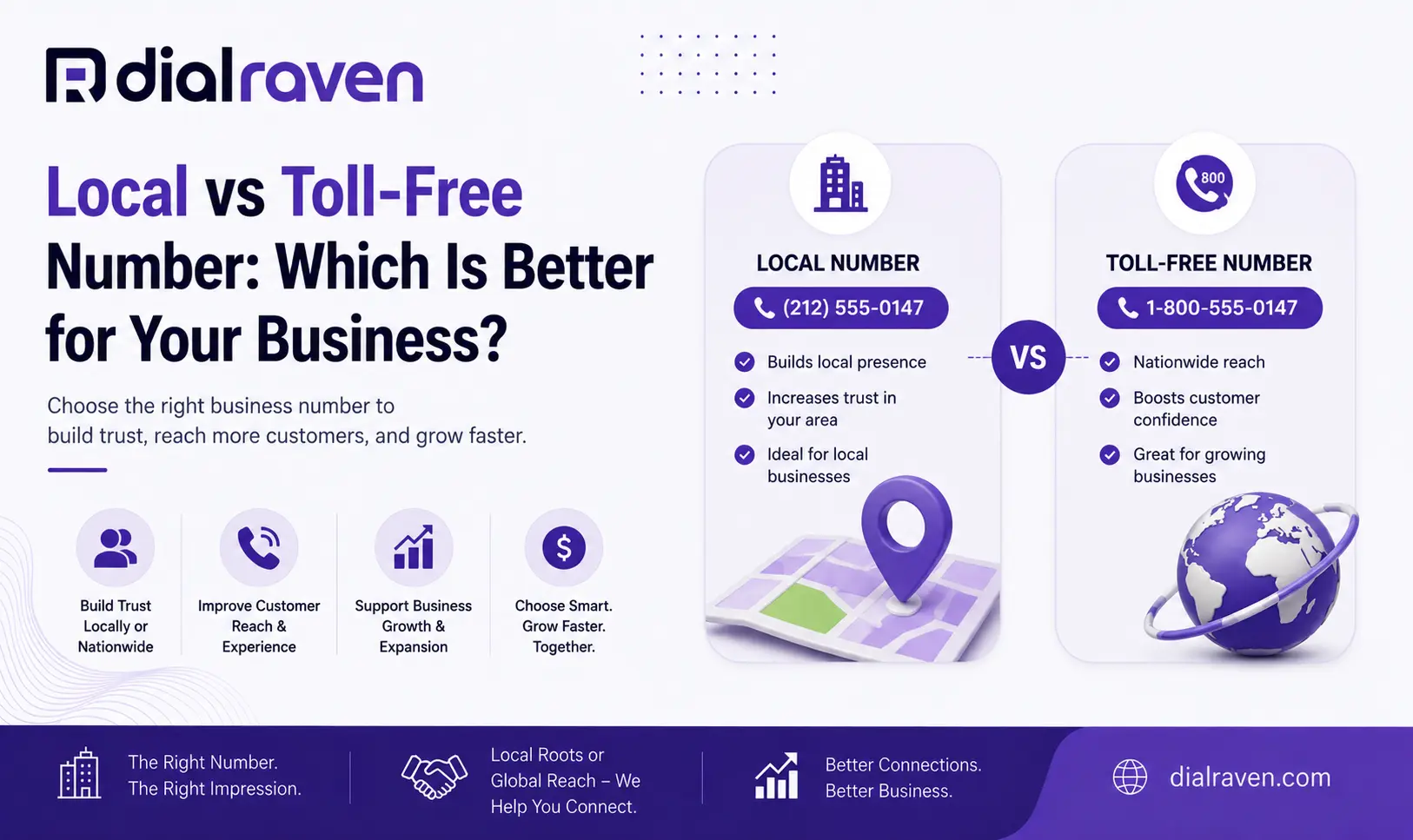
Local vs Toll-Free Number: Which Is Better for Your Business?
Compare local vs toll-free numbers for business by customer trust, inbound and outbound calls, texting, multi-location use, and national vs local reach.
Quick Answer
A local number uses a geographic area code and can strengthen regional familiarity, while a toll-free number creates a centralized, non-local identity. Local numbers often fit regional sales and service; toll-free numbers fit national inbound support. Many businesses benefit from using both.
Dial Raven Team
VoIP Communication Expert
A phone number does more than give customers a way to reach your business. It can signal where you operate, shape how your company presents itself, determine how different locations are organized, and influence how calls and texts fit into your communications setup. That makes the local vs toll free number decision more important than simply choosing between two number formats.
A local number creates a geographic identity through a recognizable area code. A toll-free number creates a centralized, non-local identity that can work well for companies serving customers across multiple regions. For many businesses, however, the best answer is not choosing one and rejecting the other. The better question is: what job should each business number perform?
Local vs Toll-Free Number: Quick Answer
Choose a local number when geographic familiarity is important to how customers find, recognize, or contact your business. Choose a toll-free number when you want one centralized number for customers across multiple markets, especially for national support, general inquiries, or broader advertising. Use both when your company needs local market identity and centralized reach at the same time.
The right local vs toll free number for business strategy depends on your audience, call direction, geography, texting needs, and routing architecture—not simply the size of the company.
Local vs Toll-Free Number at a Glance
| Factor | Local Number | Toll-Free Number |
|---|---|---|
| Geographic identity | Associated with a specific area code | Non-geographic identity |
| Best fit | Local or regional markets | Centralized or nationwide access |
| Inbound calls | Strong | Strong |
| Outbound calls | Familiar within a target region | Useful when one central identity matters |
| Multi-location strategy | Separate number per market possible | One central number possible |
| Business texting | Can be supported with proper setup | Can be supported with proper setup |
| Number portability | Eligible numbers may be portable | Eligible numbers may be transferable |
| Branding | Regional or local identity | Central or national identity |
| Vanity options | Depends on available inventory | Strong vanity-number potential |
| Call routing | Can route according to business rules | Can route according to business rules |
Modern cloud phone systems separate the number customers dial from the physical place where an employee answers. A local number can therefore route to a central team, remote employee, call queue, receptionist, or another office rather than being tied to one desk.
What Is a Local Business Phone Number?
A local business phone number is a standard telephone number associated with a geographic area code. A company serving Orlando, for example, may use an Orlando-area number so customers see a familiar regional code when calling or receiving a callback.
- Home-service companies
- Medical and dental offices
- Law firms
- Real estate businesses
- Restaurants and retailers
- Regional sales teams
- Individual branch locations
- Property management offices
With VoIP, having a local number does not necessarily mean every employee answering that number must physically sit in that area. Calls can be routed according to business rules while the customer-facing number retains its local identity.
What Is a Toll-Free Business Number?
A toll-free business number uses a non-geographic toll-free prefix rather than a local geographic area code. Common U.S. toll-free prefixes include 800, 888, 877, 866, 855, 844, and 833.
Somos, which administers the U.S. Toll-Free Number Registry ecosystem, explains that businesses obtain toll-free numbers through authorized Toll-Free Service Providers. You can review how U.S. toll-free numbers are administered for more information about the registry and service-provider process.
In modern business communications, the practical value of a toll-free number is often less about old-style long-distance billing and more about creating one centralized business identity across multiple markets.
Local vs Toll-Free Number: 7 Key Differences
1. Geographic Identity
A local number immediately contains a recognizable area code. For a business whose customers associate it strongly with a city or region, that geographic signal can be useful. A toll-free number removes that geographic association, which can be an advantage for a company that does not want customers to think of it as belonging to one specific market.
2. Customer Perception
A local number may feel more regionally familiar because customers recognize the area code. A toll-free number may signal that the business serves customers across a broader geographic area. Neither perception is inherently better: a neighborhood HVAC contractor and a nationwide software support team are solving very different communication problems.
3. Inbound Calling
Both local and toll-free numbers can work well for inbound calling. A local number makes sense when the caller is connected to a specific market, branch, service area, or office. A toll-free number can be useful when the company wants one central point of entry for callers nationwide.
What happens after the call arrives is a separate decision. Either number can feed into an auto attendant, call queue, department, receptionist, employee, or another approved call flow.
4. Outbound Calling
The local vs toll free number for outbound calls decision deserves more attention than it usually gets. For regional sales or service callbacks, a local number may align naturally with the market where the customer lives or does business. A toll-free number may make more sense when the organization wants every employee or department to present one centralized identity.
The important considerations are consistency, legitimate caller identity, customer expectations, callback handling, and reputation—not simply trying to make one number format look more trustworthy than another.
5. Multi-Location Use
A company with several offices has more flexibility than choosing one number for the entire organization. A Philadelphia office can retain a Philadelphia local number, an Orlando office can use an Orlando number, and a Dallas office can use a Dallas number while corporate customer support uses one toll-free line.
All of those numbers can still operate on one communications platform. Dial Raven's guide to VoIP for multiple locations explains how businesses can centrally manage numbers, users, routing, queues, business hours, and failover while retaining location-specific identities where useful.
6. Business Texting
Both local and toll-free business numbers can support messaging when the provider, number, and messaging configuration allow it. However, U.S. business messaging requirements are not identical across every number type.
Local 10-digit business messaging may involve A2P 10DLC registration, while toll-free messaging follows its own verification and carrier requirements. Dial Raven's 10DLC guide for small business covers local-number business messaging registration in more detail, while Business SMS explains how customer conversations can be managed from professional business numbers.
- Confirm whether the number supports SMS
- Determine whether MMS is required
- Identify which registration or verification process applies
- Document how customers provide consent
- Configure opt-out handling
- Decide whether multiple employees need shared inbox access
7. Number Management and Portability
The right number should also be one your business can manage long term. Document the number owner, current provider, departments using it, where it is advertised, how calls are routed, whether SMS is active, and what caller ID configuration applies.
If the business later changes communications providers, eligible local and toll-free numbers may often be transferred rather than replaced.
Should I Use a Local or Toll Free Number?
If you are asking should I use a local or toll free number, start with the audience rather than the technology.
Use a Local Number When
- Most customers come from one city or region
- Local identity matters to the service
- Each office needs a recognizable regional contact
- Sales representatives primarily work specific territories
- Customers commonly search for local service providers
Use a Toll-Free Number When
- Customers call from many states
- One centralized support line is useful
- Geographic identity is not central to the business
- The company markets nationally
- A memorable vanity number would support branding
Use both when local identity and national access solve different problems. A growing business does not need to force every department and location onto the same number strategy.
Which Is Better for a Local Service Business?
Local numbers are usually the more natural starting point for a business whose customer relationship is directly tied to a geographic market. That includes plumbers, HVAC contractors, electricians, dental practices, auto repair shops, local law offices, property managers, and real estate teams.
A customer searching for a service provider in one city may reasonably expect the business to have a recognizable local contact point. That does not mean the underlying phone system has to be physically installed in that city—the number can still route into a cloud system and reach office staff, mobile employees, a central receptionist, or an after-hours team.
Which Is Better for a Nationwide Business?
A toll-free number becomes more useful when geographic neutrality is an advantage. A company serving customers throughout the United States may prefer one central toll-free contact point for customer support, general inquiries, national advertising, reservations, billing, corporate sales, or partner support.
Regional departments can still have separate local numbers where those numbers add value. The number strategy does not need to mirror the organizational chart exactly.
Local vs Toll-Free Number for Outbound Calls
Outbound calling changes the decision because the recipient sees the number rather than intentionally choosing it from your website. A good outbound strategy should consider whether customers recognize the number, whether callbacks reach the correct team, whether caller ID information is accurate, whether the number is used consistently, and whether customers can text the number back where appropriate.
Do not assume switching from toll-free to local automatically fixes low answer rates. Number reputation, caller identity, calling patterns, customer reports, and carrier analytics can also influence how calls are displayed. If legitimate calls are showing as Spam or Scam Likely, Dial Raven's business phone number marked as spam guide explains how to investigate caller-ID and reputation issues separately.
Can a Business Use Both Local and Toll Free Numbers?
Yes. In fact, can a business use both local and toll free numbers is often the wrong question. A better question is: which business function should each number serve?
| Business Function | Number Strategy |
|---|---|
| National customer support | Toll-free |
| Orlando sales team | Local |
| Dallas sales team | Local |
| Philadelphia service team | Local |
| National advertising campaign | Toll-free |
| Local customer-facing branch | Relevant local number |
All of these numbers can route into one cloud phone platform. That gives the company local identity where geography matters and a centralized number where it does not.
Local vs Toll-Free for Multi-Location Businesses
Multi-location companies usually have three practical number architectures.
One Central Number
The company publishes one main number and routes callers to the correct location using an auto attendant, receptionist, or routing logic. This simplifies branding but provides less location-specific identity.
Separate Local Numbers
Each location keeps or receives its own local number. This works well when branches operate as distinct customer-facing locations or serve clearly separated geographic markets.
Hybrid Number Structure
The company maintains local numbers for individual markets and one central toll-free number for corporate or nationwide inquiries. For many growing organizations, this offers a useful balance between regional identity and centralized access.
Can Local and Toll-Free Numbers Receive Text Messages?
They can when messaging is supported and appropriately configured. The bigger issue is not simply whether a number technically supports SMS. The business also needs to decide which number customers should text, who owns incoming conversations, which verification or registration process applies, how consent and opt-outs are handled, and whether voice and SMS should use the same published number.
A professional Business SMS setup helps keep customer texts tied to business-managed numbers instead of employee personal phones.
Can You Keep Local and Toll-Free Numbers When Switching Providers?
Eligible existing numbers can often be transferred when a business changes communications providers, but number selection and number porting are two separate tasks. First decide which numbers the organization actually needs. Then document each number and port only the ones worth retaining.
- Confirm who owns each number
- Identify whether it is local or toll-free
- Gather current account information
- Verify port eligibility
- Keep existing service active
- Build the new routing environment
- Complete the port
- Test inbound and outbound calls
- Cancel the old provider last
Dial Raven's guide to porting a business phone number to VoIP explains the transfer process, preparation steps, and common causes of porting delays.
Does Local vs Toll-Free Affect Spam Labels?
The number format alone does not determine whether a legitimate business call receives a spam label. A local number is not automatically protected from reputation problems, and a toll-free number is not automatically considered spam.
- Caller ID accuracy
- CNAM where applicable
- STIR/SHAKEN attestation
- Sudden volume spikes
- Short-duration calling patterns
- Customer complaints
- Number registration
- Consistent callback handling
Treat number reputation as its own operational discipline rather than choosing a local number solely because it appears more familiar.
Local vs Toll-Free Number by Business Scenario
| Business Scenario | Recommended Starting Strategy | Why |
|---|---|---|
| Local plumbing company | Local number | Strong geographic relationship |
| Single dental practice | Local number | Patients primarily come from one market |
| National SaaS support team | Toll-free number | Centralized nationwide support |
| Multi-state service company | Local + toll-free | Local identity plus central access |
| Multi-location medical group | Local per clinic + central number | Preserve clinic identity while centralizing routing |
| Nationwide customer service | Toll-free number | One recognizable support entry point |
| Regional outbound sales teams | Local numbers | Align customer-facing numbers with territories |
| National brand with local branches | Hybrid | Separate corporate and local roles |
These are starting strategies rather than rigid rules. The correct architecture depends on how customers actually interact with the business.
Five Questions to Choose the Right Business Number
1. Who Is the Audience?
Is the number intended for one community, one state, several regions, or customers nationwide? Geographic scope is one of the strongest signals for choosing between local, toll-free, or a hybrid setup.
2. Is the Number Mainly Inbound or Outbound?
A national support hotline and a regional sales callback number solve different problems. Identify the dominant call direction and customer expectation before choosing the number.
3. Does Geographic Identity Matter?
If location affects how customers choose the business, a local number may add useful context. If the company intentionally presents one national identity, a toll-free number may fit better.
4. Will Customers Call, Text, or Both?
Voice and messaging requirements should be planned together. Confirm texting support, registration requirements, shared inbox needs, and whether customers should call and text the same number.
5. Where Should the Call Ultimately Go?
The answer might be one branch, a central receptionist, a call queue, several locations, or an after-hours team. The customer-facing number and the final answering location do not have to be the same.
Final Verdict: Local or Toll-Free?
Neither number type is universally better. A local number is usually the stronger choice when geographic familiarity is an important part of the customer relationship. A toll-free number is usually stronger when one centralized, non-local identity better reflects how the company serves customers.
Many businesses should not choose only one. A hybrid strategy can use local numbers for regional identity plus a toll-free number for centralized national access. The best toll free vs local number decision therefore comes down to the role each number needs to perform—not which one appears more professional in isolation.
Frequently Asked Questions
What is the difference between a local and toll-free number?
A local number is associated with a geographic area code, while a toll-free number uses a non-geographic prefix such as 800, 888, 877, 866, 855, 844, or 833. Local numbers can reinforce regional identity, while toll-free numbers are useful for centralized or nationwide access.
Should a small business use a local or toll-free number?
A local number is often a good starting point for businesses serving one geographic market. A toll-free number can be useful for businesses serving customers across multiple regions. Companies that need both local presence and national access can use both.
Are toll-free numbers still useful in 2026?
Yes. Toll-free numbers remain useful for nationwide customer support, general inquiries, national advertising, vanity-number branding, and businesses that want one centralized contact number rather than a location-specific identity.
Is a local number better for outbound business calls?
A local number may align well with regional outbound calling because recipients recognize the area code, but number type alone does not determine answer rates. Caller identity, reputation, customer expectations, calling patterns, and callback handling also matter.
Can a business use both local and toll-free numbers?
Yes. A business can use local numbers for individual markets or branches and a toll-free number for centralized customer support, corporate inquiries, or national advertising while routing all numbers through one cloud phone system.
Can local business numbers receive text messages?
Yes, eligible local business numbers can support SMS when messaging is enabled and applicable registration requirements are completed. U.S. application-to-person messaging from local 10-digit numbers may require A2P 10DLC registration.
Can toll-free business numbers receive SMS?
Many toll-free business numbers can support SMS and MMS when the provider supports messaging and the number completes applicable toll-free verification requirements.
Can I keep a toll-free number when switching phone providers?
Eligible toll-free numbers can often be transferred between service providers. Verify eligibility, keep existing service active during the transfer, and test the number after migration before cancelling the former provider.
Should each business location have its own local number?
Not always. Separate local numbers are useful when each location has a distinct market, staff, or customer identity. Businesses with centralized operations may use one main number, while others benefit from a hybrid structure with local numbers plus one central number.
Does a toll-free number make a business look more professional?
A toll-free number can create a centralized or nationwide identity, but professionalism depends more on reliable answering, accurate caller ID, clear routing, consistent branding, and customer experience than on the number format alone.
Not sure whether your business should use local numbers, toll-free numbers, or both? Dial Raven can review your service areas, locations, existing numbers, inbound and outbound call patterns, texting requirements, caller-ID needs, and routing structure and recommend a number strategy that fits how customers actually contact your business. Plan your business numbers with Dial Raven.
Related pages
Ready to modernize your phone system?
Talk to a Dial Raven specialist and get a plan built around how your team works.