
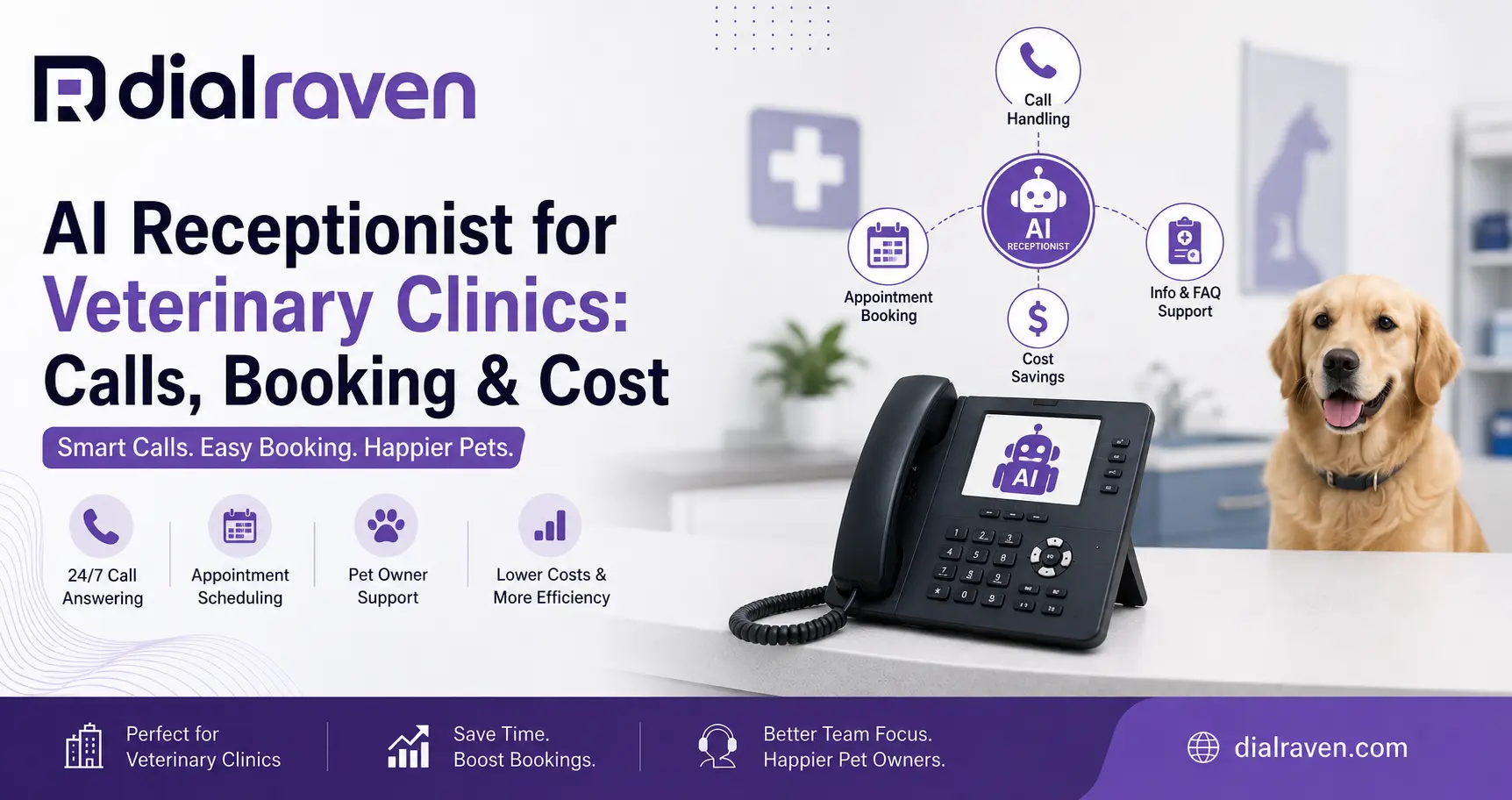
AI Receptionist for Veterinary Clinics: Calls, Booking & Cost
Learn how an AI receptionist helps veterinary clinics answer calls 24/7, book appointments, route urgent cases, and support front-desk teams.
Quick Answer
An AI receptionist for veterinary clinics can answer routine calls 24/7, capture new-client details, book or request appointments, route refill requests, and escalate urgent or clinical calls to approved staff without giving medical advice.
Dial Raven Team
VoIP Communication Expert
The phone rings while your receptionist is checking in a nervous dog. Another client is waiting to pay, a technician needs help, and two callers are already on hold. Later that evening, a new pet owner calls to request an appointment, but the clinic is closed. Veterinary teams do not usually lack calls; they lack enough uninterrupted time to answer every caller properly. An AI receptionist for veterinary clinics can provide a reliable first response by answering routine calls, identifying why a pet owner is calling, capturing approved information, supporting appointment workflows, routing refill requests, and directing urgent or uncertain situations to the appropriate person.
The goal is not to automate veterinary medicine. It is to automate predictable front-desk work while keeping clinical decisions, medical advice, and emotionally sensitive conversations with qualified people.
What Is an AI Receptionist for Veterinary Clinics?
An AI receptionist for veterinary clinics is conversational call-handling software configured around a clinic's approved procedures. Instead of forcing every caller through a rigid phone menu, it can understand ordinary requests such as scheduling an annual exam, moving an appointment, requesting a medication refill, asking whether the clinic accepts new clients, checking business hours, or asking to speak with someone about a sick pet.
A broader AI receptionist for small business may handle general scheduling and call routing. A veterinary version requires more specific rules for pet and owner information, appointment types, refill requests, urgent-call escalation, and clinical boundaries. The safest system does not attempt to answer every question. It completes approved administrative tasks and moves the caller to a human whenever clinical knowledge, judgment, empathy, or authorization is required.
Why Veterinary Clinics Need a Different Call Workflow
Veterinary calls do not all belong in one queue. A typical clinic may receive new-client inquiries, routine appointment requests, surgical scheduling questions, prescription-refill requests, billing calls, boarding questions, postoperative concerns, and potentially urgent symptom reports during the same hour. Each call needs a different outcome.
- Identify who is calling
- Identify which pet the call is about
- Determine why the client is calling
- Separate administrative, clinical, urgent, and uncertain requests
- Complete an approved task, capture a message, or involve staff
- Follow the clinic's predefined workflow rather than creating medical rules
What Can a Veterinary AI Receptionist Handle?
| Call Type | AI Can Help With | Veterinary Staff Should Handle |
|---|---|---|
| New-client inquiry | Owner details, pet details, appointment request | Clinical questions or complex intake |
| Routine appointment | Booking, cancellation, or rescheduling under approved rules | Scheduling exceptions |
| Prescription refill | Capture medication and callback information | Approval, dosage, and medication advice |
| Routine office question | Hours, location, services, and approved policies | Questions outside verified information |
| Billing or complaint | Identify the issue and route the call | Detailed disputes or sensitive conversations |
| Urgent concern | Detect approved warning language and activate escalation | Clinical assessment and medical direction |
| After-hours call | Capture intent, route, or create follow-up | Emergencies and clinical decisions |
A veterinary AI receptionist is most valuable when it handles high-volume, repeatable administrative work. It should not act as a veterinarian, veterinary technician, poison-control service, or emergency clinician.
Can an AI Receptionist Book Veterinary Appointments?
Yes, when it is connected to an approved calendar or practice-management workflow. The system may collect the client's name and contact information, pet name and species, new or existing client status, general reason for the visit, requested date or time, preferred veterinarian or location, and other scheduling information approved by the clinic.
Depending on the setup, the receptionist may book the appointment directly or submit a request for staff confirmation. Scheduling rules still matter because wellness exams, technician appointments, surgical consultations, sick-pet visits, and new-client examinations may require different appointment lengths, resources, and approval steps.
The underlying veterinary phone system should also support reliable routing, queues, after-hours rules, and multiple departments or locations. Once an appointment is confirmed, business SMS can support reminders, confirmations, rescheduling instructions, and appropriate follow-up from the clinic's business number.
How Should Prescription-Refill Requests Be Handled?
An AI receptionist can collect a refill request, but it should not authorize one. An approved intake workflow may capture the client and pet name, medication name, current dosage as reported by the client, requested quantity, preferred pharmacy, callback number, and whether the medication is nearly finished.
That information can then be routed to the veterinarian, technician, pharmacy team, or other authorized staff member. The receptionist should not recommend medication, change a dosage, promise approval, or tell the client whether continued treatment is appropriate. Those decisions belong with the veterinary team.
How Should After-Hours and Urgent Calls Work?
A 24/7 AI receptionist for veterinary clinics should do more than repeat the clinic's opening hours. A useful after-hours workflow can identify the client and pet, determine the general reason for the call, answer approved nonclinical questions, capture appointment or cancellation requests, record refill requests, activate the clinic's urgent-call process, transfer callers to an approved on-call contact, and create a clear summary for follow-up.
The AI should not independently diagnose the pet or decide that a condition is safe to monitor at home. It may recognize predefined warning phrases or responses and activate the clinic's escalation instructions, but the actual clinical assessment, treatment advice, and emergency decision should remain with an appropriate veterinary professional.
The American Animal Hospital Association notes that AI can support routine phone answering and appointment scheduling, but veterinary client-service protocols still require purposeful human oversight. For additional context, see AAHA's guidance on AI and client communication and its VCPR position.
What Should an AI Receptionist Never Handle Alone?
- Diagnosis
- Treatment recommendations
- Medication or dosage advice
- Poisoning or possible toxin exposure decisions
- Breathing difficulty, collapse, seizures, or severe bleeding
- Postoperative clinical concerns
- Questions involving euthanasia or quality of life
- Serious complaints requiring empathy or judgment
- Financial distress requiring a sensitive discussion
- Information the AI cannot verify
- Exceptions to the clinic's normal policy
The correct response to uncertainty is not a confident guess. The system should transfer the caller, activate an approved urgent-call workflow, collect a precise message, or provide another clinic-approved next step.
AI Receptionist vs. Veterinary Answering Service vs. Human CSR
| Capability | AI Receptionist | Answering Service | Human Clinic CSR |
|---|---|---|---|
| 24/7 availability | Often available | Depends on plan | Usually scheduled hours |
| Simultaneous calls | Highly scalable | Staffing dependent | Limited |
| Routine appointment intake | Strong with clear rules | Usually possible | Strong |
| Direct scheduling | Depends on integration | Varies | Strong |
| Refill-request capture | Strong | Usually possible | Strong |
| Clinic-specific knowledge | Configurable | Training dependent | Usually strongest |
| Empathy and judgment | Limited | Human but remote | Strong |
| Clinical decisions | Not appropriate | Depends on qualified staff | Escalates to clinical team |
| Automatic summaries | Often available | Varies | Usually manual |
An AI answering service for veterinary clinics can be useful for repetitive calls and overflow. A human CSR remains better suited to sensitive conversations, complicated exceptions, distressed clients, and situations requiring flexible judgment. For many practices, a hybrid model is the strongest option: AI handles predictable reception work while people retain ownership of complex client care.
Does It Need to Connect With a Veterinary PIMS?
A PIMS connection can make scheduling and client recognition more useful, but integration should be evaluated carefully. Before choosing a system, determine whether it can safely identify existing clients and patients, create new-client requests, read available appointment times, apply appointment-type rules, book or reschedule, avoid duplicate records, record the reason for the visit, route refill requests, and add summaries or follow-up tasks.
Do not assume every vendor connects with every veterinary platform. Ask whether the integration is direct or dependent on manual review, which records the AI can read or change, how permissions are restricted, and what happens when the PIMS is unavailable.
What Happens After the Call?
The value of the call is lost if staff do not know what happened next. Dial Raven's AI voice transcription can convert permitted calls into searchable text, concise summaries, and action items. This can help the team identify who called, which pet was discussed, what was requested, and who owns the follow-up.
If calls are recorded or transcribed, the clinic should use a legally reviewed disclosure and consent process appropriate to the participants' locations. Dial Raven's guide to call recording laws by state explains why requirements can differ across U.S. jurisdictions. Practices should also define access controls, retention periods, correction procedures, and rules for keeping sensitive conversations out of systems that do not need them.
How Much Does a Veterinary AI Receptionist Cost?
Veterinary AI receptionist cost varies by provider and workflow. Common pricing models include a flat monthly subscription, included minutes plus overages, per-minute pricing, per-call pricing, per-location pricing, setup or implementation fees, PIMS integration charges, additional SMS or automation fees, and custom pricing for multi-location groups.
- Appointment-booking and scheduling workflows
- After-hours answering
- Urgent-call routing
- Call transfers
- Transcripts and call summaries
- Business texting
- Multiple phone numbers or clinic locations
- PIMS or calendar integrations
- Usage limits and overages
- Ongoing workflow changes and support
Compare more than the starting price. A low entry price may not be the lowest total cost if the clinic must pay separately for the functions it actually needs.
How to Introduce AI Without Disrupting the Front Desk
- Review recent call logs, voicemails, and staff feedback to identify common requests
- Define which appointments, office questions, cancellations, and refill requests the AI may handle
- List clinical questions, urgent scenarios, and sensitive conversations that always require a person
- Create escalation rules for urgent calls, complaints, failed transfers, and after-hours messages
- Test difficult calls including background noise, vague symptoms, distressed callers, unavailable staff, and system outages
- Start with overflow or after-hours calls before expanding coverage
- Track appointments, successful transfers, unresolved calls, incorrect classifications, and staff follow-up workload
Is an AI Receptionist Right for Your Veterinary Practice?
An AI receptionist for veterinary practices is most useful when valuable calls regularly reach voicemail, front-desk staff are constantly interrupted, or routine phone work prevents the team from focusing on clients and patients inside the clinic. It should not be evaluated by how many employees it can replace. A better standard is whether it can reliably complete low-risk administrative work, capture accurate information, and involve a person at the right moment.
Frequently Asked Questions
What is an AI receptionist for veterinary clinics?
An AI receptionist for veterinary clinics is conversational software that answers routine calls, identifies client intent, captures approved owner and pet information, supports appointment workflows, and routes clinical, urgent, or uncertain calls to veterinary staff.
Can an AI receptionist book veterinary appointments?
Yes, when it is connected to an approved calendar or PIMS workflow. The clinic should define appointment types, duration, availability, new-client rules, and situations requiring staff approval.
Can an AI receptionist handle veterinary emergencies?
It should not diagnose or independently determine treatment. It can recognize clinic-approved warning language, collect essential information, and activate the practice's predefined transfer or escalation process.
Can it handle prescription-refill requests?
It can collect and route refill information, including the client, pet, medication, pharmacy, and callback details. Authorization, dosage decisions, and medication advice must remain with qualified veterinary staff.
Can an AI receptionist work with a veterinary PIMS?
Some platforms support PIMS or calendar connections, but compatibility and access differ. Verify which systems are supported, what information can be read or changed, and how failed or uncertain actions are handled.
How much does a veterinary AI receptionist cost?
Pricing may be based on a monthly subscription, included minutes, per-minute usage, clinic locations, integrations, setup, and overages. Compare the total cost using your clinic's real call volume and required workflows.
Routine calls, appointment requests, and refill inquiries should not overwhelm your front desk or disappear into voicemail. Dial Raven's virtual receptionist service can support 24/7 answering, routing, overflow coverage, message capture, and AI call summaries. Book a free demo to discuss how a smarter veterinary call flow could fit your clinic.
Related pages
Ready to modernize your phone system?
Talk to a Dial Raven specialist and get a plan built around how your team works.