
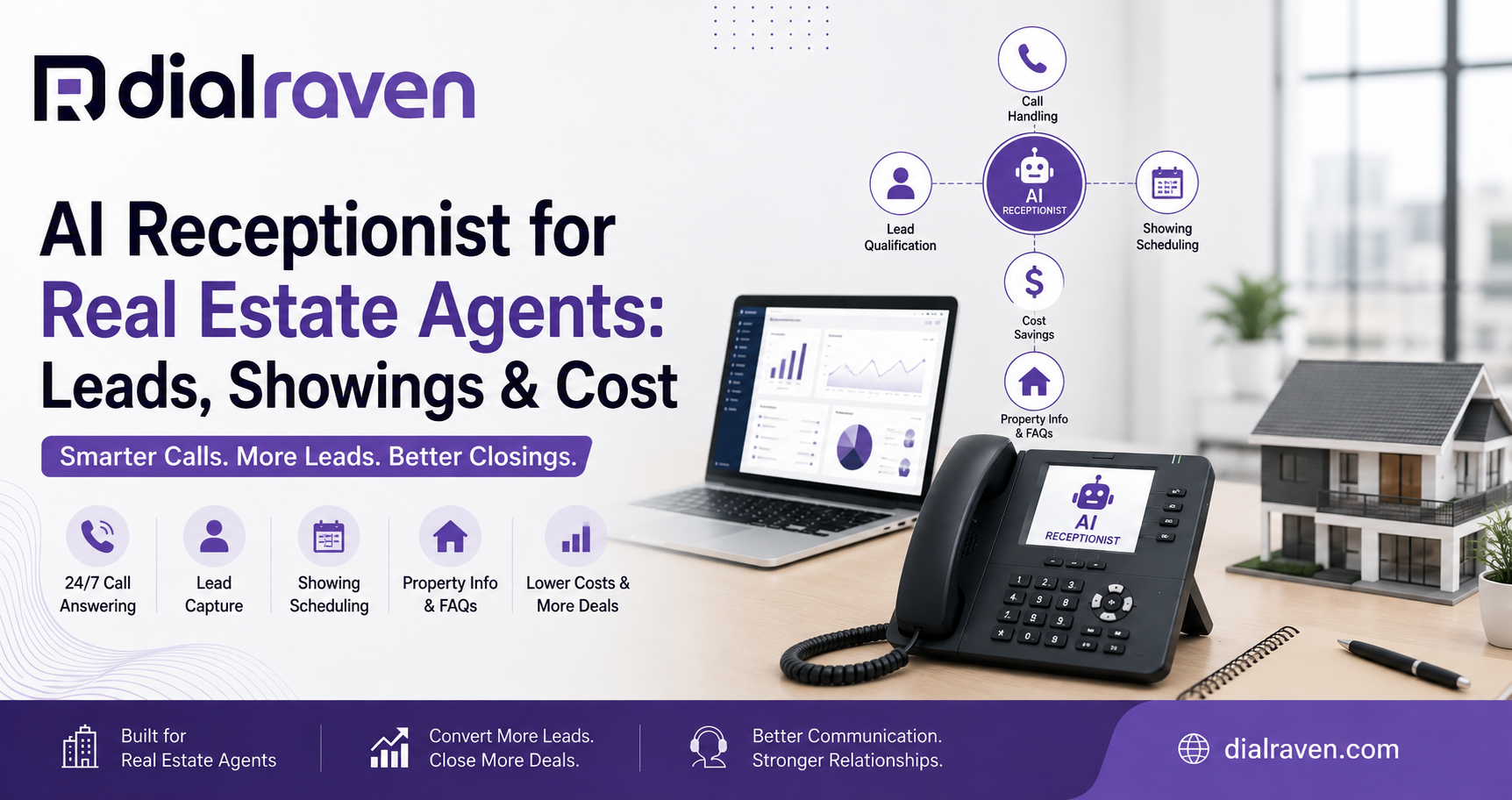
AI Receptionist for Real Estate Agents: Leads, Showings & Cost
Learn how AI receptionists help real estate agents capture buyer and seller leads, handle calls 24/7, schedule showings, and follow up faster.
Quick Answer
An AI receptionist for real estate agents can answer calls 24/7, capture buyer and seller details, route qualified leads, support showing requests, and send call summaries so agents can follow up faster.
Dial Raven Team
VoIP Communication Expert
A buyer calls about a listing while you're showing another property. A homeowner interested in selling calls while you're driving to a closing. A potential client reaches your office after hours and gets voicemail. In real estate, a missed call can mean a missed conversation with someone ready to buy, sell, or schedule a showing. An AI receptionist for real estate agents helps cover those gaps by answering routine inbound calls, identifying what callers need, capturing buyer and seller information, routing important conversations, and supporting faster follow-up. The goal isn't to replace the agent — it's to make sure valuable inquiries don't disappear simply because no one was available to answer the phone.
What Does an AI Receptionist for Real Estate Agents Do?
An AI receptionist is conversational call-handling software configured around your brokerage's rules. Instead of forcing callers through a traditional phone tree, it can understand requests such as asking about a property, requesting a showing, contacting a listing agent, or discussing selling a home. A properly configured virtual receptionist service can answer calls around the clock, capture information, route conversations, and provide a useful first response when agents are busy or unavailable. The best systems also know when a question needs human judgment and should be transferred to an agent.
Why Real Estate Teams Use AI Receptionists
Real estate agents rarely spend the entire day beside a desk phone. They're conducting showings, hosting open houses, meeting sellers, attending inspections, driving between properties, and working with existing clients. At the same time, new prospects expect a quick response. An AI receptionist for real estate creates a first-response layer between the incoming call and the agent, allowing routine inquiries to be handled immediately while higher-value or more complex conversations follow predefined routing rules.
- Answer buyer and seller calls when agents are busy or unavailable
- Capture caller names, contact details, and the reason for calling
- Identify the property or listing a buyer is asking about
- Collect showing or listing-consultation requests
- Route qualified or high-priority leads to the appropriate agent
- Provide after-hours coverage instead of sending every caller to voicemail
- Create a clear call record for faster agent follow-up
How Can an AI Receptionist Handle Buyer Leads?
Buyer calls should follow a simple workflow that captures useful information without turning the conversation into an interrogation. The receptionist can collect the caller's name, phone number, property or area of interest, reason for calling, general buying timeframe, requested showing time, and preferred callback method. If someone calls about a specific listing, the AI can identify the property, capture their details, determine whether they need information or a showing, and route the request to the right agent.
A modern business phone system can then use call routing, queues, and mobile access to connect that inquiry with the appropriate person. The goal is to capture enough context that the agent can continue the conversation instead of starting from zero.
How Can It Handle Seller Leads?
Seller inquiries need a different workflow. A homeowner may be ready to list immediately, researching potential agents, planning a future move, or requesting a consultation. An AI receptionist can collect basic information such as the caller's name, contact details, property address, reason for calling, approximate selling timeframe, and preferred callback time. It can also record a request for a listing consultation and send that information to the appropriate agent.
The AI should not independently provide property valuations, negotiate commissions, promise a selling price, or give legal or financial advice. Those conversations require professional judgment and should be passed to a real estate professional.
Can an AI Receptionist Schedule Property Showings?
Yes, when the AI receptionist is connected to an approved scheduling or calendar workflow. It can collect the property requested, preferred date and time, contact details, and the agent or team involved. Depending on the brokerage's process, the system may request an available time or help book an appointment when the required calendar connection and business rules are in place.
The workflow should also define what happens when a requested time isn't available, a property has special showing restrictions, or agent approval is required. After a showing is confirmed, business texting can support confirmations, reminders, and appropriate follow-up from the business number.
What Happens to Real Estate Calls After Hours?
After-hours coverage is one of the strongest use cases for a real estate virtual receptionist. Instead of simply telling a caller the office is closed, the system can identify why they're calling, capture their contact information, identify the relevant property, answer approved routine questions, collect a showing or consultation request, and create a follow-up record for the appropriate agent.
That context matters. A generic voicemail saying someone called is far less useful than a call summary showing that a buyer is interested in a specific property, wants a Saturday afternoon showing, and has requested an agent callback.
AI Receptionist vs. Traditional Real Estate Answering Service
| Capability | AI Receptionist | Traditional Answering Service |
|---|---|---|
| 24/7 availability | Often available | Depends on provider and plan |
| Simultaneous call handling | Highly scalable | Staffing dependent |
| Routine lead capture | Strong | Strong |
| Consistent workflows | Strong | Training dependent |
| Showing requests | Can follow automated workflows | Usually handled manually |
| Complex conversations | Should escalate | Better suited |
| Human empathy | Limited | Strong |
| Automatic call summaries | Often available | Varies |
An AI answering service for real estate and a traditional answering service can solve similar problems, but one doesn't have to completely replace the other. For many brokerages, the strongest approach is AI for predictable reception tasks and humans for conversations requiring judgment, negotiation, trust, or empathy.
When Should the AI Transfer a Call to a Human?
Every AI receptionist for realtors should have clear escalation rules. Human involvement is especially important when a caller wants to negotiate, requests legal or financial advice, raises a complaint, asks something the AI cannot verify, needs an exception to normal policy, discusses a sensitive transaction issue, raises a safety concern, or asks a question involving Fair Housing considerations.
- Negotiation or offer-related conversations
- Legal, contractual, lending, or financial questions
- Sensitive complaints or emotionally difficult conversations
- Questions about listing information the AI cannot verify
- Requests that require an exception to normal business rules
- Safety-related issues
- Fair Housing-sensitive questions
- High-value leads the brokerage wants an agent to handle personally
An AI receptionist should never invent an answer simply to keep a call moving. When information isn't reliable or the situation requires professional judgment, transferring the call or arranging human follow-up is the better outcome.
What About Fair Housing and AI?
Real estate businesses should be particularly careful when designing automated conversations. The National Association of REALTORS has highlighted both the growing use of AI in real estate and risks involving privacy, bias, Fair Housing, and appropriate human oversight. The federal Fair Housing Act also prohibits housing discrimination based on protected characteristics.
For an AI receptionist, the practical takeaway is to use approved questions and verified information rather than allowing the system to make unrestricted recommendations about neighborhoods, buyers, sellers, or housing suitability. Brokerages should define prohibited topics, keep listing information current, establish human escalation rules, and regularly review AI responses. For additional guidance, see the National Association of REALTORS resources on artificial intelligence and the HUD Fair Housing Act overview. This article provides general operational information, not legal advice.
How Much Does a Real Estate AI Receptionist Cost?
Real estate AI receptionist cost varies because providers use different pricing models. Common approaches include monthly subscriptions, per-minute pricing, per-call pricing, usage-based plans, per-user pricing, or a base plan with additional charges for advanced integrations. Instead of choosing a provider based only on the advertised monthly price, compare what the plan actually includes.
- After-hours answering
- Call transfers
- Support for multiple agents
- Showing or calendar workflows
- Business SMS follow-up
- AI-generated call summaries
- CRM or other integrations
- Usage limits and overage charges
- Setup or implementation fees
A lower advertised price isn't automatically better if the workflows your brokerage actually needs require several paid add-ons. Evaluate total cost against call volume, team size, required integrations, and the type of customer experience you want to provide.
How to Set Up an AI Receptionist for Your Real Estate Team
- Review recent buyer, seller, showing, listing, client, and after-hours calls
- Create separate buyer and seller intake workflows
- Define the information the AI is allowed to provide
- Set rules for showing requests and scheduling
- Decide which calls should be transferred immediately
- Create a human fallback for uncertain or sensitive questions
- Test common and unusual call scenarios before expanding coverage
- Review real call outcomes and improve the workflow over time
Post-call information is also important. Dial Raven's AI call transcription can turn business calls into searchable transcripts, summaries, and action items, helping agents understand what happened without replaying every conversation.
Is an AI Receptionist Right for Your Real Estate Business?
An AI receptionist for real estate agents makes the most sense when valuable calls regularly arrive while your team is busy, mobile, or unavailable. It can provide a consistent first response for buyer inquiries, seller leads, showing requests, and after-hours calls while leaving relationship-driven conversations to your agents.
The strongest setup isn't the one that automates everything. It's the one that knows what to automate, what information to collect, and exactly when a person should take over.
Frequently Asked Questions
What is an AI receptionist for real estate agents?
An AI receptionist for real estate agents answers incoming calls, identifies what callers need, collects approved buyer or seller information, handles routine questions, supports appointment requests, and routes conversations that require an agent.
Can an AI receptionist schedule real estate showings?
Yes, when connected to an appropriate scheduling or calendar workflow. The brokerage should define availability, appointment rules, property restrictions, and situations that require agent approval.
Can an AI receptionist qualify real estate leads?
It can collect approved information such as contact details, property interest, reason for calling, general timeframe, and appointment requests. Qualification rules should be reviewed carefully and include clear human escalation.
Can an AI receptionist answer real estate calls after hours?
Yes. An AI receptionist can provide 24/7 first-response coverage, collect caller information, answer approved questions, capture showing requests, and arrange appropriate follow-up.
How much does a real estate AI receptionist cost?
Pricing varies by provider and may depend on monthly usage, call minutes, conversations, users, integrations, or included features. Compare total cost based on the workflows your brokerage actually needs.
Is an AI receptionist better than a real estate answering service?
It depends on the call. AI is effective for repeatable tasks such as answering routine questions and capturing lead information, while human receptionists are generally better for sensitive or complex conversations. Many businesses benefit from combining both approaches.
Buyer calls, seller inquiries, and showing requests shouldn't disappear into voicemail when your team is busy. See how Dial Raven can help build a smarter real estate call flow with 24/7 reception, routing, messaging, and AI-powered call handling. Book a free demo to discuss how it could fit your brokerage.
Related pages
Ready to modernize your phone system?
Talk to a Dial Raven specialist and get a plan built around how your team works.