
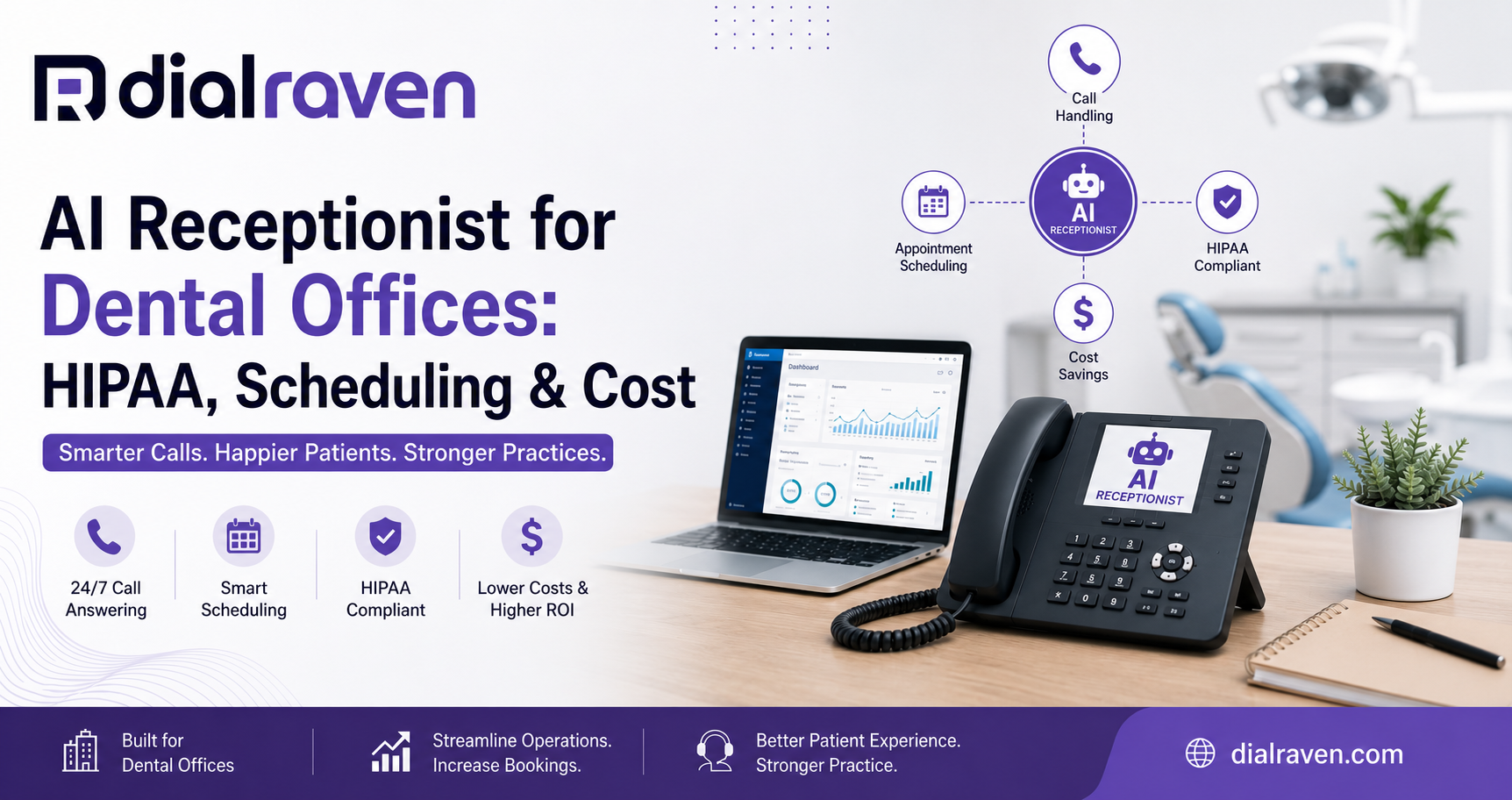
AI Receptionist for Dental Offices: HIPAA, Scheduling & Cost
See how an AI receptionist for dental offices handles patient calls, scheduling, after-hours coverage, HIPAA safeguards, and cost in 2026.
Quick Answer
An AI receptionist for dental offices answers patient calls 24/7, handles approved scheduling requests and routine questions, captures new-patient information, and routes clinical, urgent, or sensitive calls to staff.
Dial Raven Team
VoIP Communication Expert
A new patient calls while your receptionist is checking someone in. Another patient wants to reschedule while the front desk is handling insurance paperwork. Later that evening, someone calls with a question about becoming a patient, but the office is already closed. Dental practices do not usually have a shortage of calls; they have a shortage of uninterrupted time to handle every call well. An AI receptionist for dental offices can provide a first-response layer for those conversations by answering routine calls, identifying what a patient needs, capturing approved information, supporting scheduling workflows, and routing calls that require staff attention. The goal is not to remove people from the patient experience. It is to let automation handle predictable reception tasks while your team focuses on patients and conversations that genuinely require human judgment.
What Is an AI Receptionist for Dental Offices?
An AI receptionist for dental offices is conversational software that answers incoming patient calls and follows rules configured around the practice. Instead of sending every caller through voicemail or a basic phone menu, it can understand requests such as scheduling a cleaning, moving an appointment, asking whether the office accepts new patients, checking business hours, or requesting help with a billing question. A properly configured virtual receptionist service can help dental offices manage call routing, after-hours coverage, message capture, and overflow when staff cannot answer immediately.
The critical part is knowing where automation should stop. Clinical questions, urgent symptoms, sensitive billing issues, treatment advice, and uncertain situations should have a clear path to a person. The strongest dental AI receptionist is not the one that tries to answer everything; it is the one that reliably handles routine communication and knows when staff should take over.
Why Dental Practices Are Looking at AI Receptionists
AI adoption in dentistry is increasingly focused on administrative efficiency as well as clinical technology. For front-desk teams, the practical opportunity is reducing the number of routine calls that interrupt check-ins, billing work, patient conversations, and other office tasks. A dental AI receptionist is most useful when it handles repetitive communication without attempting to make clinical decisions.
- Answer routine patient calls when the front desk is busy
- Capture new-patient inquiries and contact information
- Support appointment scheduling and rescheduling workflows
- Provide approved office information such as hours and location
- Handle after-hours and overflow calls
- Record messages and call reasons for staff review
- Route clinical, urgent, or sensitive calls to staff
What Can a Dental AI Receptionist Handle?
| Call Type | AI Can Help With | When Staff Should Take Over |
|---|---|---|
| New patient | Contact details, office information, appointment request | Complex treatment or clinical questions |
| Existing patient | Scheduling, rescheduling, basic office questions | Treatment-related concerns |
| Cancellation | Capture or process according to practice workflow | Exceptions or unusual situations |
| Insurance question | Approved general information | Coverage interpretation or disputes |
| Billing call | Route the call or capture the reason | Detailed account disputes |
| Urgent concern | Identify the need for escalation | Clinical assessment and advice |
| After-hours call | Message capture and approved routing | Emergencies or clinical concerns |
This structure keeps automation useful without asking it to make decisions that belong with trained staff. Each dental office should define which questions the receptionist may answer, what information it may collect, and which situations require an immediate transfer or callback.
How Can an AI Receptionist Handle New-Patient Calls?
New-patient calls are especially important because the caller has not yet established a relationship with the practice. An AI receptionist for dentists can collect basic information such as the patient's name, phone number, preferred contact method, reason for contacting the office, general appointment request, preferred day or time, and whether the caller needs additional assistance from staff.
If the dental office uses a modern dental office phone system, call routing and queues can help make sure the inquiry reaches the correct person instead of sitting in a general voicemail box. The objective should be to capture enough information to move the patient forward without turning the first call into a long automated interview.
Can an AI Receptionist Schedule Dental Appointments?
Yes, if the receptionist is connected to an approved scheduling workflow and has permission to perform the required action. Depending on the practice and technology involved, the system may identify the type of appointment requested, collect patient information, check or request available times, schedule or submit the appointment request, confirm what happens next, and escalate scheduling exceptions to staff.
Practices should not assume every AI receptionist automatically integrates with every dental practice-management system. Integration capabilities vary by platform and configuration. After an appointment is scheduled, HIPAA-compliant appointment reminders and approved patient messaging workflows can help patients confirm, cancel, or reschedule without creating unnecessary front-desk calls.
How Should After-Hours and Overflow Calls Work?
After-hours coverage is one of the most practical applications of an AI answering service for dental offices. A basic voicemail records a message, while a structured AI workflow first determines what the caller needs. A new patient may have contact information and an appointment request captured, an existing patient may be routed based on the reason for calling, and an appointment-change request can be recorded for the appropriate scheduling workflow.
Potentially urgent or clinical concerns should follow the practice's approved escalation process instead of receiving automated clinical advice. The advantage is that staff return to useful context rather than a list of unexplained missed calls. They can see who called, why they called, and what action may be required next.
When Should the AI Transfer a Patient to Staff?
A dental AI receptionist should never be designed to answer everything. Human escalation is especially important whenever a conversation requires clinical knowledge, professional judgment, empathy, access to sensitive account information, or an exception to the practice's normal workflow.
- Clinical questions
- Severe pain or urgent symptoms
- Medication questions
- Post-treatment concerns
- Treatment recommendations
- Complicated billing disputes
- Angry or distressed patients
- Questions the system cannot verify
- Privacy-sensitive situations
- Exceptions to normal office policy
If the AI does not know an answer, the correct response is not to guess. It should transfer the call, take an accurate message, or follow another approved escalation path. This human fallback is one of the most important things to evaluate when choosing an AI receptionist.
Is an AI Receptionist for Dental Offices HIPAA Compliant?
HIPAA compliance depends on how the system handles protected health information, how the dental practice configures it, and the relationship between the practice and its technology vendors. A marketing statement saying a product is HIPAA compliant is not enough by itself. The U.S. Department of Health and Human Services explains that when a service provider creates, receives, maintains, or transmits protected health information on behalf of a covered entity, it may be acting as a business associate.
When evaluating a HIPAA compliant AI receptionist for dental practices, review whether the vendor will sign an appropriate Business Associate Agreement when required, how patient information is protected, who can access call and message records, how recordings or transcripts are stored, what subcontractors may handle protected information, and how long communication data is retained. For official guidance, review the HHS Business Associate Contracts guidance. Dial Raven also provides HIPAA-ready communication solutions for healthcare covering calling, routing, patient messaging, virtual fax, and related communication workflows. This article provides general operational information and is not legal advice.
AI Receptionist vs. Human Receptionist vs. Hybrid
| Option | Best Use | Main Limitation |
|---|---|---|
| Human receptionist | Complex and relationship-sensitive conversations | Limited availability and simultaneous-call capacity |
| AI receptionist | Routine calls, overflow, after-hours, and repeatable workflows | Limited human judgment |
| Hybrid | AI for routine tasks with staff escalation | Requires clear routing and escalation rules |
For many dental practices, a hybrid setup is the most practical. AI handles repetitive and predictable communication, while staff remain responsible for patients who need empathy, clinical knowledge, judgment, or an exception to normal workflow.
How Much Does a Dental AI Receptionist Cost?
Dental AI receptionist cost varies substantially by vendor and configuration, so a single universal monthly price is not useful. Common pricing structures include monthly subscriptions, per-minute charges, per-call charges, usage-based plans, per-location pricing, implementation fees, integration charges, and additional messaging or automation fees.
- After-hours call answering
- Appointment scheduling workflows
- Call transfers and escalation
- Support for multiple providers or locations
- Business text messaging
- Call summaries or transcription
- Practice-management integrations
- Usage limits and overage charges
- Setup or implementation support
When comparing providers, look beyond the advertised monthly price. The best value is the system that fits your actual call volume, scheduling process, patient communication needs, and staff workflow rather than automatically choosing the lowest headline price.
What Should a Dental Office Look for Before Choosing One?
- 24/7 and overflow call handling
- Clear human escalation rules
- New-patient intake workflows
- Scheduling capabilities
- HIPAA and BAA support where applicable
- Appropriate access controls
- Call routing
- Business texting
- Call summaries or transcription
- Reporting and call visibility
- Required practice-management integrations
- Responsive support
Most importantly, ask the vendor to demonstrate what happens when the AI cannot answer a question. That scenario often tells you more about the real patient experience than a perfectly scripted demo call.
How Should a Dental Practice Introduce AI Reception?
- Start with after-hours or overflow calls rather than automating everything at once
- Identify the most common patient call types
- Define approved answers and scheduling workflows
- Create clear clinical and urgent-call escalation rules
- Test unusual scenarios as well as routine calls
- Review real call outcomes with front-desk staff
- Expand automation only where the workflow consistently performs well
Post-call documentation matters too. Dial Raven's AI voice transcription can help turn permitted calls into searchable text, summaries, and follow-up information so staff do not have to replay every conversation. For appointment confirmations or appropriate follow-up, business SMS can keep communication on the practice's business number rather than employees' personal devices.
Is an AI Receptionist Right for Your Dental Office?
An AI receptionist for dental offices makes the most sense when your team regularly struggles with simultaneous calls, front-desk interruptions, after-hours inquiries, scheduling requests, or messages that have to be manually sorted later. It should not be judged by how many staff tasks it can replace. A better question is whether it can reliably handle routine communication while helping your staff spend more time on patients and conversations that need a human.
Frequently Asked Questions
What is an AI receptionist for dental offices?
An AI receptionist for dental offices is conversational software that answers incoming patient calls, handles approved routine requests, captures patient information, supports scheduling workflows, and routes calls requiring staff attention.
Can an AI receptionist schedule dental appointments?
Yes, when connected to an approved scheduling system or workflow. Available functionality depends on the receptionist platform, practice-management software, permissions, and rules configured by the dental office.
Is an AI dental receptionist HIPAA compliant?
It can support HIPAA-regulated workflows when appropriate safeguards, vendor agreements, access controls, and practice procedures are in place. If a vendor handles protected health information on behalf of a covered entity as a business associate, an appropriate Business Associate Agreement is generally required.
Can an AI receptionist handle dental emergencies?
It should not diagnose or provide clinical advice. A dental practice should configure urgent or clinical calls to follow an approved escalation path to qualified staff or other appropriate resources.
Can an AI receptionist answer dental calls after hours?
Yes. After-hours coverage is a common use case. The system can answer routine questions, capture messages and appointment requests, and route calls according to the practice's approved rules.
How much does a dental AI receptionist cost?
Pricing varies by provider and may include monthly subscriptions, usage charges, per-minute fees, setup costs, integrations, messaging, and overages. Compare total cost based on the workflows and call volume your practice actually needs.
Patient calls, appointment requests, and after-hours inquiries should not disappear into voicemail when your front desk is busy. See how Dial Raven can help build a smarter dental call flow with AI-powered reception, routing, messaging, and staff escalation. Book a free demo to discuss how it could fit your dental practice.
Related pages
Ready to modernize your phone system?
Talk to a Dial Raven specialist and get a plan built around how your team works.