
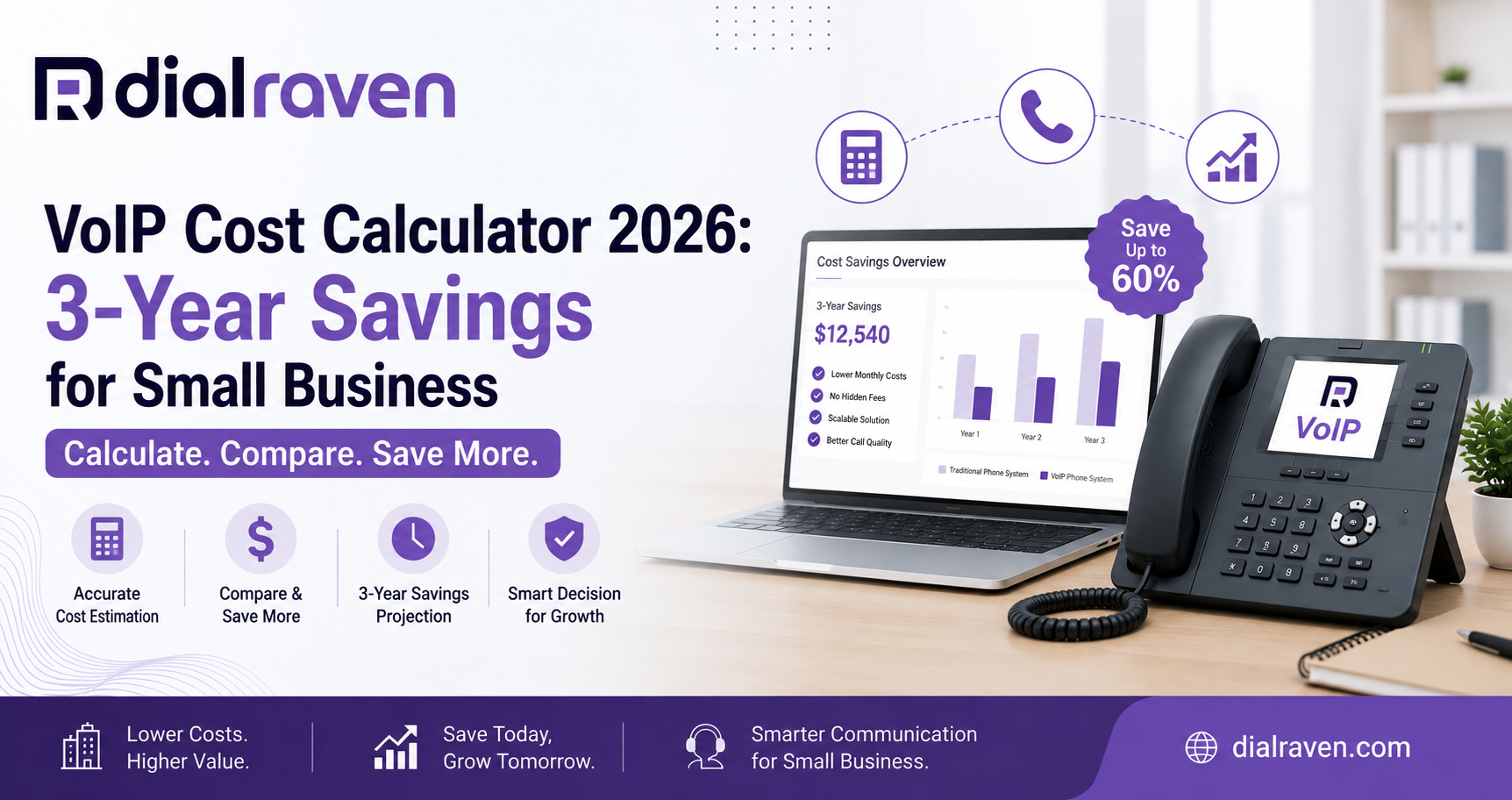
VoIP Cost Calculator 2026: 3-Year Savings for Small Business
Estimate your monthly VoIP cost, three-year total cost of ownership, and potential savings versus a landline or legacy PBX.
Quick Answer
A VoIP cost calculator estimates recurring service, hardware, setup, add-ons, taxes, and three-year total cost of ownership. Compare that total with your current landline or PBX costs to estimate savings and decide whether to request a tailored quote.
Dial Raven Team
VoIP Communication Expert
A VoIP cost calculator should show more than an advertised per-user price. A useful estimate includes monthly service, optional phones, implementation, number migration, add-ons, usage charges, taxes, and the cost of maintaining your current landline or PBX. This guide gives U.S. small businesses a transparent way to calculate monthly costs, three-year total cost of ownership, and potential savings before requesting a final provider quote.
Quick Answer: How Much Does VoIP Cost Over Three Years?
Calculate three-year VoIP cost by multiplying the complete monthly bill by 36, then adding hardware, migration, integration, and other one-time expenses. Dial Raven's current published plans start at $14.99 per user per month for Starter and $24.99 per user per month for Pro. Review the latest business phone system pricing before calculating because available plans, features, and prices can change.
Your estimated savings equal the three-year cost of your current landline or legacy PBX minus the three-year cost of the proposed VoIP system. The result should be treated as a planning estimate until a provider confirms your user count, hardware, taxes, regulatory charges, usage, and implementation requirements.
Use This Small Business VoIP Cost Calculator
For the most accurate result, collect three to six recent phone bills, your current maintenance expenses, hardware plans, contract terms, and expected number of users. This business VoIP cost calculator works best when you compare equivalent systems with the same required features, locations, and calling capacity.
| Calculator Input | What to Enter | Why It Matters |
|---|---|---|
| Paid users | Employees who need an individual extension, voicemail, or app login | Hosted VoIP is usually billed per user |
| Monthly price per user | The plan price containing the features your team requires | Determines the recurring subscription cost |
| Current monthly phone bill | Average of three to six complete invoices | Creates the current-system comparison baseline |
| Current annual maintenance | PBX support, repairs, licenses, warranties, and technician visits | Prevents a legacy system from appearing artificially inexpensive |
| Desk phones and headsets | Number of devices multiplied by the expected purchase price | Creates a one-time hardware cost |
| Setup and migration | Configuration, training, porting, network work, or professional services | Can increase first-year cost |
| Recurring add-ons | Recording, transcription, analytics, contact center, CRM, fax, or messaging | May require a higher plan or additional monthly fee |
| Usage charges | International, toll-free, premium, or out-of-plan calling | Changes with actual monthly call traffic |
| Taxes and regulatory charges | The provider's estimate for every service location | Varies by jurisdiction, service, and configuration |
| Contract exit cost | Early termination fees or remaining equipment leases | Can extend the migration payback period |
Monthly VoIP Cost Formula
Monthly VoIP cost = paid users multiplied by monthly price per user, plus recurring add-ons, phone-number charges, usage, estimated taxes, and regulatory fees.
Three-Year VoIP Total Cost of Ownership Formula
Three-year VoIP total cost of ownership = monthly VoIP cost multiplied by 36, plus hardware, setup, migration, integrations, network improvements, and contract-exit costs.
Three-Year Savings Formula
Three-year savings = current phone system three-year TCO minus proposed VoIP three-year TCO. To calculate a percentage, divide the estimated savings by the current system's three-year TCO and multiply the result by 100.
A negative result means the proposed configuration costs more during the selected period. That does not automatically make it the wrong option, but the business should identify whether features such as remote calling, AI transcription, business SMS, call routing, reporting, or reduced administration justify the additional cost.
Base VoIP Cost Estimates by Team Size
The estimates below use Dial Raven's published Starter and Pro prices as of August 1, 2026. They show base subscription cost only and exclude optional hardware, Enterprise services, specialized integrations, usage, taxes, and regulatory charges.
| Paid Users | Starter Monthly at $14.99 | Starter 3-Year Base | Pro Monthly at $24.99 | Pro 3-Year Base |
|---|---|---|---|---|
| 5 | $74.95 | $2,698.20 | $124.95 | $4,498.20 |
| 10 | $149.90 | $5,396.40 | $249.90 | $8,996.40 |
| 25 | $374.75 | $13,491.00 | $624.75 | $22,491.00 |
| 50 | $749.50 | $26,982.00 | $1,249.50 | $44,982.00 |
Starter covers core business calling, while Pro adds capabilities such as business SMS and MMS, auto attendant or IVR, call recording, analytics, and team collaboration. Compare included features before selecting the lower-priced plan because purchasing missing functions separately can eliminate the expected savings.
A cloud VoIP phone system for small business can remove the need for an on-premise PBX and allow employees to work through desk phones, computers, browsers, or mobile applications. Internet readiness, power continuity, call-flow design, and employee training should still be included in the project plan.
What Costs Should a Business Phone System Calculator Include?
1. User Licenses
Count the people who require an individual extension, voicemail box, calling identity, direct routing, or application login. Do not automatically count every employee if some workers share a common-area device and do not require an individual account. At the same time, do not overlook remote, part-time, seasonal, or after-hours employees who still need access.
2. Desk Phones, Headsets, and Conference Hardware
VoIP can operate through desktop, mobile, and browser applications, so buying new desk phones is not always necessary. If employees prefer physical devices, include handsets, headsets, conference-room equipment, receptionist expansion modules, power supplies, and shipping in the hardware estimate.
Dial Raven's business phone catalog includes desk phones, cordless handsets, conference devices, headsets, and expansion modules. The business phone hardware guide can also help determine which employees need physical devices and which can work through software.
3. Network and Power Readiness
A cloud phone system depends on a stable business internet connection and a properly configured local network. Include any router, managed switch, Wi-Fi, Ethernet cabling, Quality of Service, backup internet, or uninterruptible power supply work. A basic broadband speed test does not confirm that the network can consistently prioritize real-time voice traffic.
4. Setup, Onboarding, and Migration
Confirm whether the proposed price includes call-flow design, auto-attendant configuration, user provisioning, training, number porting, testing, and cutover support. Dial Raven currently includes onboarding and setup with its published plans, but complex integrations and specialized technical work should still be confirmed in the final scope.
Keep the old service active until every required number has transferred successfully. The guide to switching from landline to VoIP explains how to audit existing lines, prepare porting records, configure call flows, test the new service, and complete the migration without intentionally creating downtime.
5. Add-Ons and Advanced Features
A low advertised price may not include every function the business needs. Compare configurations that perform the same operational tasks rather than comparing a basic VoIP subscription with a fully configured current system.
- Auto attendant and multi-level IVR
- Call queues and contact-center supervision
- Call recording, retention, and AI transcription
- Business SMS and MMS
- CRM or help-desk integrations
- Toll-free numbers and usage
- International calling
- Secure virtual fax
- Advanced reporting and analytics
- Compliance and custom data-retention requirements
6. E911, Taxes, and Regulatory Charges
Confirm how each office, remote worker, and device location is configured for emergency calling. The FCC's guidance on VoIP and 911 service explains why portable VoIP service creates important registered-location considerations.
Taxes and provider pass-through charges vary by jurisdiction and service type. Some underlying factors also change over time. For example, USAC publishes Universal Service contribution factors quarterly. Ask the provider for an itemized estimate instead of applying one percentage to every U.S. business.
7. Existing Contracts and Sunk Costs
Include early-termination charges, remaining equipment leases, maintenance agreements, and licenses that cannot be canceled immediately. Do not count money that has already been spent and cannot be recovered as a future expense. The comparison should measure costs from the decision date forward.
VoIP vs. Landline or Legacy PBX: What Changes the TCO?
A landline or legacy PBX may appear inexpensive when the comparison includes only the current monthly carrier bill. The full three-year cost can also include line rental, PRI circuits, support agreements, software licenses, replacement parts, technician visits, system moves, and a planned PBX upgrade.
Dial Raven's detailed VoIP versus traditional landline comparison explains the operational differences. For a cost calculation, place every future expense into the same three-year period and avoid mixing a basic VoIP plan with a legacy system that includes additional features or managed support.
| Cost Area | Hosted VoIP | Landline or Legacy PBX |
|---|---|---|
| Core billing model | Usually per user or service plan | Lines, circuits, licenses, support, or a combination |
| On-site call-control hardware | Usually not required | Often required for a PBX |
| Desk phones | Optional for application-based users | Common and sometimes proprietary |
| Maintenance | Commonly included in the managed service | May require a support contract or technician |
| Adding users | Usually an administrative change | May require ports, cards, lines, wiring, or licenses |
| Remote and mobile work | Included in many cloud platforms | May require separate systems or licensing |
| Feature upgrades | Cloud update or plan change | May require hardware, licensing, or professional services |
| Business continuity | Depends on internet, power, provider design, and failover | Depends on circuits, on-site hardware, power, and disaster planning |
The FCC's VoIP overview explains that VoIP carries voice through an Internet Protocol connection rather than a traditional circuit-switched telephone line. This architectural change shifts spending away from fixed circuits and on-site call-control equipment toward recurring cloud service, internet connectivity, managed support, and optional endpoint devices.
Worked Business Phone System Cost Calculator Example
The following hypothetical 10-user example demonstrates the calculation process. It is not a guarantee of savings and should be replaced with the company's actual invoices, maintenance records, hardware needs, taxes, usage, and contract obligations.
Current Landline or PBX Assumptions
- Current phone bill: $450 per month
- Expected maintenance and upgrades over three years: $2,500
- Contract termination cost: $0
Current system three-year TCO = $450 multiplied by 36 months, plus $2,500 in maintenance and upgrades. The resulting three-year cost is $18,700.
Proposed VoIP Assumptions
- 10 Dial Raven Pro users at $24.99 per user per month
- Base recurring subscription: $249.90 per month
- Optional phone and headset budget: $1,000
- Setup and onboarding: $0 under the current published plan terms
- Taxes, regulatory charges, usage, and custom work: excluded until quoted
Proposed VoIP three-year TCO before the excluded items = $249.90 multiplied by 36 months, plus $1,000 in hardware. The resulting planning estimate is $9,996.40.
Illustrative Three-Year Savings
Estimated savings = $18,700 minus $9,996.40, producing an illustrative result of $8,703.60 over three years. Before treating that number as final, add itemized taxes, fees, usage, network work, integrations, and any remaining legacy contract costs.
The value of this example is the method, not the result. Both systems are compared over the same period, and both recurring and one-time costs are included. Your actual saving may be higher, lower, or nonexistent depending on the starting system and required configuration.
Hosted VoIP or SIP Trunking: Which Costs Less?
Hosted VoIP is often the simpler financial option when a business wants to replace its PBX, support mobile employees, reduce on-site equipment, or adopt cloud calling and messaging. It is generally billed per user and places platform maintenance with the provider.
SIP trunking may provide better economics when the business owns a compatible PBX that remains reliable and useful. Instead of replacing the full system, SIP trunking services connect the PBX to internet-based voice service. Capacity is generally based on concurrent calls rather than one separate channel for every employee.
Use the SIP trunk pricing guide to estimate channel-based costs separately. Do not compare hosted per-user pricing with SIP per-channel pricing without also including PBX support, licenses, maintenance, electricity, replacement risk, and technical administration.
How to Avoid Misleading VoIP Savings Estimates
- Use complete phone bills instead of only the advertised line rate
- Average several months when call usage is seasonal
- Compare equivalent features and service levels
- Include hardware only for employees who genuinely need it
- Separate recurring costs from one-time costs
- Include legacy PBX maintenance and planned upgrades
- Add contract-exit charges to the migration scenario
- Request itemized taxes, E911, toll-free, international, and usage charges
- State the pricing date and update the calculation when plans change
- Treat savings as an estimate until the provider validates the configuration
A credible VoIP savings calculator should expose its assumptions. If a tool presents a dramatic percentage without identifying the current-system baseline, included features, hardware, fees, or comparison period, the result is not reliable enough for a purchasing decision.
When Should You Request a Custom VoIP Quote?
A small business VoIP cost calculator is useful for initial budgeting, but a customized quote is necessary when the communications environment includes multiple locations, unusual devices, specialized compliance requirements, or complex call-routing needs.
- Multiple offices or registered emergency locations
- A call center or high concurrent-call volume
- Toll-free or international calling
- An existing PBX that might be retained
- Complex number-porting requirements
- CRM, help-desk, or custom software integrations
- Compliance, call-recording, or retention requirements
- Paging, door phones, analog devices, fax, or specialty endpoints
- Seasonal staffing or rapid growth
- Redundant internet or advanced failover requirements
A specialist should validate the paid-user count, required features, hardware, network readiness, number-porting scope, emergency locations, and expected final monthly bill before a cutover date is selected.
Frequently Asked Questions
How much does VoIP cost per user per month?
Dial Raven's current published plans start at $14.99 per user per month for Starter and $24.99 per user per month for Pro. The final cost may also include optional phones, add-ons, usage, taxes, regulatory charges, and custom services.
How do I calculate three-year VoIP total cost of ownership?
Multiply the complete estimated monthly VoIP bill by 36, then add hardware, setup, migration, integration, network improvements, contract-exit costs, and other one-time expenses. Use the same period and cost categories for the existing system.
Is VoIP always cheaper than a landline?
No. VoIP may reduce hardware, maintenance, circuit, and administration expenses, but the result depends on the current bill, required features, user count, devices, usage, contract terms, and migration work.
Does every employee need a paid VoIP user?
Not always. Count employees who need an individual extension, voicemail, calling identity, direct routing, or application login. Shared-area devices may be licensed differently depending on the provider and plan.
Are desk phones required for business VoIP?
No. Employees can often call through desktop, mobile, or browser applications. Physical desk, cordless, conference, and reception phones remain useful for workers and locations that require dedicated devices.
Should I replace my PBX or use SIP trunking?
Retain and connect the PBX when it is compatible, reliable, supported, and financially sensible. Choose hosted VoIP when maintenance, scaling, mobility, support, or feature limitations make the existing system difficult or costly to operate.
What hidden VoIP costs should I check?
Check hardware, setup, number porting, E911, phone-number charges, taxes, regulatory fees, international and toll-free usage, recording storage, messaging, integrations, support tiers, contract terms, and network upgrades.
How accurate is a VoIP cost calculator?
It is useful as a planning framework when the inputs are complete and current. It is not a binding quote because taxes, regulatory charges, usage, hardware, network work, integrations, and specialized configurations vary.
Bring Dial Raven your current phone bill, user count, locations, hardware needs, and required features. A communications specialist will validate the assumptions, compare hosted VoIP with SIP trunking where appropriate, and prepare an itemized monthly and three-year estimate. Get your exact VoIP quote before making a migration decision.
Related pages
Ready to modernize your phone system?
Talk to a Dial Raven specialist and get a plan built around how your team works.