
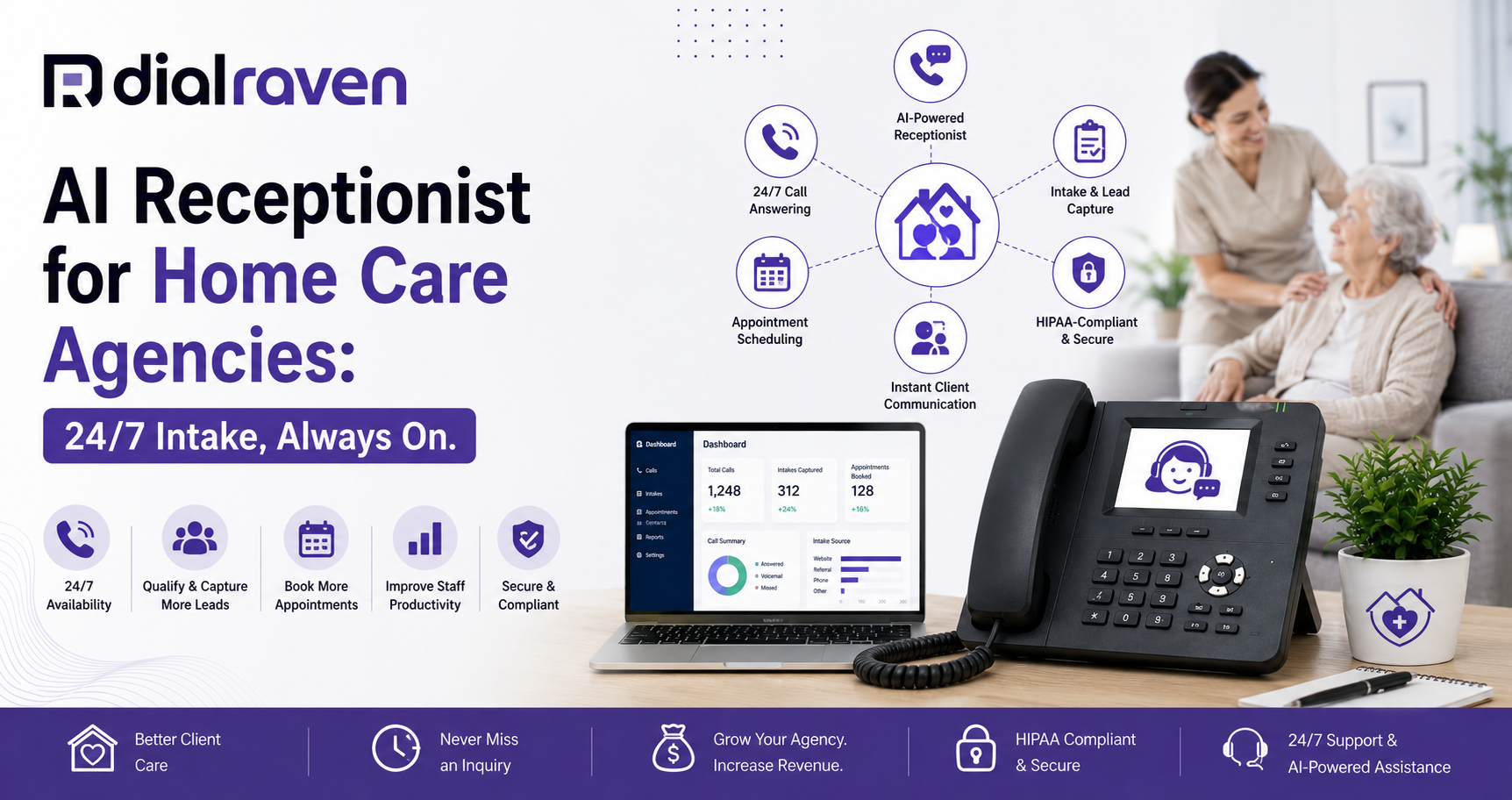
AI Receptionist for Home Care Agencies: 24/7 Intake
Learn how home care agencies can manage family intake, caregiver call-outs, after-hours calls, and HIPAA-ready communication with AI.
Quick Answer
An AI receptionist helps home care agencies answer calls 24/7, capture family intake details, route caregiver call-outs, and escalate urgent concerns. It can also send notifications and summaries while following approved privacy and compliance workflows.
Dial Raven Team
VoIP Communication Expert
A family searching for care may call after office hours. A caregiver may report an absence before an early-morning shift. A hospital discharge coordinator may need an immediate response while your intake team is helping another caller. For a home care agency, these are not ordinary missed calls. An AI receptionist for home care agencies can answer around the clock, identify why someone is calling, collect approved information, and route the conversation to the right person without replacing human judgment.
What Is an AI Receptionist for Home Care Agencies?
An AI receptionist is a voice-based call-handling system that follows predefined scripts and routing rules. It can answer calls, capture new-client information, identify caregiver call-outs, route referrals, notify on-call staff, send text confirmations, and create call summaries. It should not provide medical advice, make staffing decisions, assess emergencies, or promise that care will be available.
- Answer family and referral calls 24/7
- Collect approved intake details
- Identify caregiver call-outs and delays
- Route urgent calls to on-call staff
- Send SMS confirmations and staff notifications
- Create structured call summaries for follow-up
Why Home Care Agencies Need Specialized Call Handling
Home care agencies receive several different kinds of calls, and each requires a different response. A prospective client may need an assessment, a caregiver may be unable to attend a shift, a hospital may be coordinating a discharge, and an existing client may have a scheduling concern. Sending every caller to one voicemail box creates delays, incomplete messages, and unnecessary follow-up.
A specialized workflow helps the agency identify who is calling, why they are calling, what information is needed, who should receive the message, how quickly staff must respond, and when a human must take over.
Five Essential Home Care Call Workflows
1. New Family and Client Intake
Families may contact several agencies while trying to arrange care. An AI receptionist can collect the caller's name, callback number, service location, general type of assistance needed, expected start date, preferred callback time, and whether the request is urgent. The system can then notify the intake team or transfer the call when someone is available. A full care assessment should remain with qualified agency staff.
2. Hospital and Referral Partner Calls
Hospitals, rehabilitation facilities, physicians, senior communities, and community organizations may call with referral-related questions. The receptionist can identify the caller as a referral partner, collect the organization name, contact details, general purpose of the referral, service location, and requested response time, then route the call to intake or business development.
3. Caregiver Call-Outs and Delays
Caregiver call-outs require faster handling than ordinary administrative messages. The workflow should confirm the caregiver's identity, identify the affected client or shift, record whether the caregiver is absent or delayed, notify the scheduler or on-call coordinator, and contact a backup person if the first staff member does not respond. The AI should not independently assign replacement staff or promise that coverage has been arranged.
4. Existing Client and Family Calls
Current clients and family members may call about schedules, invoices, caregiver changes, service concerns, or general questions. The receptionist can classify the request before routing it. Concerns involving injury, medication, neglect, a fall, or a significant change in condition should be escalated immediately under the agency's approved policy.
5. Urgent and After-Hours Calls
An after hours answering service for home care agencies should do more than record a message. The workflow must define which calls can wait, which calls go to the on-call coordinator, how many times staff should be contacted, who receives the call if the primary contact does not answer, and when the caller should contact 911. The receptionist should use approved emergency language without trying to determine whether the situation is medically urgent.
How Does a Virtual Receptionist for Home Care Agencies Work?
A virtual receptionist for home care agencies works with the agency's business phone system. The system answers the call, identifies the caller's intent, asks approved questions, and then transfers, escalates, or records the message. Staff may receive a notification, call summary, or SMS alert. Dial Raven's virtual receptionist supports professional greetings, intelligent routing, after-hours handling, message capture, and AI call summaries within a broader cloud communications system.
AI Receptionist vs. Home Care Answering Service
A traditional home care answering service normally uses live operators. An AI receptionist uses approved scripts and automated routing, while voicemail simply records whatever message the caller chooses to leave.
| Capability | AI Receptionist | Live Answering Service | Voicemail |
|---|---|---|---|
| 24/7 call answering | Yes | Usually | Yes |
| Handles several calls at once | Yes | Depends on staffing | Yes |
| Consistent intake questions | Yes | May vary | No |
| Automatic call routing | Yes | Sometimes | No |
| Human empathy | Limited | Strong | None |
| Structured call summaries | Yes | Sometimes | No |
AI may be suitable for repetitive intake, overflow, and routing. Live staff may be better for complex or emotionally sensitive conversations. Some agencies benefit from a hybrid model in which AI handles routine calls and transfers higher-risk situations to trained people.
Home Care vs. Home Health Agencies
Home care and home health are related terms, but they may describe different services. Non-medical home care commonly includes companionship and assistance with daily activities, while home health may involve nursing, therapy, or other clinical services. An AI receptionist for home health agencies may encounter more clinical information, so its scripts and routing rules should clearly separate administrative questions, scheduling requests, clinical questions, and emergencies.
Is an AI Receptionist for Home Care HIPAA Compliant?
No AI system should be described as automatically HIPAA compliant by itself. HIPAA obligations depend on the organization, the information being handled, the vendor relationship, system settings, contracts, and internal procedures. Not every non-medical home care agency is automatically a HIPAA-covered entity.
When a vendor creates, receives, maintains, or transmits protected health information for a covered entity, the vendor may be considered a business associate and a Business Associate Agreement may be required. When evaluating a HIPAA compliant AI receptionist for home care, review BAA availability, encryption, user authentication, role-based access, call-recording controls, transcript retention, audit logs, deletion procedures, subprocessor access, and breach-notification responsibilities. The U.S. Department of Health and Human Services provides official guidance on covered entities and business associates, the HIPAA Security Rule, and Business Associate Agreements.
Features Home Care Agencies Should Evaluate
- 24/7 answering and overflow coverage
- Custom family-intake questions
- Caregiver call-out routing
- On-call escalation with backup contacts
- Support for multiple offices or service areas
- Warm call transfers
- Business SMS notifications
- Call summaries and searchable history
- Number porting
- Recording and retention controls
- Role-based permissions
- BAA support where required
- Human takeover and ongoing call-flow testing
Do not assume a platform integrates with a specific home care scheduling or management system. Ask for written confirmation and test the integration before relying on it.
How to Implement an AI Receptionist
- Review recent calls and group them by purpose, time, urgency, and destination
- Create separate workflows for families, referrals, caregivers, clients, and urgent callers
- Choose primary contacts, backup contacts, retry intervals, and approved emergency language
- Decide what information the system may collect, who can access it, and how long it should be retained
- Test routine and difficult scenarios before launch, then review outcomes regularly
Frequently Asked Questions
What is an AI receptionist for home care agencies?
It is a voice-based system that answers calls, identifies the caller's purpose, collects approved information, and routes the call according to the agency's rules. It can support family intake, referrals, caregiver call-outs, and after-hours coverage.
Can an AI receptionist handle caregiver call-outs?
Yes. It can collect the caregiver's identity, affected shift, and reason category before notifying a scheduler or on-call coordinator. It should not independently arrange replacement coverage.
Can an AI receptionist answer home care calls after hours?
Yes. It can answer calls during evenings, weekends, and holidays. The agency must define which calls can wait and which ones require immediate escalation.
Is an AI receptionist automatically HIPAA compliant?
No. Compliance depends on the agency, data involved, vendor relationship, contracts, safeguards, and configuration. A BAA may be required when the system handles protected health information for a covered entity.
Can an AI receptionist schedule home care assessments?
It may collect an assessment request or use a supported scheduling workflow. Agencies should confirm integration capabilities and decide whether appointments require staff approval.
Can an AI receptionist provide medical advice?
No. It should not diagnose conditions, recommend treatments, or determine whether a medical emergency exists. Clinical questions should be transferred to qualified staff.
Improve Your Home Care Call Workflow
An AI receptionist for home care agencies is most effective when it follows the agency's real intake, scheduling, and escalation process. Dial Raven can help you review family intake, caregiver call-outs, referral calls, after-hours routing, on-call escalation, SMS confirmations, call summaries, and privacy requirements. Book a free home care call-flow audit to identify where intelligent routing and AI-assisted reception could reduce missed inquiries and improve staff response.
Related pages
Ready to modernize your phone system?
Talk to a Dial Raven specialist and get a plan built around how your team works.